Moksha Patam Myth Meaning & Symbolism
A divine gameboard of life and death, where the soul ascends through virtues and descends through vices, seeking liberation from the cosmic cycle.
The Tale of Moksha Patam
Listen, child, and hear the tale not of kings and wars, but of the game played on the board of the cosmos itself. In a time when the gods walked closer to [the earth](/myths/the-earth “Myth from Hindu culture.”/), there was a great assembly in the celestial halls of [Svarga](/myths/svarga “Myth from Hindu culture.”/). The divine sages, the Rishis, sat in deep meditation, their minds vast as [the sky](/myths/the-sky “Myth from Persian culture.”/). Yet, a restlessness stirred among the younger gods and the sons of men who visited the heavens. Their minds were distracted, their spirits caught in the web of earthly play.
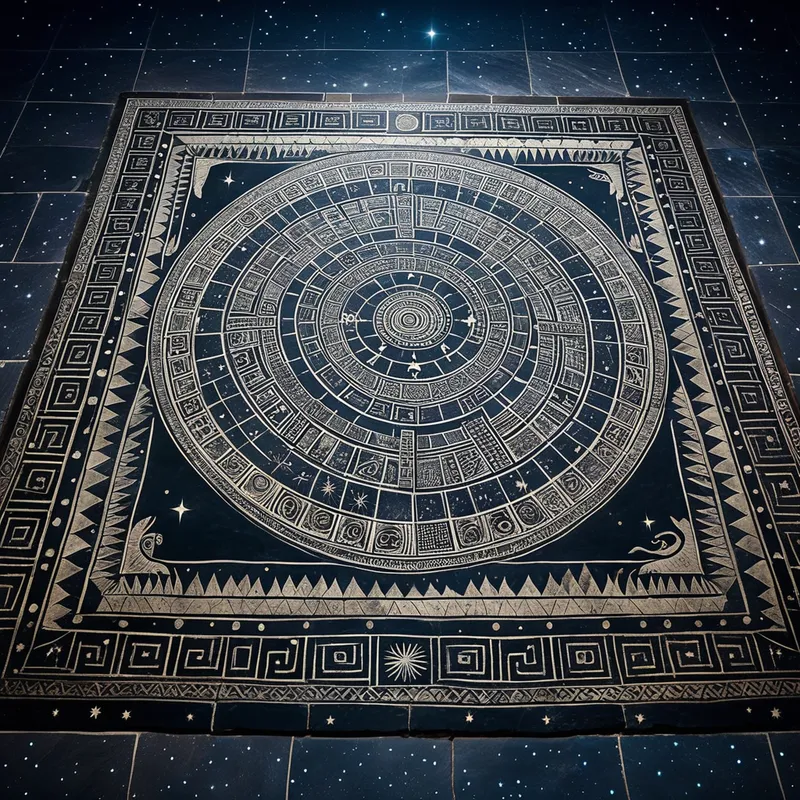
Seeing this, the great god [Vishnu](/myths/vishnu “Myth from Hindu culture.”/), he who dreams the universe into being, smiled a knowing smile. From the stillness of his meditation, he summoned a vision. Before the assembled host, a board materialized upon the air—not of wood or stone, but of shimmering light and shadow. It was a grid of one hundred and eight squares, a map of existence itself. On one side were squares of radiant splendor, adorned with lotuses and gates of [pearl](/myths/pearl “Myth from Chinese culture.”/)—the houses of Dharma, Faith, and Compassion. On the other lay squares dark and coiled, marked with the gaping jaws of serpents—the dens of Kama (Desire), Krodha (Anger), and Moha (Delusion).
Then, from Vishnu’s side emerged his divine consort, [Lakshmi](/myths/lakshmi “Myth from Hindu culture.”/), her presence bringing the scent of [lotus](/myths/lotus “Myth from Hindu culture.”/) and the chime of gold. She held in her hands a set of pawns, carved from the heartwood of the eternal Ashvattha tree. “These are the Jivas,” she declared, her voice like flowing [water](/myths/water “Myth from Chinese culture.”/). “They shall play the game of life.”
But a game must have a challenger. From the shadows at the edge of the assembly arose a mighty presence, scaled and immense. It was Vasuki, the great serpent, his thousand hoods forming a canopy of awe and dread. His eyes held the wisdom of [the underworld](/myths/the-underworld “Myth from Greek culture.”/) and the allure of the deep earth. “I shall be the opponent,” he hissed, a sound like wind through ancient caves. “For I am the power of attachment, the pull of the senses, the very coil of [Samsara](/myths/samsara “Myth from Buddhist culture.”/).”
The game began. A devotee, his heart pure, would cast the divine dice—the roll of [Karma](/myths/karma “Myth from Hindu culture.”/). He would advance his pawn-soul with joy, climbing the ladder of generosity to reach a square of celestial music. But then, a roll of fate would bring him to a square of pride or greed. Vasuki would stir, and from that dark square, his serpentine essence would strike! The pawn would tumble down, down through the levels, back to a lower realm of the board, the player’s heart sinking with a palpable fall.
Yet, the game was not cruel, but instructive. Each ladder, placed by Lakshmi, was a lesson in virtue. Each serpent, placed by Vasuki, was a lesson in consequence. The goal, the hundredth square, glowed with a soft, unwavering light. It was [Moksha](/myths/moksha “Myth from Hindu culture.”/)—not a prize to be won, but a state to be realized when the soul, through countless climbs and falls, learned to navigate the board itself. The final roll was not chance, but grace; the final move, a release from the game into the silent, watching presence of Vishnu, who had been the board, the players, and the liberation all along.
Cultural Origins & Context
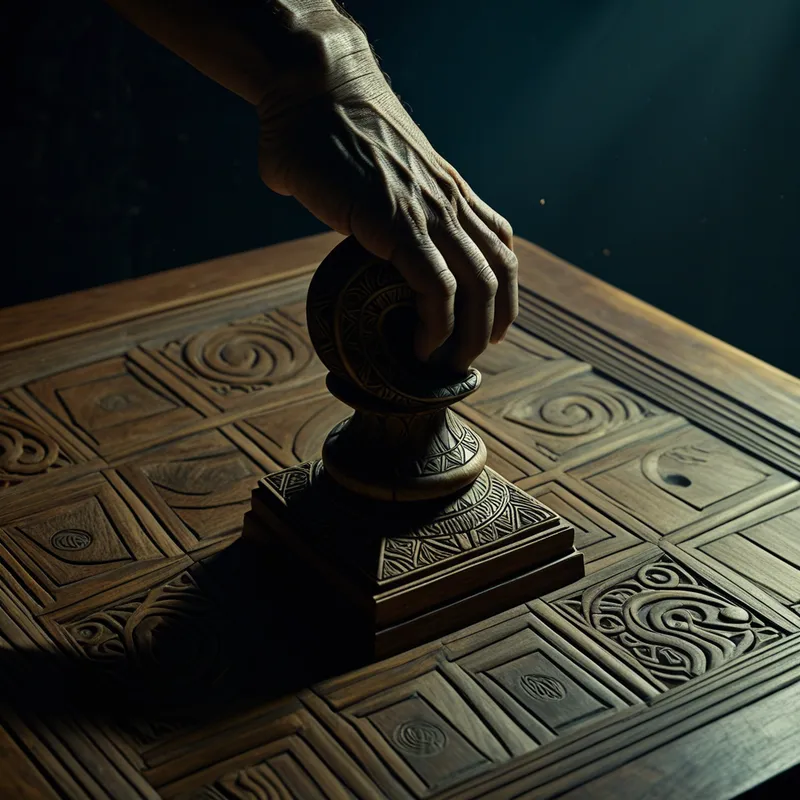
The tale of Moksha Patam is not merely a children’s fable but a sophisticated pedagogical tool from medieval India, dating back to at least the 13th century. It is attributed to the poet-saint Gyandev, who created it as a visual and tactile scripture for the illiterate and the young. The original gameboard was a Yantra, a geometric instrument for spiritual instruction.
It was passed down not in royal courts, but in temples and homes, by grandmothers and wandering monks. As the wooden pawns clicked on the painted cloth, the storyteller would narrate the corresponding virtue or vice. A climb on the 12th square, the ladder of Faith (Shraddha), would be accompanied by a parable of devotion. A fall from the 41st square, the serpent of Vanity (Mada), would come with a cautionary tale from the epics. Its societal function was profound: to internalize the core Dharma of Hindu philosophy—that every action (Karma) has a precise reaction, leading either upward toward liberation or downward into bondage. It made the abstract principles of Vedanta tangible, a lived experience in the space between a child’s fingertips.
Symbolic Architecture
The myth is a masterful symbolic map of the [soul](/symbols/soul “Symbol: The soul represents the essence of a person, encompassing their spirit, identity, and connection to the universe.”/)‘s [journey](/symbols/journey “Symbol: A journey in dreams typically signifies adventure, growth, or a significant life transition.”/). The board is Maya, the divine play of illusion, structured by the laws of cause and effect. The [pawn](/symbols/pawn “Symbol: A chess piece representing expendable individuals, sacrifice, and being controlled by external forces in hierarchical systems.”/) is the individual [soul](/symbols/soul “Symbol: The soul represents the essence of a person, encompassing their spirit, identity, and connection to the universe.”/), the Jiva, identified with a particular name and form, experiencing itself as a separate player.
The ladders are moments of Satsang, where contact with truth, selfless action, or profound grace catalyzes an upward leap in consciousness.
The serpents are the Arishadvargas, the internal enemies. They do not attack from outside; they are latent within certain states of mind (the squares). When the soul lands on [the square](/myths/the-square “Myth from Platonic culture.”/) of “Lust” ([Kama](/symbols/kama “Symbol: A ritual sickle or curved blade used in Hindu and Buddhist traditions, symbolizing the cutting of attachments and spiritual liberation.”/)), it activates the [serpent](/symbols/serpent “Symbol: A powerful symbol of transformation, wisdom, and primal energy, often representing hidden knowledge, healing, or temptation.”/) of attachment coiled within that very desire, leading to a fall into “Anger” or “[Jealousy](/symbols/jealousy “Symbol: A complex emotion signaling perceived threat to valued relationships or status, often revealing insecurities and unmet needs.”/).” Vasuki, the great [serpent](/symbols/serpent “Symbol: A powerful symbol of transformation, wisdom, and primal energy, often representing hidden knowledge, healing, or temptation.”/)-[king](/symbols/king “Symbol: A symbol of ultimate authority, leadership, and societal order, often representing the dreamer’s inner power or external control figures.”/), represents the totality of this binding, attractive power—Prakriti or [nature](/symbols/nature “Symbol: Nature symbolizes growth, connectivity, and the primal forces of existence.”/) itself—which captivates the soul.
The final square, Moksha, is symbolically empty. It represents the [dissolution](/symbols/dissolution “Symbol: The process of breaking down, dispersing, or losing form, often representing transformation, release, or the end of a state of being.”/) of the pawn-player [dichotomy](/symbols/dichotomy “Symbol: A division into two contrasting parts, often representing opposing forces, choices, or perspectives within artistic or musical expression.”/). It is not a place on the board, but the realization that one is the [awareness](/symbols/awareness “Symbol: Conscious perception of self, surroundings, or internal states. Often signifies awakening, insight, or heightened sensitivity.”/) watching the board.
The Dreamer’s Resonance
When this myth stirs in the modern unconscious, it rarely appears as a literal gameboard. Instead, one dreams of endless bureaucratic ladders at work that collapse; of elevators that shoot upward only to plummet into basements; of academic degrees earned and then rendered meaningless. These are the somatic echoes of Moksha Patam.
The psychological process is one of confronting the karmic ledger. The dreamer is experiencing a profound review of cause and effect in their personal life. A dream of climbing a fragile ladder may correlate with the anxiety of a new spiritual or professional pursuit, fearing an inherent flaw (a serpent) will cause a fall. A dream of sliding down a chute into a dark, moist place may follow a conscious act perceived as a moral compromise, a somatic registration of a “descent.” The dream is the [psyche](/myths/psyche “Myth from Greek culture.”/)’s way of playing out the consequences of choices, showing the dreamer the invisible ladders of opportunity they’ve ignored and the serpentine pitfalls of habit they repeatedly approach.

Alchemical Translation
For the individual engaged in the process of Individuation, Moksha Patam is a blueprint for psychic transmutation. The game is [the ego](/myths/the-ego “Myth from Jungian culture.”/)‘s journey through the complexes of the personal and collective unconscious.
The first alchemical stage is [Nigredo](/myths/nigredo “Myth from Alchemical culture.”/), the blackening. This is the encounter with the serpents—[the shadow](/myths/the-shadow “Myth from Jungian culture.”/). Each fall is a confrontation with a repressed aspect of [the self](/myths/the-self “Myth from Jungian culture.”/): the envy, the pride, the cowardice we deny. One must not merely “avoid” these squares, but, through [the fall](/myths/the-fall “Myth from Biblical culture.”/), be forced to consciously integrate their energy. The serpent square of “Theft” (Steya) may force one to acknowledge how one steals one’s own time, energy, or self-worth.
The ladder is the Albedo, the whitening—a moment of synthesis where a conscious insight (a virtue) redeems and elevates the material of the shadow. Compassion becomes the ladder that lifts one out of the pit of resentment.
The repeated cycles of ascent and descent constitute the Citrinitas, the yellowing, the long, arduous work of analysis and conscious living. Finally, reaching the end of the game is the [Rubedo](/myths/rubedo “Myth from Alchemical culture.”/), the reddening or realization. It is not the inflation of the ego (“I won!”), but its dissolution. The pawn (the identified ego) is surrendered. The player realizes they are not the piece being moved by karma, but the spacious awareness in which the entire game—with all its Vishnu-like serenity, Lakshmi-like abundance, and Vasuki-like passion—unfolds. The alchemical gold is this liberated consciousness, which holds the play of opposites (ascent/descent, virtue/vice) within itself, finally at home in the paradoxical unity of the Self.
Associated Symbols
Explore related symbols from the CaleaDream lexicon: