Moai Myth Meaning & Symbolism
The silent stone guardians of Rapa Nui, embodying ancestral mana, watchful memory, and the profound dialogue between the living and the sacred past.
The Tale of Moai
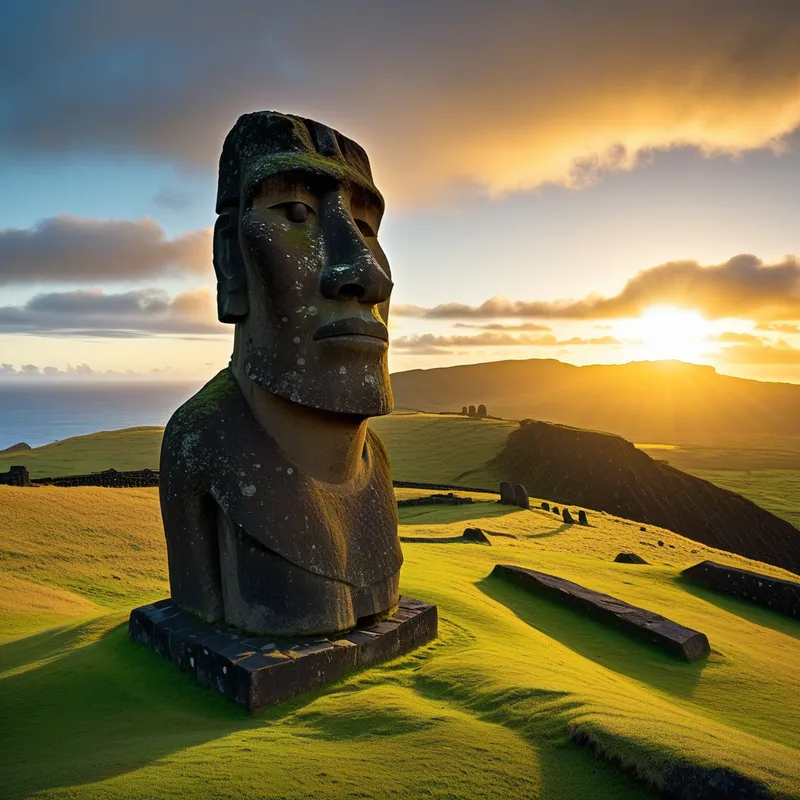
Listen. The wind does not whisper here; it hums a low, eternal note through the hollows of the stone. This is Rapa Nui, the navel of the world, an island born from the spear of the great god Hau-Maka. The sea is a vast, encircling moat of indigo and jade. The grass is gold. And from the flesh of the island’s sacred volcano, Rano Raraku, they are waking.
The people hear the mountain’s dream. It is a dream of faces—stern, long-eared, with lips pressed in a line of infinite knowing, and eyes that see beyond the curve of the horizon. The master carvers, the tangata honui, approach the living rock. They do not say, “We will make a statue.” They whisper, “We will invite an ancestor to come forth.”
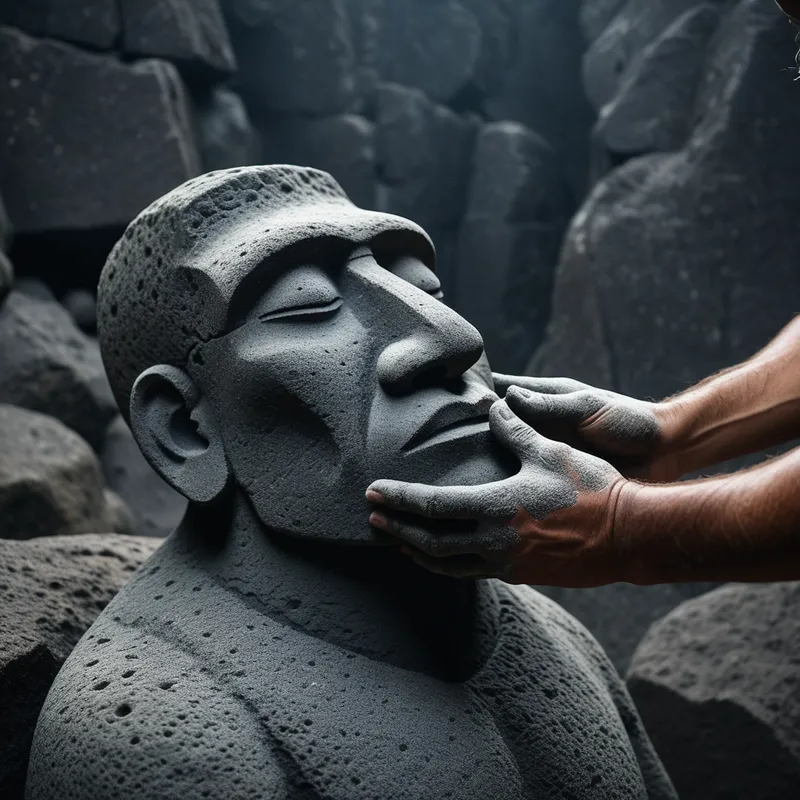
Their tools are born of the island itself: hand-axes of dense basalt, born from the fire of the earth. With each strike, tok-tok-tok, they are not breaking stone; they are having a conversation. They ask the rock for its form. They follow the veins of tuff, the whispers of its grain. Slowly, from the cliff’s womb, a brow emerges. Then the proud ridge of a nose, a strong jawline that speaks of generations. The eyes remain closed, waiting. For the ancestor is not yet present.
When the form is freed, lying on the slopes like a slumbering giant, the final ritual begins. This is the mana. The priests chant the lineage, the long song of names that stretches back to the first canoe. They call the ancestor’s spirit, the mana, from the realm of Po. And then, with a sacred coral and obsidian tool, they open the eyes.
In that moment, the stone is no longer stone. The ancestor has arrived. Its gaze is activated, a conduit of watchful power. Now begins the great journey. Hundreds of men, moving in rhythmic unison, chant and pull. They walk the ancestor, upright, on ropes across the island, a solemn procession over hills and plains. They are bringing the ancestor home, to an ahu overlooking the village of its descendants.
There, upon the ahu, the Moai is raised. Its back is to the endless sea. Its open eyes face the people, the taro fields, the homes. It does not guard against invaders from the ocean; it guards the life within. It is a perpetual witness. It holds the history, the law, the very identity of the clan in its silent, stone memory. The wind hums through its form. The rain traces paths on its cheeks. It stands. It watches. It is. A bridge of bone and breath between the living and the long, sacred past.
Cultural Origins & Context
The Moai are not mere monuments of a forgotten kingdom; they are the ultimate expression of a core Polynesian cosmological principle: the indivisible bond between the living and their ancestors. On Rapa Nui, isolated in the vastness of the Pacific, this principle took a uniquely monumental form. The mythos of the Moai is not a single narrative but a cultural practice—a living mythology carved directly into the landscape.
The tradition is believed to have begun around 1000-1100 CE, evolving over centuries. It was an act of profound communal effort and spiritual technology. The carvers were not just artisans but priests of form, intermediaries who could translate ancestral mana into tangible presence. The erection of a Moai was the central societal project, binding the community together in a shared sacred endeavor that affirmed their identity, their rights to land and resources, and their place in the cosmic order.
The myth was passed down not only in chants and oral histories but in the very act of creation. Each generation learned by doing, by touching the stone, by pulling the ropes, by feeling the collective strain and triumph. The Moai were the library, the constitution, and the family portrait of Rapa Nui society. Their silent gaze was a constant reminder of the foundational pact: the ancestors provide protection and fertility (mana), and the living provide remembrance and honor. This cycle of reciprocity was the heartbeat of the culture, until the ecological and social pressures of the island led to the cessation of this practice, leaving the silent witnesses in their quarries and on their platforms, their story shifting from one of active creation to one of enigmatic legacy.
Symbolic Architecture
Psychologically, the Moai represents the monumentalization of memory and the externalization of the superego—the internalized voice of ancestral authority and cultural law. It is the Self made stone.
The ancestor is not behind the eyes of the Moai; the ancestor is the gaze itself.
The statue’s imposing, stylized features symbolize a transcendence of individual personality. These are not portraits of a specific man, but archetypes of authority, wisdom, and watchfulness. The elongated ears signify the capacity to listen—to the gods, to the ancestors, to the land. The prominent brow holds the weight of collective thought and memory. Its placement on the ahu, with its back to the chaotic, unknown sea and its face toward the ordered, human world, perfectly diagrams the psychological function: to create a boundary. The Moai’s gaze delineates the known from the unknown, the internalized moral and cultural structure from the formless potentials of the unconscious (the sea).
The journey from quarry to ahu is a profound symbol of incarnation—the difficult process of bringing a spiritual essence (the ancestor’s mana) into a fixed, earthly position where it can interact with daily life. It is the struggle to make inner values concretely manifest in one’s world. The unfinished Moai, still lying in the quarry womb of Rano Raraku, represent potential selves, ideas, or ancestral influences that were never fully “born” or integrated into the psyche of the individual or the culture.
The Dreamer's Resonance
To dream of a Moai is to encounter the psyche’s own monuments. It often appears during periods of deep introspection, when one is questioning their foundation, their legacy, or the internalized voices of authority (parental, cultural, or personal).
A Moai in a dreamscape may feel overwhelmingly stern, judgmental, and immovable. This is the dreamer brushing against a monolithic aspect of their own superego—a rule, a expectation, a “should” that has been carved into the bedrock of their personality. It can feel cold and silencing. Conversely, a Moai that feels benevolent, protective, and wise indicates a healthy connection to inner guidance, to the “ancestral” wisdom of one’s own lived experience and inherited strengths.
Somatically, this dream can manifest as a feeling of being watched, or a stiffness in the neck and jaw—the body mirroring the statue’s rigid posture. The dream may involve trying to move the Moai, to change its gaze, or to understand what it sees. This is the psyche’s work of reassessing its own foundational structures. Is this internal monument still serving me? Does its gaze protect my inner village, or does it imprison me? The dream Moai invites a dialogue with the silent, stony parts of ourselves that hold immense power but no longer speak in a language we understand.
Alchemical Translation
The alchemical process modeled by the Moai myth is that of solidification and right placement—the opus of taking the volatile spirits of memory, influence, and potential and giving them a stable, oriented form in the theater of the soul.
The first stage is the nigredo, the work in the dark quarry. This is the introspection where we confront the raw, unformed material of our psyche—our inherited patterns, our latent potentials, our unmourned past. We must “listen to the stone,” discerning what form wants to emerge from this chaotic mass. The carving is the difficult, repetitive work of self-definition, chipping away what is not essential to reveal the core image of our authentic authority.
The journey across the island is the perilous integration of this new self-structure into the landscape of our daily life.
The raising of the Moai upon the ahu is the final stage—rubedo, the red dawn of realization. It is the moment when this inner figure is fully erected and “activated.” Its eyes are opened. This is not an act of arrogance, but of sacred orientation. We consciously turn the back of this inner authority to the sea of chaos and unconscious reactivity, and we allow its gaze to oversee and bless our cultivated life—our relationships, our work, our community. The ancestor we integrate is no longer a ghost of the past demanding tribute, but a stabilized, witnessing presence that grants our life depth, continuity, and meaning. We become, simultaneously, the carver, the ancestor, and the living village—a complete circuit of being, anchored in time yet facing eternity.
Associated Symbols
Explore related symbols from the CaleaDream lexicon: