Máni Myth Meaning & Symbolism
The story of Máni, the Nordic Moon God, who guides the silver chariot across the night, pursued by wolves, holding the secrets of time and human destiny.
The Tale of Máni
Listen. The sky is not empty when the sun flees. When Sól’s chariot plunges beyond the western edge of the world, painting the clouds with the last embers of day, another journey begins. A colder, quieter one.
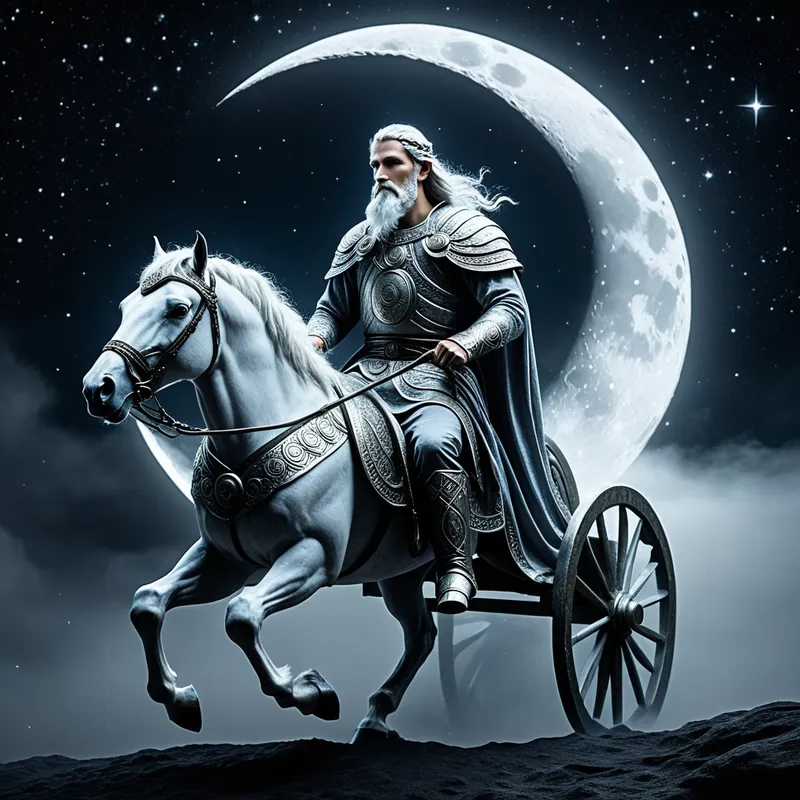
From the east, a new light emerges. Not a blaze, but a glow. A soft, silver radiance that spills like milk across the black cloak of night. This is the chariot of Máni. He does not ride with thunder or fire. His steed is named Alsvidr, “All-Swift,” yet its hooves make no sound on the star-road. Máni himself is a figure of serene and melancholy beauty, his face pale as the orb he guides, his eyes holding the stillness of deep wells. He is the shepherd of the night, the gentle counterpoint to his sister’s fierce day.
But his road is not peaceful. It is a road of dread. For from the deep forests of Midgard and the iron woods of Jötunheimr, two wolves lift their heads. They are named Hati Hróðvitnisson and Sköll. Their fur is the colour of shadow, their eyes chips of hungry stars. Sköll pursues the sun, but Hati… Hati is for the moon. His jaws drip with anticipation for the silver disc, his name meaning “He Who Hates.”
So Máni drives, an eternal fugitive. He whips Alsvidr onward, the chariot’s pearlescent glow flowing over sleeping mountains and silent fjords. He looks down, and in his cold light, he sees two children. They are a boy and a girl, lifted from the earth, their faces frozen in an eternal moment of wonder. Their names are Hjúki and Bil. He took them as they carried a pail of water from the well Byrgir, and now they follow him, a reminder of time’s capture, of moments snatched from the stream of life. They are his companions in this silent flight.
The chase is the drumbeat of the cosmos. As the moon waxes, filling its belly with light, Hati lags, his howl a distant promise of despair. As it wanes, sliver by silver sliver, his breath grows hot on the chariot’s trail. The people below watch this celestial hunt, knowing its end is written in the bones of the world. At Ragnarök, the great twilight, Hati will finally close his jaws. The moon will be swallowed, its light extinguished in gore and darkness. Máni knows this. He has always known. Yet, he drives on. He tends his stolen children, he casts his reflective gaze upon the world, and he runs the course fate has woven for him, a luminous, doomed caretaker in the vast, cold hall of the night.
Cultural Origins & Context
The myth of Máni is not a standalone epic, but a vital thread in the vast, grim tapestry of Norse cosmology, primarily preserved in the Poetic Edda and the Prose Edda of Snorri Sturluson. These texts, written in Christianized Iceland, are our window into a much older, oral tradition. The myth would have been told not for mere entertainment, but as an explanation of the natural order. The moon’s phases, its eerie light, its apparent flight across the sky, and the terrifying phenomenon of lunar eclipses—all were given narrative life through Máni’s story.
This myth functioned as a cosmic clock and a moral lesson. It embedded the concept of inescapable fate (ørlög) into the very heavens. Every person who looked up at the moon was witnessing a god enacting a pre-ordained drama of pursuit and eventual doom. It taught resilience in the face of inevitable ends. Máni does not rage or surrender; he performs his duty with a solemn grace until the final moment. The myth was likely recited by skalds and elders, a reminder that even divine beings are subject to the laws of time and destiny, and that nobility lies in the steadfastness of one’s course.
Symbolic Architecture
Máni is far more than a personified celestial body. He is the archetype of the reflective consciousness, the luminary of the inner world.
The moon does not generate its own light; it receives the sun’s fire and transforms it into a cool, contemplative glow. So too does consciousness receive the raw blaze of experience and translate it into understanding.
His eternal flight from the wolf Hati symbolizes the psyche’s struggle with the devouring aspects of time, decay, and the unconscious. The waxing and waning moon is the perfect symbol of cyclicality—of growth and retreat, of fullness and emptiness, mirroring the rhythms of life, emotion, and fortune.
The children, Hjúki and Bil, are profound symbols. Stolen while performing a mundane task (carrying water), they represent captured moments of time, the specific memories and experiences that constitute our personal history. They follow us, as our past follows us, visible in the changing face of our own “moon”—our personality and memory. Máni, as their guardian, becomes the keeper of personal chronology and karma.
The Dreamer's Resonance
When the pattern of Máni’s myth stirs in the modern dreamer, it often signals an encounter with the psychology of time, fate, and the shadow. To dream of being pursued by a dark beast under a cold moon speaks to a somatic feeling of anxiety—a sense that time is running out, that a neglected duty or a repressed aspect of the self (the shadow) is gaining ground.
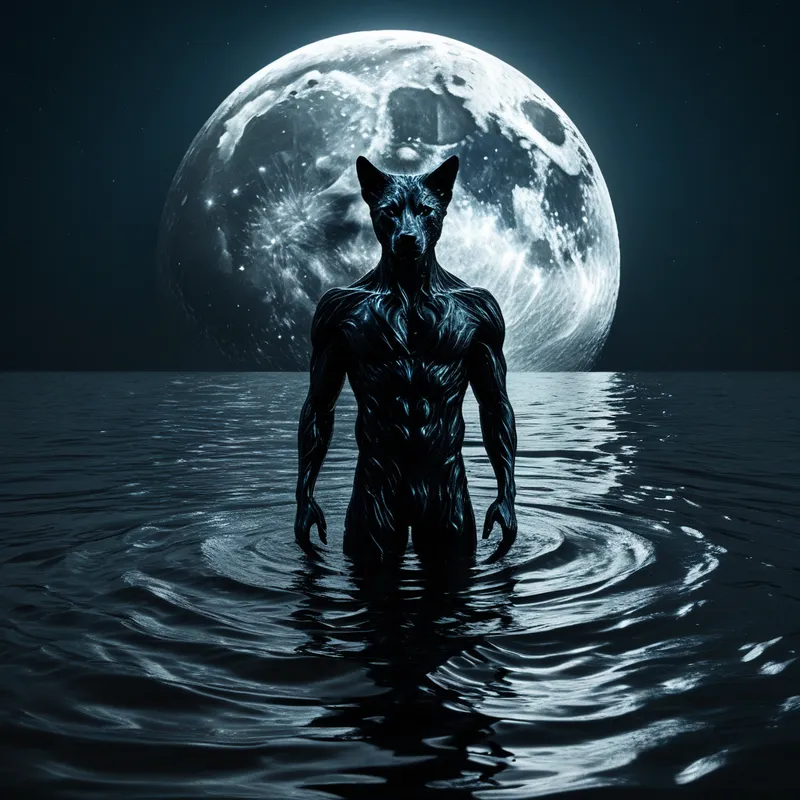
Dreaming of guiding a silent, luminous vehicle through darkness may reflect the dreamer’s role as a caretaker of their own inner world or of others, a journey that feels lonely and fraught. A dream of two children following, or of looking at one’s reflection in moonlit water, can indicate a process of reviewing one’s personal history, of trying to understand the stolen moments and choices that have shaped the present. The dream is the night sky of the psyche, and Máni is the active principle moving through it, asking us to face what chases us, and to acknowledge what we carry with us.
Alchemical Translation
The alchemical process mirrored in Máni’s myth is not one of violent conquest, but of sacred endurance and reflective integration—the core of the caregiver archetype’s higher function.
The first stage is receiving the light: accepting the raw experiences of life (Sól’s fire) without being burned by them. The second is the opus contra naturum, the work against nature: here, it is the conscious, steadfast journey along a fated path, despite the terrifying presence of the devouring shadow (Hati). Máni does not fight the wolf; he outruns it by fulfilling his nature. This is the individuation process—becoming who you are meant to be is the only true “escape” from the chaotic, consuming unconscious.
The ultimate alchemy is the realization that the pursuer and the pursued are part of the same system. The wolf gives meaning to the flight; the moon’s beauty is heightened by its impermanence.
Finally, the integration is seen in the children. The conscious self (Máni) must take responsibility for the contents of its own history (Hjúki and Bil). They are not burdens, but companions. The psychic transmutation is complete when one can drive the chariot of one’s life, mindful of the pursuing end, while tenderly attending to all the moments—bright and dark—that one carries. In doing so, the individual performs their own cosmic duty, illuminating the darkness within and without, until their own destined cycle is complete.
Associated Symbols
Explore related symbols from the CaleaDream lexicon: