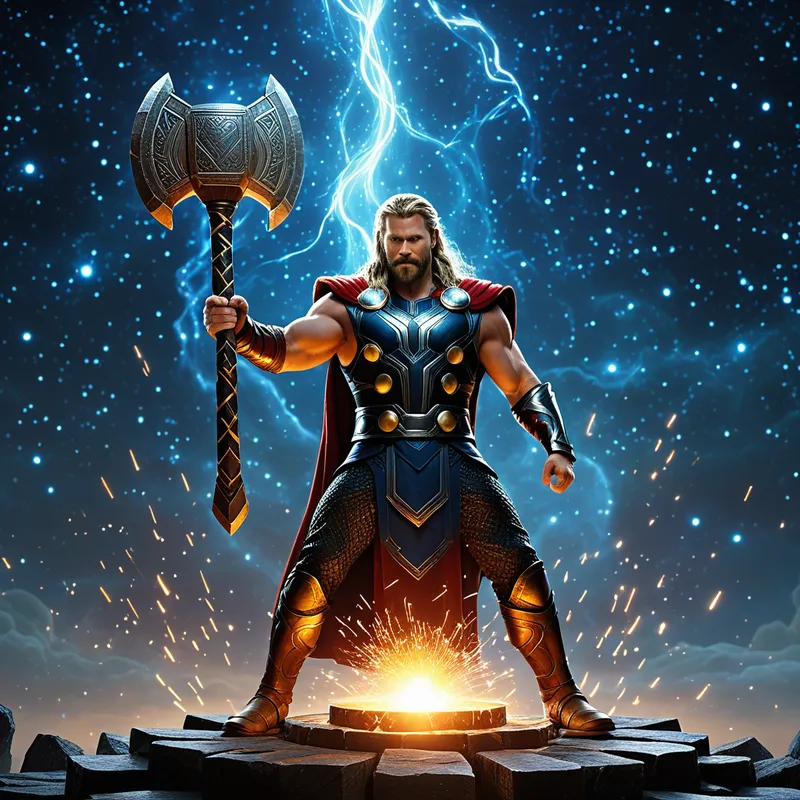
Mjölnir's Iron Myth Meaning & Symbolism
The story of how Thor's hammer, Mjölnir, was forged from a heart of iron, a weapon of divine will born from trickery and cosmic necessity.
The Tale of Mjölnir's Iron
Listen, and hear the tale of the thunder’s heart, the iron that holds back the twilight. It begins not with a god’s triumph, but with a god’s folly.
Loki, silver-tongued and restless, had sheared the golden hair of Sif, wife of Thor. When the thunderer’s rage shook the halls of Asgard, Loki swore to make amends. He descended from the high branches of Yggdrasil, down into the smoky, resonant dark of Svartálfheim. There, in caverns where the earth’s bones groaned with heat, he found the sons of Ivaldi. With promises and lies, he commissioned gifts: hair of spun gold for Sif, a ship that folds for Freyr, and a spear that never misses for Odin.
Puffed with pride, Loki boasted that no smiths in all the worlds could craft finer works. Another dwarf, Brokkr, heard this and his eyes glinted in the forge-light. “My brother Eitri can do better,” he growled. A wager was struck: Loki’s head against Brokkr’s skill.
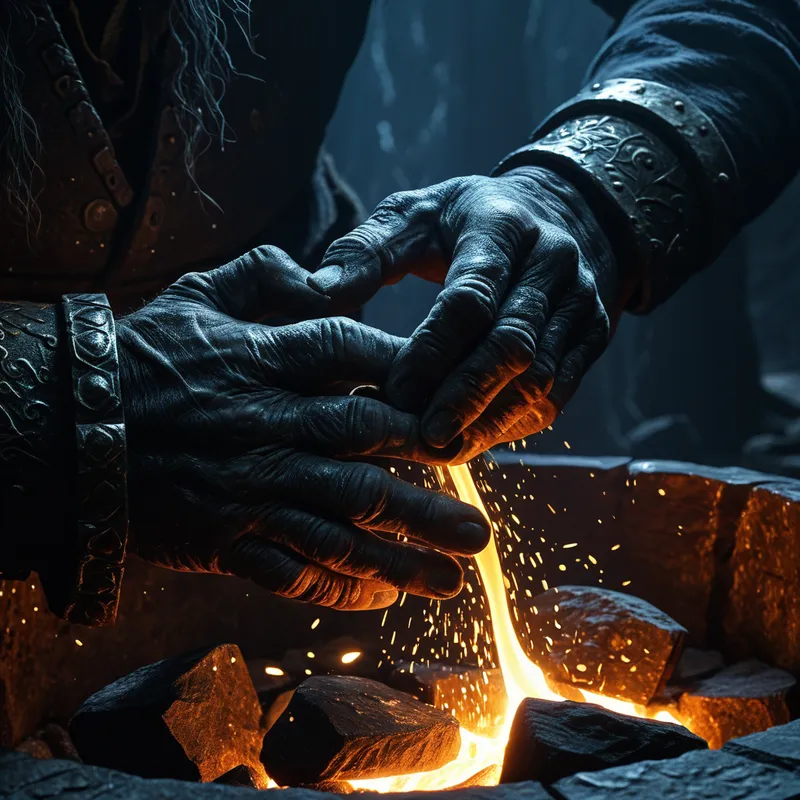
The true forging began. In a chamber where the air itself tasted of metal and magic, Eitri laid a lump of raw, star-fallen iron upon the anvil. “Pump the bellows,” he commanded Brokkr, “and do not stop for a single breath, or all is lost.” As Eitri chanted old, guttural runes, Brokkr worked the great bellows. The fire roared from a mere forge-flame to a miniature sun, a crucible of creation. The iron did not just glow; it wept, it sang, it became a liquid heart of darkness and potential.
Into that seething pool, Eitri cast whispers of mountain roots, the resilience of the world-serpent’s scales, and the unyielding will of the thunder god himself. The first breath of a fly—Loki in disguise—bit Brokkr’s hand, but he did not falter. The iron took form: a massive, brutal head, geometric and terrible in its simplicity. The second breath, the fly bit Brokkr’s neck, drawing blood that sizzled on the anvil. Still, he pumped. The haft was being born, short and stout, meant for one hand’s devastating grip. The third and most vicious bite came at Brokkr’s eyelid, the blood blinding him. He roared in pain but his hands, knowing their purpose, never ceased. The bellows sighed one final, mighty breath.
Eitri drew the weapon from the ashes. It was not elegant. It was not beautiful in the way of elven blades. It was necessary. A hammer of solid, rune-carved iron, its weight a promise, its form a verdict. They named it Mjölnir. When presented to the gods, it was judged the greatest treasure of all, despite its flaw—the haft was slightly too short, a mark of Loki’s interference. Yet in that “flaw” lay its destiny: to be swung with devastating, close-quarters force, a weapon not of distance, but of intimate, world-shaking impact.
Cultural Origins & Context
This myth, preserved primarily in the Prose Edda of Snorri Sturluson, is not merely a whimsical story of divine procurement. It is a foundational narrative of the Norse cosmos, emerging from a culture that lived intimately with the realities of iron. In the Viking Age, iron was not just a metal; it was a hard-won treasure, pulled from bog and earth, transformed through immense labor and skill in the smithy—a place seen as half workshop, half sacred space.
The myth was likely told in halls, the firelight mimicking the forge of Eitri. Its function was multifaceted. It explained the origin of the gods’ most potent defensive artifact, the primary weapon against the encroaching chaos of the Jötnar. It reinforced cultural values: the supreme worth of craftsmanship (smíð), the binding nature of oaths and wagers, and the idea that even divine power requires a foundation of mortal (or in this case, dwarven) effort and sacrifice. The story also humorously integrates the ever-present, destabilizing force of Loki, showing that chaos is often the necessary catalyst for the creation of order’s greatest tools.
Symbolic Architecture
At its core, the myth of Mjölnir’s iron is an allegory for the forging of conscious will and resilient identity. The raw iron represents the unrefined, primal strength of the psyche—potentially powerful but formless and unusable.
The anvil is the self, the hammer is the will, and the fire is the transformative ordeal that joins them.
Loki, the trickster, represents the disruptive psychic energy—the doubt, the anxiety, the creative sabotage—that initiates the process. His shearing of Sif’s hair (a symbol of vitality and integrity) creates the deficit that forces a journey into the underworld of the unconscious (Svartálfheim). The dwarves, Eitri and Brokkr, are the archetypal craftsmen of the deep self, the latent skills and patient endurance within the psyche that can shape raw potential into functional power. Brokkr’s unwavering effort under torment symbolizes the absolute focus and suffering required for true psychological transformation.
The resulting Mjölnir, with its “flawed” short handle, is a profound symbol. It signifies that one’s greatest strength is often inseparable from one’s perceived limitation or wound. The hammer is not a weapon of finesse, but of concentrated, undeniable impact—the ability to say a definitive “yes” or “no,” to set boundaries (it hallows), and to destroy what must be destroyed for integrity to remain.
The Dreamer's Resonance
When this myth stirs in the modern dreamer, it often manifests as a somatic experience of pressure, heat, and shaping. One might dream of being in a vast, underground workshop, feeling the rhythmic thud of a hammer that is never seen. There may be dreams of holding something immensely heavy yet vital—a stone, a lump of metal—with the urgent knowledge that it must be shaped.
Psychologically, this signals a process of consolidation. The dreamer is in the crucible of forging a new aspect of their ego-strength or will. It is a response to a recent “shearing”—a betrayal, a failure, a loss of face or status (Sif’s hair). The psyche has descended into its own workshop. The flies that bite in the dream (irritations, nagging thoughts, minor pains) represent the distractions and self-sabotaging tendencies (the Loki within) that test one’s focus during this vulnerable, creative process. To dream this is to be Brokkr at the bellows: you are in the midst of the labor, and the outcome depends entirely on your endurance.
Alchemical Translation
The alchemical journey mirrored in this myth is the opus contra naturam—the work against nature, which here means the work against one’s own unrefined, instinctual state. The prima materia is the base iron of the personality: reactive anger, brute strength, undirected power (the early Thor is all these things).
The goal of the work is not to discard the iron, but to subject it to the sacred fire of consciousness and the skillful blows of experience, until it becomes an instrument of divine function.
The first stage (nigredo) is Loki’ crime—the blackening, the shame or crisis that dissolves the old, complacent identity. The journey to the dwarves is the separatio, diving into the unconscious to find the hidden craftsmen (insight, discipline). The forging itself is the fierce heat of albedo and citrinitas, the whitening and yellowing, where the material is purified and given spiritual quality through relentless effort and suffering (Brokkr’s bites).
The final hammer is the rubedo, the red stone, the achieved Philosopher’s Stone of the psyche. For the modern individual, this translates to the forging of a resilient, grounded will. It is the development of the ability to “hold the hammer”—to take decisive action, to protect one’s sacred space (be it home, values, or psyche), and to channel one’s raw, chaotic power into a focused, creative, and protective force. The myth teaches that this tool is not given; it is earned in the dark, smoky depths of the self, paid for with focus and pain, and its final, imperfect form is your strength alone to wield.
Associated Symbols
Explore related symbols from the CaleaDream lexicon: