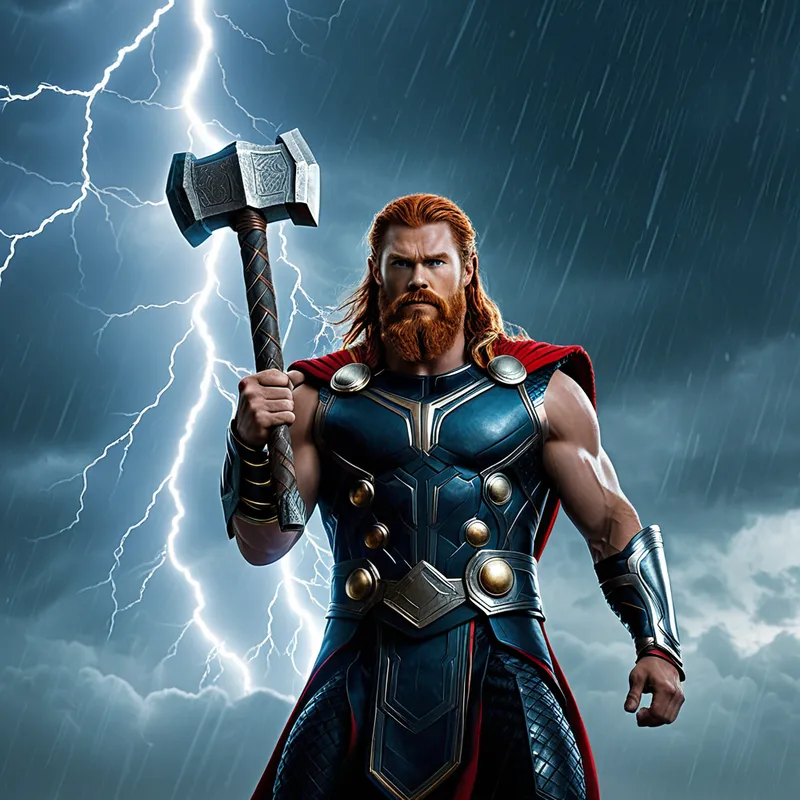
Mjölnir Myth Meaning & Symbolism
A trickster sabotages the forging of a god's weapon, creating a flaw that becomes its greatest strength—the short-handled, unerring hammer Mjölnir.
The Tale of Mjölnir
Listen, and hear the tale of the thunder’s heart, born not in glory, but in cunning and flame.
The air in Asgard was thick with shame. Loki, silver-tongued and swift, had sheared the golden hair of Sif, wife to the mighty Thor. In his wrath, Thor’s grip promised to grind every bone in Loki’s body to dust. To save his skin, Loki swore an oath: he would journey to the realms below and procure replacements more magnificent than the sun-bleached locks he had stolen.
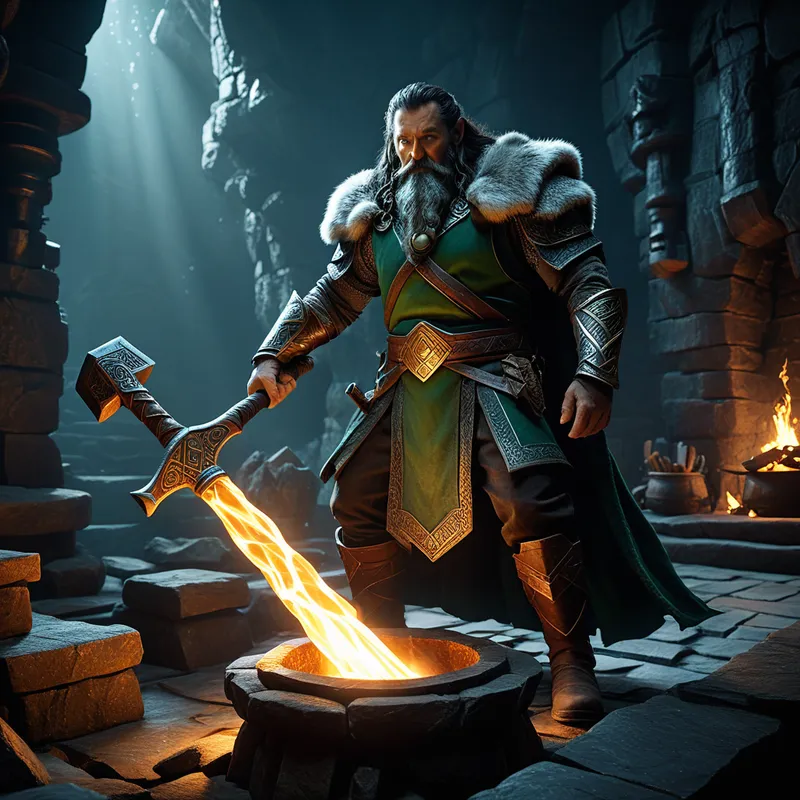
He descended into the earth, into the smoky realms of the dvergar, the dwarves. In the forges of the sons of Ivaldi, he commissioned gifts of appeasement: hair of spun gold that would grow like living grain for Sif, a ship that could fold into a pocket for Odin, and a spear that never missed its mark. Puffed with pride, Loki boasted to another pair of dwarf brothers, Brokkr and Sindri, that their skill could never match such creations. Fury is a hotter fire than any forge. The brothers laid a wager: their heads against Loki’s, that they would craft three treasures to surpass all others.
Sindri, the master smith, placed a boar’s hide in the hearth. “Pump the bellows, brother,” he commanded Brokkr, “and do not cease for a single breath, no matter what you see or hear.” As the magical bellows roared, a fly—Loki in disguise—landed on Brokkr’s hand and bit deep. Brokkr did not flinch. From the fire, Sindri drew Gullinbursti, a living boar of gold that shone in the dark and raced across sky and sea. Next, Sindri threw a circle of gold into the flames. The fly returned, biting Brokkr’s neck until blood flowed. Still, the bellows roared. From the coals, Sindri drew Draupnir, a ring from which eight new rings of equal weight dripped every ninth night.
For the third treasure, Sindri placed a simple block of iron in the heart of the fire. “Now, brother,” he whispered, his voice grave, “this above all. Do not stop.” The fly, desperate now, alighted on Brokkr’s eyelid and bit so fiercely the eyelid swelled shut with blood. For one agonizing moment, Brokkr’s hand faltered. Just one. He brushed the fly away, and the bellows gasped.
Sindri drew the form from the fire. It was a hammer. A weapon of terrible, beautiful symmetry, its head perfectly formed, inscribed with runes of dominion. But the handle… the handle was cruelly, irrevocably short. The flaw born from that single moment of distraction. They named it Mjölnir, the Grinder.
Presented before the gods, the treasures shone. Yet all eyes fell on the hammer. Odin proclaimed it the greatest, for though its reach was limited, its blow was unerring, and it would always return to the hand that threw it. The gods laughed, and Loki, who had lost the wager, fled—but not before the dwarves sewed his lips shut with a leather thong, a final, silent lesson. And so Mjölnir passed to Thor, the protector, its shortness a constant reminder that even the mightiest power is born of a flaw, and that true strength lies not in perfection, but in unbreakable return.
Cultural Origins & Context
This myth, preserved primarily in the 13th-century Poetic Edda and Prose Edda of Snorri Sturluson, is not merely a whimsical origin story. It is a foundational narrative of a culture shaped by harsh landscapes, existential threat, and profound craftsmanship. In the Norse worldview, the cosmos was a fragile order besieged by chaotic forces—the jötnar. The gods were not omnipotent; they were dependent on tools, alliances, and cunning.
The myth of Mjölnir’s forging would have been told in longhouses, its rhythm matching the crackle of the central fire. It served multiple societal functions: it explained the nature of Thor’s primary weapon, the protector of both gods and humanity; it reinforced the high value placed on smithcraft and the magical potency of objects; and it encoded a deeply pragmatic worldview. The story teaches that the tools for survival are not given but must be won through contest, risk, and negotiation with capricious powers (like Loki or the dwarves). Furthermore, it underscores that the outcome, however powerful, will bear the mark of the struggle that created it. The short handle is not glossed over; it is the central, defining feature, teaching that utility and power trump idealized form.
Symbolic Architecture
At its core, Mjölnir is a symbol of focused, contained force. It is not a sword that cuts a wide swath, nor a spear that keeps the enemy at a distance. It is a hammer, a tool of both destruction and creation, requiring one to step close, to commit, to engage directly with the material—or the adversary.
The flaw is not an accident; it is the signature of the world upon the weapon. The short handle demands intimacy with the blow.
Psychologically, the hammer represents the conscious ego’s capacity for decisive action and focused will. Thor, the archetypal hero, is the aspect of the psyche that confronts the monstrous, chaotic elements of the unconscious (the giants). Mjölnir is his instrument of differentiation—the ability to say “this, not that,” to crush amorphous fears into manageable form, and to defend the boundaries of the self. Yet, its famed return symbolizes a crucial psychic truth: a conscious act, once launched, must be integrated back into the self. Repressed emotions or ignored shadows, like thrown hammers, will return.
Loki’s sabotage is equally vital. He represents the trickster, the chaotic, amoral spark of the unconscious that disrupts sterile plans. Without his bite, the hammer might have been “perfect”—and perhaps useless in its generic idealism. His interference forces an adaptation, a compromise with reality that ultimately creates a tool uniquely suited to its purpose.
The Dreamer's Resonance
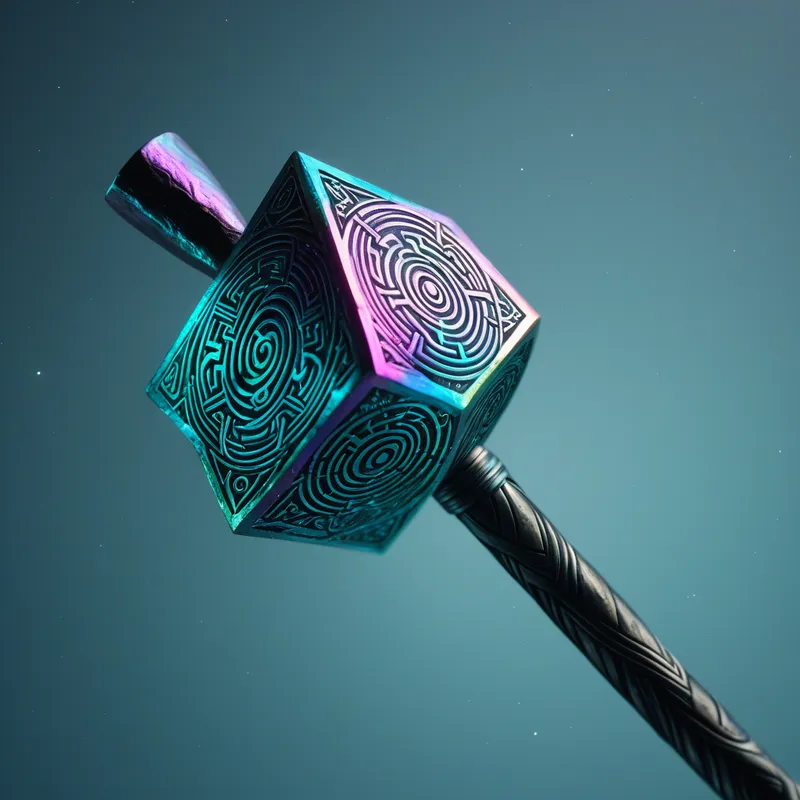
When the motif of Mjölnir appears in modern dreams, it seldom manifests as a literal comic-book hammer. More often, one dreams of a tool that is powerfully effective yet awkward to wield—a wrench that is too short, a key that fits but is hard to turn, a voice that is potent but leaves the dreamer hoarse.
Somatically, this can correlate with a feeling of immense potential energy in the arms and chest, coupled with a frustration in the wrists or grip—a literal embodiment of “power at hand, but hard to grasp.” Psychologically, the dreamer is likely navigating a process where they possess the raw strength or insight (the hammer head) to confront a life challenge, but lack the appropriate “handle”—the skill, the leverage, the nuanced approach, or the emotional readiness to apply it effectively. The dream is highlighting the flaw in the delivery system of one’s own power. It may point to a tendency toward overkill, to using a sledgehammer to crack a nut, because the shortened handle forces a clumsy, all-or-nothing swing. The returning hammer in a dream suggests the inescapable consequences or recurring nature of a problem until it is properly grasped and mastered.
Alchemical Translation
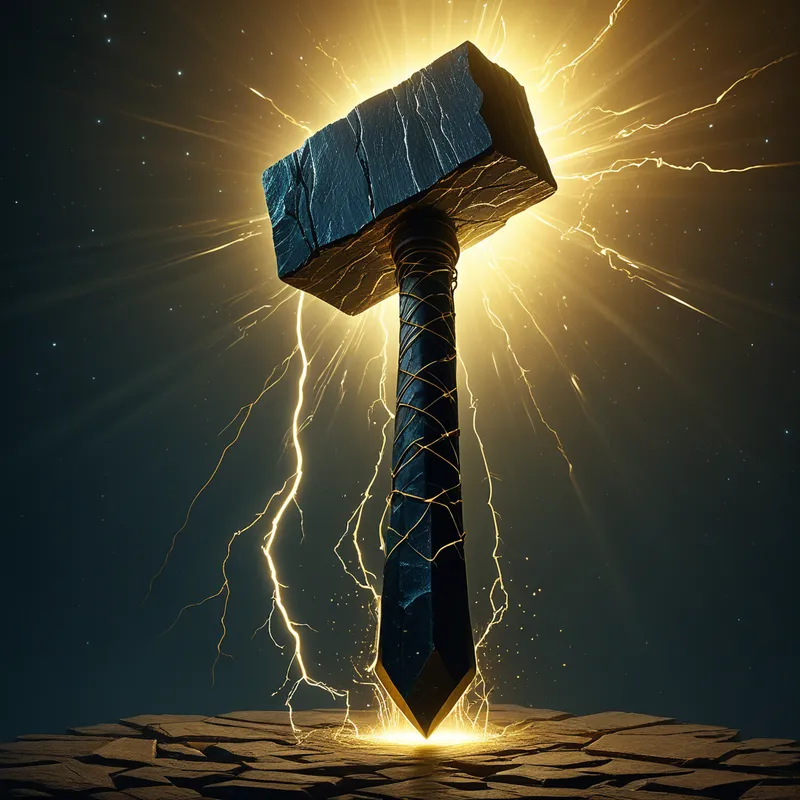
The forging of Mjölnir is a perfect allegory for the alchemical process of individuation—the forging of a coherent, resilient Self. The base material (the iron) is the raw, undifferentiated stuff of the personality, heavy with potential. The forge is the heat of lived experience, conflict, and suffering. The dwarven smiths, Brokkr and Sindri, represent the dedicated, often unconscious, inner work that occurs below the surface of awareness.
The individuated Self is not a flawless gem. It is a functional, potent tool, its unique shape hammered out on the anvil of error, limitation, and surprise.
Loki, the trickster, is the indispensable agent of transformation. In personal growth, he is the embarrassing mistake, the unforeseen crisis, the irrational emotion that ruins our “perfect” plan for self-improvement. He is the bite that breaks concentration. Yet, this sabotage prevents the creation of a sterile, idealized persona. It forces a creative adaptation—the short handle. In psychological terms, this is our limitation, our wound, our complex. We spend lives lamenting this shortness, wishing for a longer, easier grip on our powers. But the myth insists this very flaw is what makes the tool ours and defines its unique utility. Our anxiety, our past trauma, our peculiar temperament—these “short handles” force us to develop precision, to step closer to our challenges, to engage with them intimately rather than from a safe, detached distance.
Finally, the hammer’s unerring return symbolizes the core of integration. Every conscious act, every choice made, every shadow confronted, returns to the psyche. It becomes part of us. We cannot throw away our power or our responsibility. Mjölnir teaches that true psychic power—forged in the dark, shaped by flaw, and wielded with committed proximity—always comes back to the hand that truly knows how to hold it.
Associated Symbols
Explore related symbols from the CaleaDream lexicon:
- Equipment
- Iron
- Weapon
- Helmet
- Steel
- Pistol
- Weapons (Sword/Axe)
- Steel Gray
- Tourmaline Slice
- Dazzling Iridium
- Celestial Hafnium
- Sailor's Anchor
- Safety Helmet
- Football Helmet
- Wooden Mallet
- Aerodynamic Drill
- Cast Iron Skillet
- Armored Personnel Carrier
- Surge Protector
- Stone Axe
- Double-Bladed Axe
- Chipped Flint Ax
- Stone Hammer
- Worked Stone Axe
- The Immunity
- Handheld
- Turbine
- Titanium
- Peavey
- Raincoat
- Charmed Amulet
- Amulet of Protection
- Ice Hockey Puck
- Amulet of Power
- Rustic Forge Hammer
- Ax
- Hand Ax
- The Gavel
- Amulet
- Magnum