
Minthe Myth Meaning & Symbolism
A nymph's love for Hades sparks Persephone's wrath, leading to her transformation into the fragrant, resilient mint plant.
The Tale of Minthe
Listen, and let the scent of cool earth and crushed leaves carry you to a place where the living world grows thin. Here, where the River Cocytus whispers its lament, the air is heavy with the memory of life. In this twilight realm, ruled by the stern Hades, beauty was not absent. It clung to the damp rocks and murmured in the streams, embodied in the form of a nymph named Minthe.
She was a spirit of the water, her grace as fluid as the currents she served. But her heart was not content with the sun-dappled pools of the upper world. It was drawn to the profound silence, the immense gravity, of the King of the Depths. In the shadowed halls of his palace, she dared to dream. She wove fantasies of usurpation, whispering to the echoing stones that she was more beautiful, more deserving, than the Queen herself—Persephone, the Bringer of Seasons.
Perhaps she believed the darkness would keep her secrets. It did not. Words spoken in the underworld have a way of rising, carried on cold drafts to attentive ears. Persephone heard. The Queen who knew both the joy of spring meadows and the absolute sovereignty of death felt the sting of this challenge in her very core. Here was not just insult, but a threat to the sacred balance she maintained—the balance between life and death, absence and return.
Fury, cold and absolute, descended. There was no trial, no debate. In a grotto veiled by the perpetual gloom, Persephone found the boastful nymph. No words were wasted. The Queen’s power, honed in the depths, erupted. It was not a blow of violence, but of utter, transformative negation. Where Minthe stood, proud and defiant, a crushing force pressed down. Her cry was swallowed by the earth. Her delicate form shuddered, dissolved, and was pressed into the moist soil. Skin became tender stem, hair became serrated leaf, her final breath became a sharp, clean, piercing fragrance that forever filled the air.
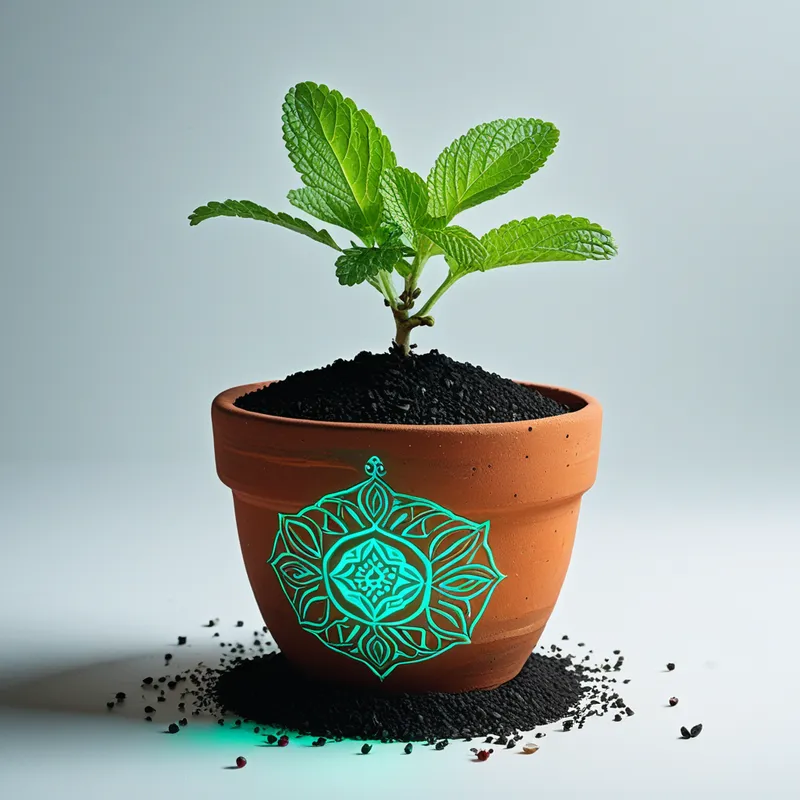
The nymph was gone. In her place, a humble, tenacious plant pushed through the underworld mud: menthe. Its scent was a ghost of her pride, its vitality a testament to her spirit, forever rooted in the realm of the god she dared to love.

Cultural Origins & Context
The story of Minthe is a fragment, a piece of deep lore preserved not in the grand epics of Homer or Hesiod, but in the more localized, explanatory myths known as aetia—stories that explain the origin of things. Our primary source is the geographer Strabo, who references the tale in his descriptions of the region around Elis, where a sanctuary of Hades once stood, famously surrounded by thickets of mint.
This geographical tether is crucial. The myth likely served a dual function. First, it was an aition for the mint plant itself, explaining its distinctive, refreshing aroma and its association with dank, shady places. More profoundly, it reinforced the sacred and terrifying hierarchy of the divine order, particularly the cult of the chthonic (underworld) deities. The myth acted as a cautionary tale about the dangers of hubris—overweening pride—directed at the gods, and specifically about challenging the established, if complex, marriage of Hades and Persephone. This marriage was itself the cornerstone of a fundamental Greek mystery: the cycle of life, death, and rebirth, which Persephone embodied through her annual journey. Minthe’s transgression was not merely romantic; it was a threat to a cosmic principle.
Symbolic Architecture
At its heart, the myth of Minthe is an archetypal drama of encounter with an overwhelming, transformative power. Minthe represents the part of the psyche that becomes intoxicated by a powerful complex—here, symbolized by Hades, the ruler of the unconscious, the gatherer of all that is hidden and repressed. Her desire is not for conscious partnership, but for a possessive identification with that power.
To be crushed into one's essential fragrance is the fate of the ego that challenges a divine syzygy.
Persephone, then, is not merely a jealous wife. She is the anima figure who has integrated the underworld. She is the conscious connection to the depths, the lawful queen of the unconscious. Her wrath is the psyche’s own corrective, immune force, which annihilates a naive or arrogant inflation. The transformation into mint is the key symbol. It represents a reduction to an essential quality. Minthe’s being is not erased; it is alchemized. Her pride and desire are transmuted into a pervasive, resilient, and useful presence—a scent that clears the head, aids digestion, and rituals of death. She becomes a healing herb born from a wound to the divine feminine.
The Dreamer's Resonance
When this myth stirs in the modern dreamer, it often signals a profound process of humiliation and essentialization. To dream of being trampled, crushed, or transformed into a plant by a powerful feminine figure points to a necessary deconstruction of an inflated self-image.
Somatically, one might feel a literal pressure on the chest—the weight of a truth that "puts you in your place." Psychologically, this is the moment when a long-held fantasy, particularly one related to usurping a position of power (in work, in a family system, in relation to a mentor or partner) is violently confronted by reality. The "Persephone" figure in the dream could be an actual person, but more often it is the dreamer’s own emerging consciousness of the lawful, structural order they have violated. The process feels like annihilation, but the result, upon waking, is often a strange clarity—a "cooling" of a feverish ambition or desire, and the emergence of a simple, grounded strength. The dreamer is being reminded, forcefully, of their true nature and place in a larger system.

Alchemical Translation
The alchemical journey modeled here is not one of heroic conquest, but of radical humility and subsequent usefulness. The prima materia is the raw, desirous ego (Minthe). The nigredo, the blackening, is her crushing and dissolution into the mud of the underworld—the utter despair of realizing one’s insignificance before an archetypal power.
The goal is not to avoid the footstep of the goddess, but to become the herb that grows from beneath it.
The albedo, the whitening, is the emergence of the mint plant—the distillation of a complex personality into a single, pure, and potent virtue. The ego-complex is broken down and reborn as a function within the psyche. Where there was a narcissistic desire to be the Queen of the Underworld, there is now the capacity to serve—to cool, to soothe, to cleanse, to facilitate transitions. In terms of individuation, this is the process where an individual, after a crushing encounter with a superior aspect of the Self (the divine couple of Hades-Persephone), abandons grandiose identification and instead discovers their unique, humble, yet indispensable role in the ecology of their own soul and the wider world. Their triumph is not in ruling, but in becoming essential.
Associated Symbols
Explore related symbols from the CaleaDream lexicon: