Mimi Spirits Myth Meaning & Symbolism
Ancient, fragile spirits of the Dreaming who taught the First People hunting, fire, and art, and now dwell in rock crevices, whispering ancestral wisdom.
The Tale of Mimi Spirits
In the time before time, when the world was soft and the songs of the Dreaming still vibrated in the very rock, the land was a place of raw potential and great hunger. The First People walked, but they walked in need. They knew the taste of berries but not the art of the spear. They felt the night's chill but had not yet coaxed the spirit of flame from sleeping wood. They were children of the earth, listening but not yet understanding its deepest language.
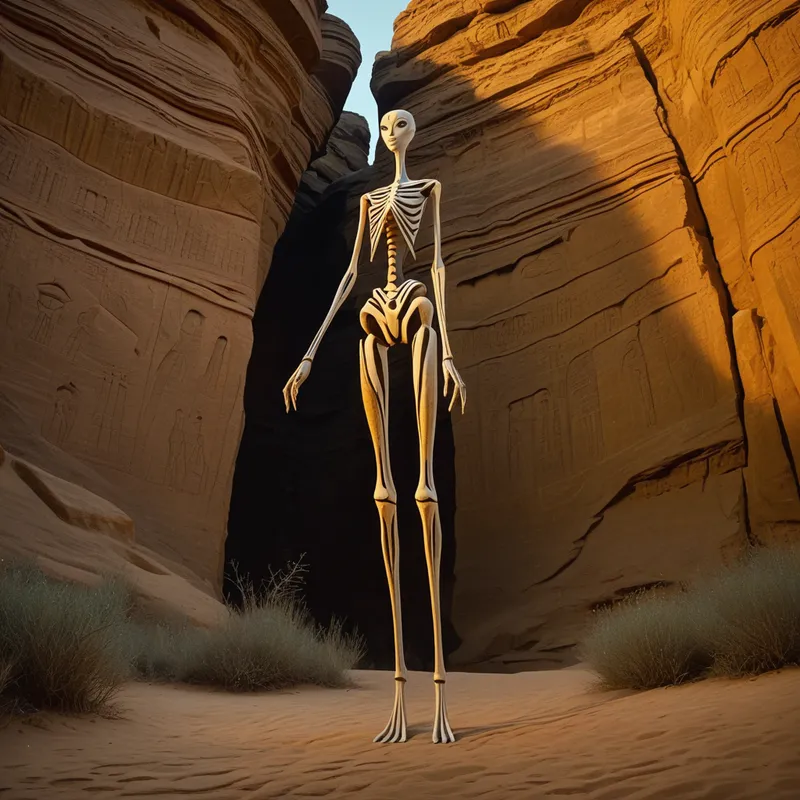
Then, from the cracks in the ancient sandstone, from the whispering crevices of the escarpments, they came. They were the Mimi. So tall they could step from valley floor to plateau top. So slender that a strong gust of wind would blow them away, forcing them to hide when storms brewed. Their bodies were like lengths of reed, painted with the sacred ochres of the earth—red, yellow, white—in patterns that told of the journeys of the Rainbow Serpent. They moved with a grace that made the grass barely bend, their elongated fingers tracing stories on the air itself.
The People watched, hidden and afraid. But the Mimi were not fearsome. They were teachers. One day, as a hunter stared in frustration at a bounding kangaroo, a Mimi appeared. Without a word, it took a long, straight branch and, with movements swift as a lizard's tongue, showed how to fashion a spear, how to balance it, how to throw it not with brute force, but with the focused energy of the whole body, becoming one with the aim. The first successful hunt was a sacrament, a gift passed from spirit to human.
As the sun fled and the cold crept in, another Mimi approached the shivering group. From a dry stick and a softer piece of wood, it spun a thread of smoke, then a spark, then a tiny, dancing tongue of light. It cupped the fledgling flame in its hands, blowing gently, and placed it amidst kindling. The People felt not just warmth, but awe—the capturing of a piece of the sun itself, a living spirit to guard them through the dark.
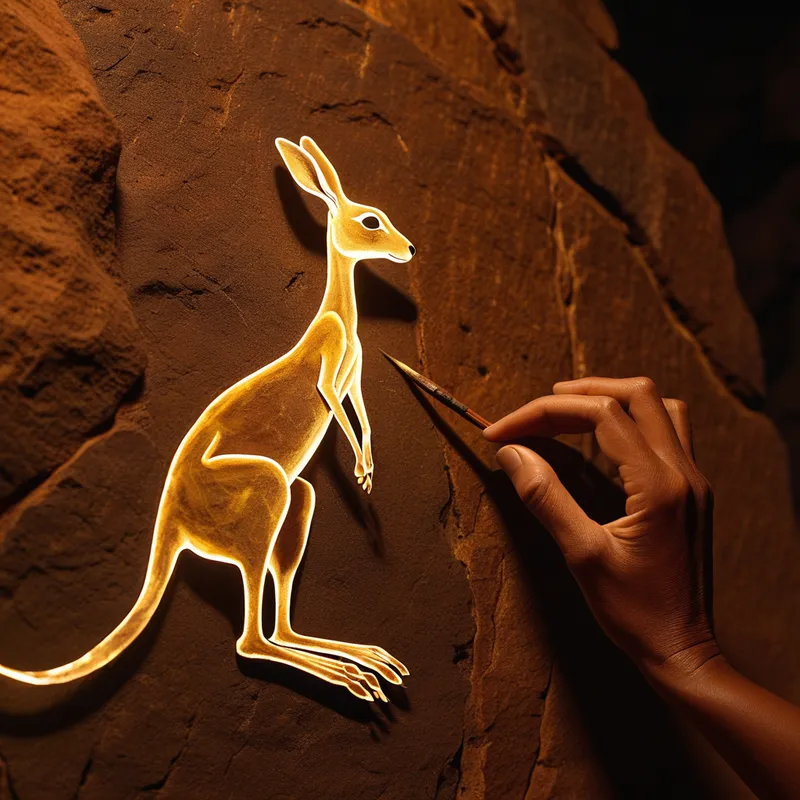
But the greatest gift was not just for the belly or the body. In the cool silence of a rock shelter, a Mimi took a piece of ochre in its delicate fingers. On the smooth stone wall, it began to draw. Not just shapes, but essences. It drew the kangaroo with its bones and heart visible, its spirit laid bare in x-ray harmony. It drew the stories of the hunt, of the ancestors, of the Dreaming tracks that crisscrossed the land. It taught the People to sing these stories, to dance them, to make them eternal. Art became the vessel of memory, the map of law, the bridge between the human and the eternal.
When the teaching was done, when the People could walk their own songlines, the Mimi retreated. They did not die or depart to a far-off heaven. They simply stepped back into the rock, into the very fabric of the escarpments from whence they came. They are there still, in the quiet places. If you listen closely to the wind whistling through a narrow canyon, that is their whisper. If you see a strangely balanced rock that seems to defy gravity, a Mimi may be holding it up, ensuring the ancient order of things. They are the fragile, eternal scribes of the world's first wisdom, forever present in the bones of the land.
Cultural Origins & Context
The myth of the Mimi spirits originates from the Aboriginal peoples of Western Arnhem Land, in what is now the Northern Territory of Australia, particularly among the Kunwinjku language groups. This is not a singular, monolithic story but a living narrative tradition embedded in the specific topography of that region—its dramatic sandstone plateaus, rock shelters, and seasonal landscapes. The Mimi are intrinsically linked to these rock formations; they are of the land in the most literal sense.
The myth was, and is, passed down through intricate oral traditions: song cycles, ceremonial dances, and most famously, through the breathtaking x-ray art that adorns the rock shelters. These paintings are not mere illustrations; they are sacred texts, maps of knowledge, and direct conduits to the Dreaming. Elders would, and still do, use these paintings as teaching tools, narrating the stories of the Mimi to impart practical skills, social laws, and ecological knowledge to younger generations. Societally, the Mimi myth functions as a foundational pedagogical narrative. It explains the origin of crucial cultural technologies (hunting, fire-making, art) and legitimizes the authority of ancestral knowledge. It establishes a model for teaching and learning that is gentle, observational, and based on a deep, respectful connection between teacher (Mimi) and student (Humanity).
Symbolic Architecture
The Mimi are profound symbolic constructs. Their extreme physical fragility—their fear of wind and storms—is their first great lesson. It symbolizes the delicate nature of wisdom itself. True knowledge is not a blunt, indestructible weapon; it is a subtle, easily lost understanding that must be protected and nurtured. It cannot survive in environments of brute force or chaotic emotion (the storm).
The most essential truths are often the most fragile; they require a sheltered heart and a calm mind to be received.
Their residence in rock crevices places them at the threshold between the visible, tangible world and the hidden, ancestral dimension of the Dreaming. They are liminal beings, personifying the interface where eternal law meets temporal need. Their act of teaching humanity represents the moment the unconscious, archetypal patterns of survival (instinct) become conscious, cultural techniques (art, tool-making). They are the psychopomps of practical consciousness.
Furthermore, their method of teaching is non-coercive and mimetic. They show, they do not tell. This symbolizes a mode of learning rooted in observation, imitation, and embodied experience—a wisdom that is felt and done before it is articulated. The x-ray art they introduce is the ultimate symbol of this: it is about seeing through the surface appearance to the underlying life force, structure, and connection of all things.

The Dreamer's Resonance
When the pattern of the Mimi emerges in modern dreams, it often signals a process of receiving ancient, instinctual wisdom from the deep psyche. Dreaming of incredibly tall, slender, or fragile figures may point to a contact with guiding inner figures (akin to Jung's "wise old man" or "wise old woman") that feel ancestral and delicate. The dreamer might be in a life stage where they are learning a new, essential "survival" skill—not for the body, but for the soul: setting boundaries (hunting), igniting passion (fire), or finding authentic self-expression (art).
The somatic feeling associated with such dreams is often one of awe mixed with a protective caution. One might feel the need to "be still" or "find shelter" to properly receive this guidance. The dream could also highlight a sense of personal fragility in the learning process—the new insight or emerging talent feels precious and easily crushed by external criticism (the "storm") or internal doubt. The dream is an invitation to create a psychic "rock shelter," a quiet, protected inner space where this delicate new growth of the self can be nurtured.
Alchemical Translation
The Mimi myth models the alchemical stage of solutio and coniunctio. The rigid, unmet needs of the early human psyche (hunger, cold, ignorance) are dissolved by the gentle, watery teaching of the Mimi, preparing the psyche for a new formation. The core transmutation is from a state of passive need to one of active, culturally-informed mastery, but a mastery that remains in respectful dialogue with its source.
For the modern individual, this translates to the process of individuation through ancestral integration. It is not about inventing oneself from nothing, but about consciously receiving and integrating the "fragile wisdom" from one's own inner ancestry—the inherited patterns, talents, and instincts that form the bedrock of the personal and collective unconscious. The Mimi represent those inner guides that teach us how to "hunt" for our true purpose, "ignite" our inner fire of motivation, and "paint" the story of our life with authenticity.
The journey to the self begins by listening for the whispers in the crevices of your own being, where fragile, ancient knowledge awaits the calm to make itself known.
The final stage, the Mimi retreating into the rock, is crucial. It signifies that once the lesson is integrated, the teacher archetype recedes into the background. The wisdom becomes our own, part of our inner landscape. We no longer project the "all-knowing sage" outward onto gurus or ideologies; we become stewards of that fragile wisdom within ourselves, capable of both holding it and, when ready, teaching it through the grace of our own lived example.
Associated Symbols
Explore related symbols from the CaleaDream lexicon:
- Spirit — The Mimi are the quintessential spirit teachers, representing non-corporeal intelligence that guides and instructs humanity from a dimension just beyond the physical.
- Cave — Symbolizes the rock shelters and crevices where Mimi dwell and teach, representing the womb of the unconscious mind where primordial wisdom is stored and accessed.
- Dream — The entire myth exists within the framework of the Dreaming, the timeless dimension of ancestral reality from which all law, art, and life emerges.
- Ancestral Spirits — The Mimi are the original ancestors, the first teachers who bequeathed the foundational knowledge of culture and survival to humanity.
- Art — The primary gift of the Mimi, symbolizing the transformation of instinct into conscious expression and the encoding of sacred law into visible form.
- Fire — Represents the captured spirit of transformation, warmth, and consciousness that the Mimi gifted, moving humanity from raw nature to cultivated culture.
- Hunter — Embodies the transformed human, no longer a passive creature of need but an active, skillful participant in the sacred exchange of life, taught by the Mimi.
- Stone — The eternal substance of the Mimi's home and the canvas for their teachings, symbolizing the enduring, foundational quality of ancestral wisdom.
- Teacher — The core function of the Mimi archetype, representing the gentle, mimetic transmission of knowledge that respects the fragility of the learning process.
- Bridge — The Mimi themselves act as a bridge between the eternal Dreaming and the temporal human world, facilitating the flow of essential knowledge.
- Root — Symbolizes the deep, ancient connection to the land and the ancestral past that the Mimi both embody and teach humanity to recognize within themselves.
- Vision — The x-ray art taught by the Mimi grants the vision to see beyond surface appearances to the inner life and structure of all things.