Midsummer Bonfires Myth Meaning & Symbolism
A myth of celestial fire, community vigilance, and the ritual purification of the land against the shadows that gather in the deceptive light of midsummer.
The Tale of Midsummer Bonfires
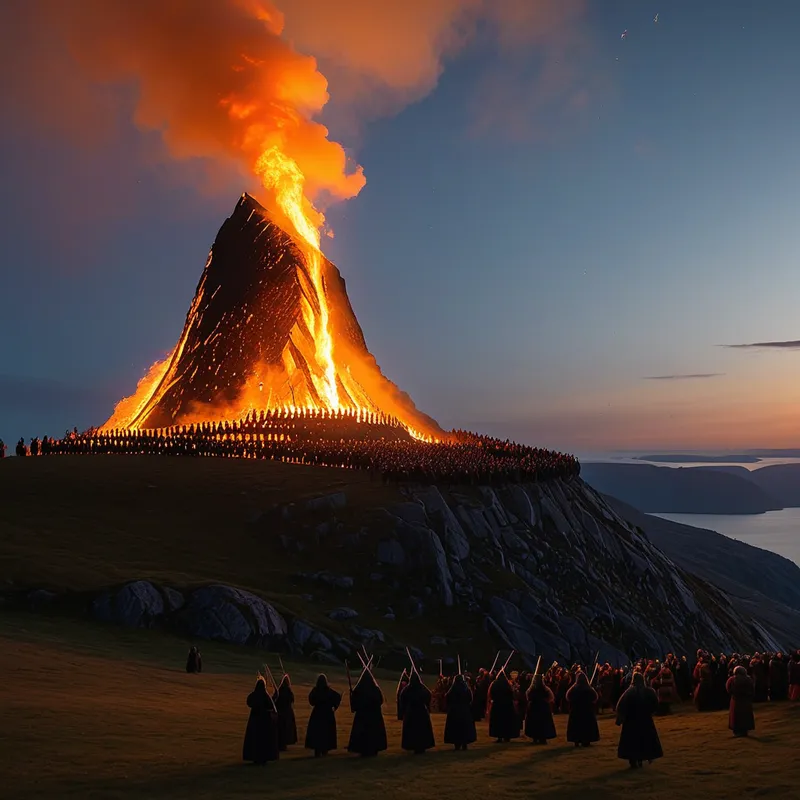
Listen, and hear the tale of the sun’s long gaze. It is the time when Sól rides her chariot highest, yet for a breath, she hesitates. The world is drenched in gold, the nights are but a pale, blue whisper, and the land groans with life. Yet in this abundance, in this deceptive eternity of light, the shadows grow bold.
For the folk of the fjords and the forests knew a secret: when the light is strongest, the darkness learns to walk within it. Unseen things, the lingering spirits of winter’s bitterness and the restless landvættir stirred by imbalance, gather in the long twilight. They are not the monsters of the deep night, but the blights, the grudges, the slow rot that thrives in plenty. The sun’s power, vast and benevolent, could not burn them away alone. It needed an echo on the earth, a answering cry from the heart of the community.
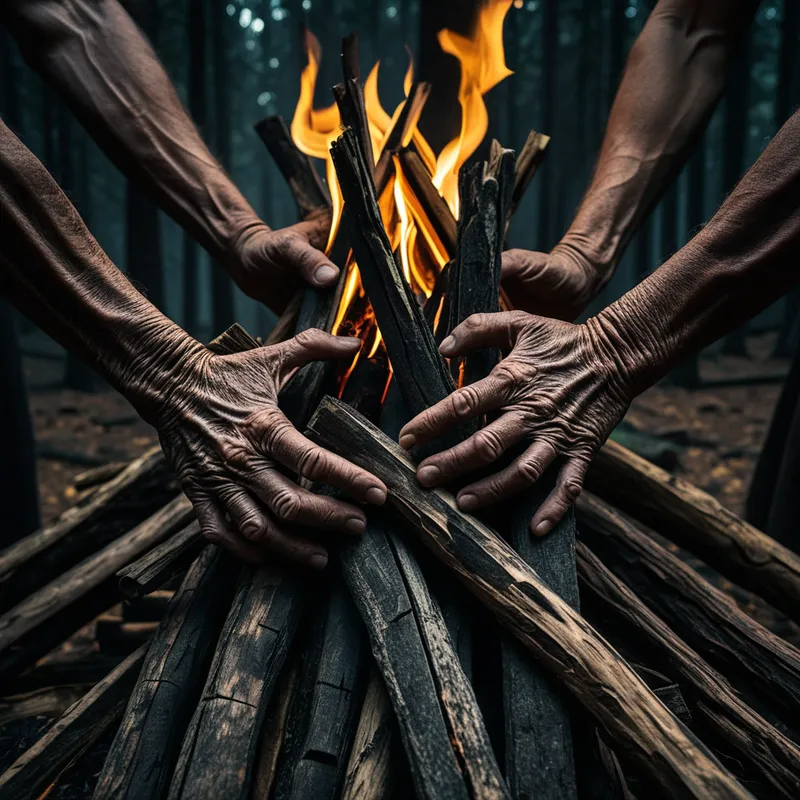
So, as the sun began its slow turn southward, the people would gather. From every stead and hall, they came to the high places, the hills that touched the sky. They brought with them the bones of the old year—the broken tools, the worn-out charms, the remnants of last season’s harvest. And most sacred of all, they brought nine kinds of wood, gathered with intention: oak for Óðinn’s steadfastness, birch for new beginnings, pine for cleansing resin.
As the sky bled from gold to violet, the village elder, face etched by seasons, would take the fire-steel. The spark was not taken from a common hearth; it was born anew, a child of iron and flint, dedicated to this single purpose. With a crack and a flash, the tinder caught. The first flame, small and hungry, was fed with the nine woods. It grew, not as a hearth-fire for warmth, but as a beacon, a defiant star planted in the soil.
The fire roared, its heat a palpable wall, its light painting the faces of the gathered in flickering ochre and crimson. Then began the circling. Not a dance of joy, but a solemn procession. Families, whole communities, would walk sunwise around the towering blaze, driving their livestock between twin fires for blessing and health. They chanted old words, names of the gods—Þórr for strength, Freyja for fruitfulness—calling upon them to witness this pact of purification.
Into the heart of the fire, they cast their burdens. The old, the broken, the ill-wishes. They watched them blacken and vanish into light and smoke. The smoke itself was a prayer, a thick, fragrant column rising to meet Sól’s last rays, carrying their intentions to the heavens. And as the true dark finally, briefly, fell, the highest act began. From the summit of the pure blaze, torches were lit. Young men and women, the swift and the brave, would run with these living embers to every distant field, every boundary stone, every home. They touched flame to waiting kindling on hilltops across the land, until the countryside was dotted with answering fires, a constellation woven on the earth, holding the line against the shadows that walk in the light. The vigil lasted until dawn, when the returning sun found a world cleansed, guarded, and renewed.
Cultural Origins & Context
The Midsummer bonfire, while a pan-European phenomenon, found a distinct expression within the Norse world. Our knowledge is pieced together from later folk traditions recorded in Scandinavia and Iceland, archaeological hints of ritual sites, and sagas that mention “sun-wending” times. Unlike the grand myths of the Æsir preserved in the Poetic Edda, this was a folk practice, a myth enacted rather than solely narrated. It belonged to the rhythm of the agricultural year and the communal psyche.
It was a story told not by skalds in mead-halls, but by farmers, fishers, and families through action. Its “bards” were the elders who remembered the proper woods, the correct direction of the circle, and the old invocations. Its function was profoundly pragmatic and spiritual: to ensure protection and fertility. The fires were a sympathetic magic, a ritual reinforcement of the sun’s power at its zenith, willing it to linger and bless the crucial growing season ahead. Societally, it was a powerful act of community cohesion. The lighting of the central fire and the running of the torches defined the social and geographical boundaries of the community, literally illuminating their shared territory and responsibility. It was a collective exhalation of anxiety—about blight, about sickness in herds, about the hidden malice of spirits—transmuted into a proactive, unifying ritual of strength.
Symbolic Architecture
At its core, the Midsummer fire is a symbol of conscious, collective purification. It represents the critical human understanding that light alone does not banish all darkness; some shadows require a fire kindled by human hands and will.
The bonfire is the psyche’s answer to the shadow that dares to grow in plain sight. It is the will to ignite a crisis of transformation rather than tolerate a slow decay.
The nine sacred woods symbolize a holistic gathering of resources—different aspects of the self and the community (strength, resilience, growth, protection) combined into a single, potent intention. The sunwise circumambulation is a ritual of ordering chaos, aligning the human community with the cosmic order of the sun’s path. The casting in of old burdens is a literal act of sacrifice—not of something valuable, but of that which impedes value: the worn-out narratives, the lingering resentments, the psychic clutter. The fire transforms dead matter into active energy (light and heat). Finally, the lighting of secondary fires from the central blaze is a symbol of dissemination, of carrying the purified, empowered consciousness from the ritual center out to the peripheries of one’s life and land.
The Dreamer's Resonance
When this mythic pattern stirs in the modern dreamer, it often signals a psychological state of deceptive prosperity masking a hidden rot. The dreamer may be in a period of apparent success (“midsummer”) yet feel an underlying unease, a sense of stagnation, or the nagging presence of old, unaddressed wounds.
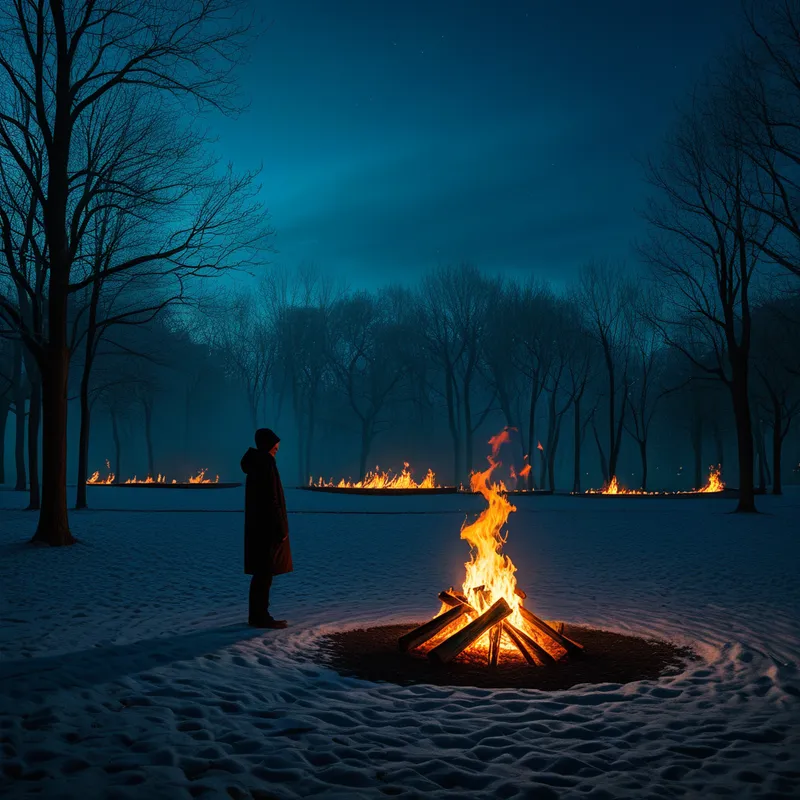
Dreams may feature fires that are compelling yet fraught—a need to build a bonfire in an unlikely place, a torch that must be carried urgently through a familiar yet threatening landscape. The somatic sensation is often one of urgent responsibility mixed with ritualistic focus. The dreamer is not a passive observer but an active participant, tasked with lighting, tending, or spreading the fire. This reflects a psyche initiating its own purification cycle. The “shadows that walk in the light” manifest as dream figures who are not monstrous, but strangely off—neighbors with blank faces, familiar rooms that feel subtly poisoned, or a beautiful landscape that induces dread. The dream is the unconscious insisting that a period of bright, conscious activity now requires a deliberate, fiery introspection to burn away what is covertly sapping vitality.
Alchemical Translation
The alchemical process mirrored here is calcinatio—reduction by fire. In the journey of individuation, there are phases where the conscious ego, like the midsummer sun, is strong and high. But this very strength can lead to inflation, blindness to one’s own shadow, or the toleration of “brilliant” but soul-killing adaptations.
The ritual fire represents the ego’s courageous decision to apply the heat of consciousness to its own hidden complexes. It is the self-directed ordeal that prevents a fate imposed from without.
The modern individual undergoes this alchemy by first gathering the nine woods—taking stock of their inner resources, strengths, and supports (the “oak” of will, the “birch” of vulnerability). Then, they must create the sacred spark through a moment of ruthless honesty or a catalytic insight (the strike of flint and steel). The circumambulation is the disciplined, patient examination of one’s life from all angles, walking the full circle of a problem or pattern. The casting in is the active, often difficult, release of outdated identities, cherished grudges, or compulsive behaviors into the transformative fire of analysis and acceptance. Finally, the lighting of the peripheral fires is the crucial step of integrating this purified awareness back into the various realms of daily life—work, relationships, creativity—ensuring the central insight doesn’t remain a isolated ritual but becomes a living, protective presence throughout one’s psychic territory. The myth teaches that true strength lies not in perpetual, untouchable light, but in the willingness to become the kindling, the flame, and the bearer of the torch for one’s own becoming.
Associated Symbols
Explore related symbols from the CaleaDream lexicon: