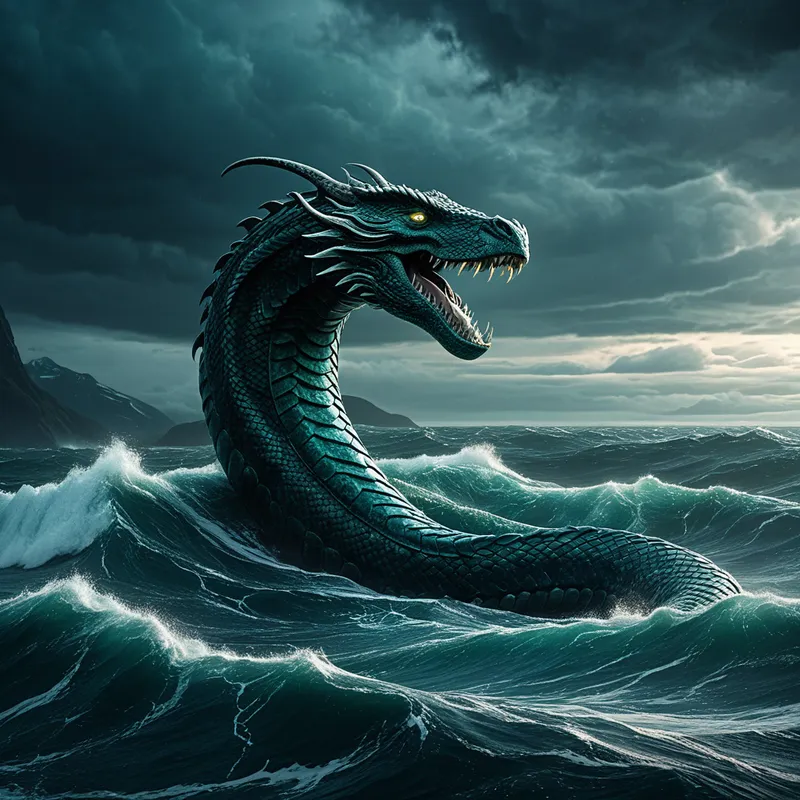
Midgard Serpent Myth Meaning & Symbolism
The immense serpent Jörmungandr encircles the world, embodying chaos, totality, and the unconscious shadow that must be faced for wholeness.
The Tale of Midgard Serpent
Hear now a tale from the dawn of [the world](/myths/the-world “Myth from Tarot culture.”/), when the breath of giants still misted the air and the bones of [the earth](/myths/the-earth “Myth from Hindu culture.”/) were still soft. In the great, echoing hall of Odin, a prophecy was whispered, cold as the roots of [Yggdrasil](/myths/yggdrasil “Myth from Global/Universal culture.”/). It spoke of three children born of [the trickster](/myths/the-trickster “Myth from Various culture.”/) Loki and the giantess Angrboða—a brood of monsters who would one day ride the winds of [Ragnarök](/myths/ragnark “Myth from Norse culture.”/).
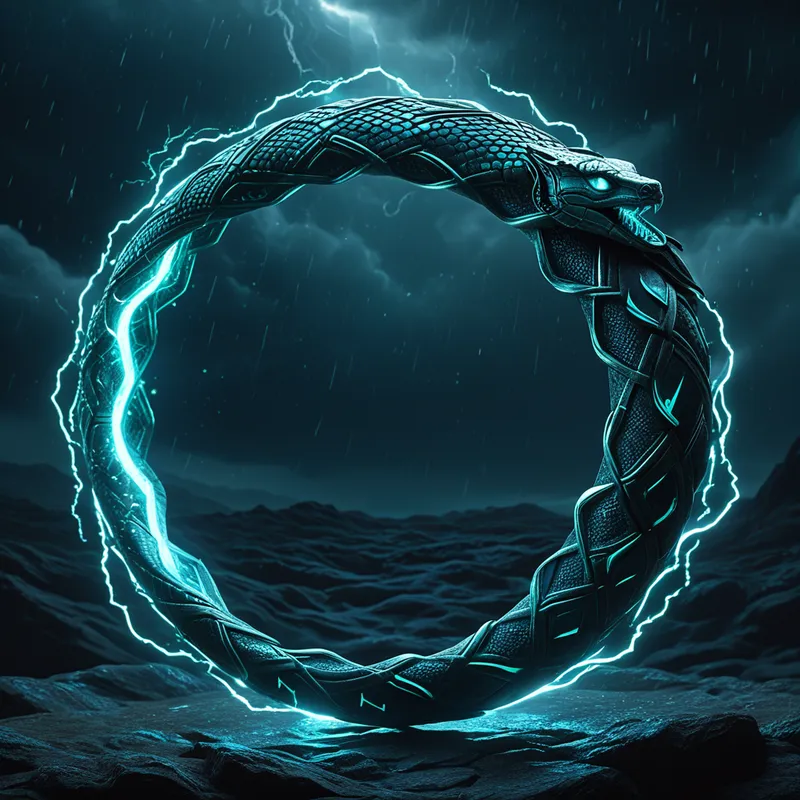
The youngest of these was a serpent. But this was no mere snake. Cast out by the fearful gods into the great ocean that girdles [Midgard](/myths/midgard “Myth from Norse culture.”/), it did not drown. It grew. It grew until its scalded length spanned all the seas, its head meeting its tail, a living, breathing ring of scale and sinew encircling the whole of the mortal world. They named it [Jörmungandr](/myths/jrmungandr “Myth from Norse culture.”/), the [Midgard](/myths/midgard “Myth from Norse culture.”/) Serpent, and in its coils, the deep ocean currents turned.
Years flowed like rivers. The serpent slept and woke in the abyssal dark, its dreams shifting the tides. But its fate was knotted with that of the thunder god, Thor, the mightiest of the Æsir. Their first meeting was not on a field of war, but in a hall of illusions. The giant king Útgarða-Loki challenged Thor to perform great feats. One task was to lift a giant’s cat. Thor, heaving with all his divine strength, could only raise one of its paws from the floor. He was shamed. Later, the giant revealed the truth: the cat was Jörmungandr itself, disguised by magic. Thor had strained against the weight of the world-encircler.
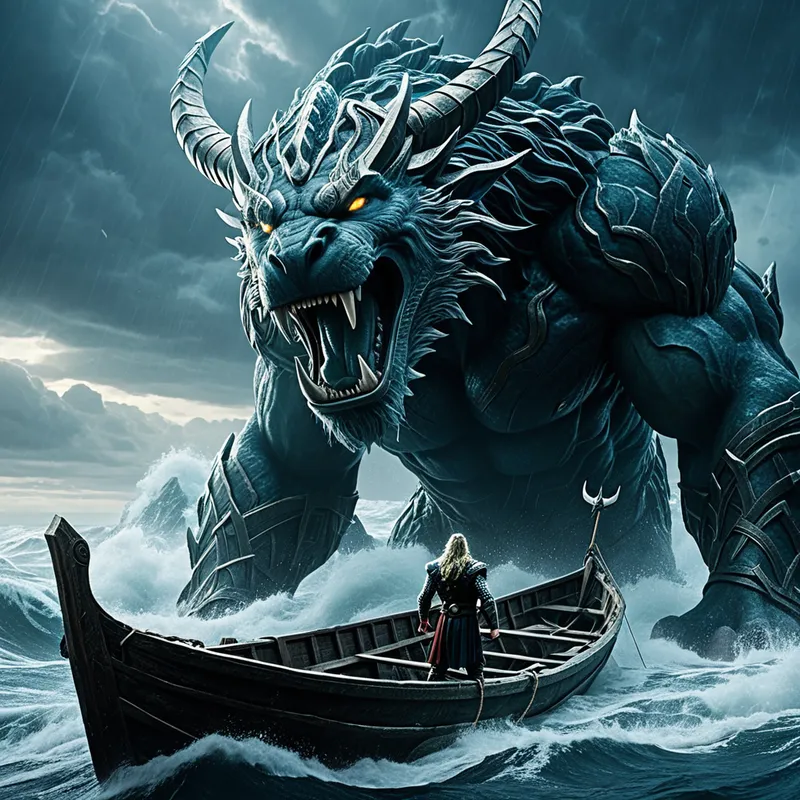
Their second meeting was in the mortal realm. Thor, disguised, went fishing with the giant Hymir. He demanded the strongest bait. Taking the head of Hymir’s largest ox, he rowed them far out into the ocean, beyond where any sane being would venture. There, in waters so deep [the sky](/myths/the-sky “Myth from Persian culture.”/) was a memory, Thor cast his line. The ox-head sank into the black. Something took it. A pull that threatened to split the boat in two. Thor, the fisherman-god, planted his feet and hauled, his muscles singing with the strain. [The sea](/myths/the-sea “Myth from Greek culture.”/) boiled. A mountain of wet scale and ancient cold broke the surface: an eye, vast as a shield, stared with primordial intelligence. It was the head of Jörmungandr.
Thor reached for his hammer, [Mjölnir](/myths/mjlnir “Myth from Norse culture.”/), his heart a drum of fury and [triumph](/myths/triumph “Myth from Roman culture.”/). But Hymir, terrified by the [leviathan](/myths/leviathan “Myth from Biblical culture.”/) he saw—a beast whose body vanished into the deep in both directions—cut the line. The serpent sank with a sound that shook the foundations of the sea. Thor roared his frustration to the skies, but the serpent was gone, leaving only a whirlpool of destiny.
Their final meeting is yet to come, written in [the runes](/myths/the-runes “Myth from Norse culture.”/) of fate. When the stars fall and Ragnarök begins, Jörmungandr will writhe in its agony, poisoning sea and sky. It will haul its endless body onto the land. And there, on the final battlefield, Thor and the [World Serpent](/myths/world-serpent “Myth from Global culture.”/) will meet for the last time. The god will slay the beast, but will stagger only nine steps before falling, dead from the serpent’s venom. It is a duel written in the bedrock of time, a circle closing with [the force](/myths/the-force “Myth from Science Fiction culture.”/) of an avalanche.
Cultural Origins & Context
This myth was not penned in a book, but breathed into the smoky air of longhouses during the endless winter nights of Scandinavia. It was part of the vast, interconnected tapestry of stories preserved in the Poetic Edda and later systematized in the Prose Edda. For the Norse, the world was a precarious enclosure—Midgard—surrounded by untamable, chaotic forces: the icy wastes of Jötunheim, the fiery realm of [Muspelheim](/myths/muspelheim “Myth from Norse culture.”/), and the encompassing sea.
Jörmungandr was the ultimate embodiment of that surrounding, encroaching chaos. The myth served as a cosmological map and a moral compass. It explained the very nature of their world: the dangerous sea that both sustained and threatened them was literally the body of a monster. The story of Thor’s fishing trip was a thrilling saga of confronting the ultimate limit, a testament to divine (and by extension, human) courage in the face of the incomprehensibly vast. It functioned as a cultural narrative that acknowledged the terror of the unknown while championing the ethos of facing it head-on, even if ultimate victory is intertwined with one’s own doom.
Symbolic Architecture
The Midgard [Serpent](/symbols/serpent “Symbol: A powerful symbol of transformation, wisdom, and primal energy, often representing hidden knowledge, healing, or temptation.”/) is not merely a [monster](/symbols/monster “Symbol: Monsters in dreams often symbolize fears, anxieties, or challenges that feel overwhelming.”/); it is a supreme [symbol](/symbols/symbol “Symbol: A symbol can represent an idea, concept, or belief, serving as a powerful tool for communication and understanding.”/) of totality, the unconscious, and the [shadow](/symbols/shadow “Symbol: The ‘shadow’ embodies the unconscious, repressed aspects of the self and often represents fears or hidden emotions.”/).
The serpent that bites its own tail is the perfect circle, the boundary that contains all known experience. To exist within it is to be human; to confront it is to touch the divine.
Jörmungandr represents the Great [Boundary](/symbols/boundary “Symbol: A conceptual or physical limit defining separation, protection, or identity between entities, spaces, or states of being.”/). It is the [horizon](/symbols/horizon “Symbol: The horizon can symbolize the boundary between the known and the unknown, representing future possibilities and the journey ahead.”/) of the known world, the psychological limit of [the ego](/myths/the-ego “Myth from Jungian culture.”/). Everything within its coil is Midgard—[consciousness](/symbols/consciousness “Symbol: Consciousness represents the state of awareness and perception, encompassing thoughts, feelings, and experiences.”/), order, culture. Everything outside is the unformed [chaos](/symbols/chaos “Symbol: In Arts & Music, chaos represents raw creative potential, uncontrolled expression, and the breakdown of order to forge new artistic forms.”/) of the unconscious and the [alien](/symbols/alien “Symbol: Represents the unknown, otherness, and the exploration of new ideas or experiences.”/) “other.” The serpent is that [boundary](/symbols/boundary “Symbol: A conceptual or physical limit defining separation, protection, or identity between entities, spaces, or states of being.”/), made flesh. It is not outside the [system](/symbols/system “Symbol: A system represents structure, organization, and interrelated components functioning together, often reflecting personal or social order.”/); it defines the system.
Thor’s struggle with it is the eternal [drama](/symbols/drama “Symbol: Drama signifies narratives, emotional expression, and the exploration of human experiences.”/) of the ego (the heroic, thunderous “I”) confronting the totality of [the Self](/myths/the-self “Myth from Jungian culture.”/) (the vast, impersonal [psyche](/myths/psyche “Myth from Greek culture.”/) that contains the ego). The [fishing trip](/symbols/fishing-trip “Symbol: A fishing trip illustrates themes of patience, solitude, and the pursuit of simplicity, often evoking feelings of tranquility and introspection.”/) is a profound [metaphor](/symbols/metaphor “Symbol: A figure of speech where one thing represents another, often revealing hidden connections and deeper truths through symbolic comparison.”/) for the deliberate, perilous act of “fishing” in the deep unconscious, baiting the hook with a sacrifice (the ox-head) to lure the great content to the surface for confrontation. That Hymir cuts the line is symbolic of the ego’s perennial failure to fully integrate [the shadow](/myths/the-shadow “Myth from Jungian culture.”/); we get a terrifying [glimpse](/symbols/glimpse “Symbol: A fleeting, partial view or moment of insight that suggests more lies beyond immediate perception, often hinting at hidden truths or future possibilities.”/) of its [magnitude](/symbols/magnitude “Symbol: A measure of scale, intensity, or importance, often reflecting one’s perception of significance, impact, or overwhelming force in life.”/), then let it sink back, unresolved.
The Dreamer’s Resonance
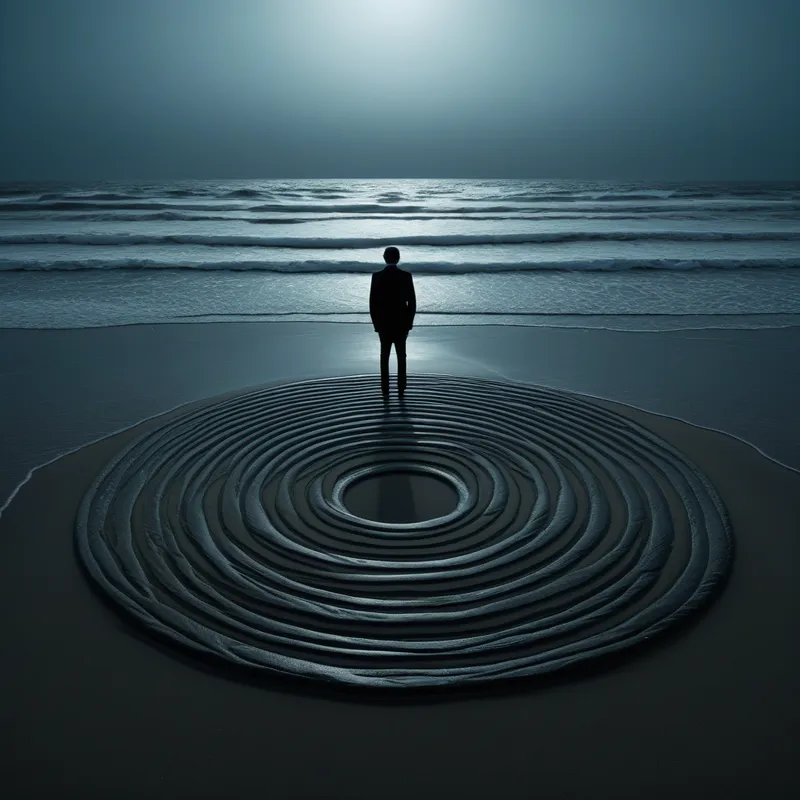
When the Midgard Serpent surfaces in modern dreams, it rarely appears as a literal Norse monster. Its presence is more atmospheric, more somatic. One might dream of being on a shore where the ocean forms a perfect, inescapable circle around [the horizon](/myths/the-horizon “Myth from Various culture.”/). Or of a vast, underground pipeline or subway tunnel that forms a perfect loop beneath a city. The dreamer may feel a sense of immense, encircling pressure, or dream of a beloved pet growing to an uncontrollable, monstrous size.
These dreams signal that a psychological “container”—a relationship, a career, a self-image—has become constricting. The serpent represents a totality that has turned from a holding structure into a strangling one. The dreamer is experiencing the limits of their current conscious worldview. The somatic feeling of pressure is the psyche’s signal that a content of the unconscious (a repressed emotion, a neglected talent, a deep fear) has grown too large to be contained by old patterns. It is demanding recognition, threatening to break the very circle that defines the dreamer’s known world. This is not a nightmare of attack, but a crisis of containment.
Alchemical Translation
The alchemical journey mirrored in this myth is the opus contra naturam—the work against nature, which here means against the comfortable, unconscious flow of staying within the known circle. The process is one of radical confrontation with the shadow to achieve a more expansive wholeness.
First is the Provocation. The gods casting the serpent into the sea is the initial act of repression, creating the shadow. For an individual, this is the childhood or cultural conditioning that pushes certain traits into the unconscious deep.
Second is the Baiting of the Hook. Thor’s deliberate journey with the ox-head represents the conscious decision, often in mid-life, to engage in deep self-work. The “ox-head” is a sacrifice—a cherished certainty, a comfortable identity offered up as bait to lure the truth.
The hero does not slay the serpent to destroy the world, but to break the circle and redefine it. The poison that kills him is the price of transformation; the old self dies from the encounter with the truth.
Third is the Confrontation and the Cut Line. Hauling the serpent up is the terrifying, exhilarating moment of insight—seeing the full scope of one’s shadow, one’s complexes, one’s destiny. The “cut line” is the inevitable recoil, the failure of full integration. We see it, we name it, but fully bringing it into the boat of the ego is a task that often requires multiple attempts, culminating in a final crisis.
The final Ragnarök is the alchemical [nigredo](/myths/nigredo “Myth from Alchemical culture.”/), the blackening, the utter dissolution of the old personality structure. The ego (Thor) must “die” from the venom of the integrated shadow. This is not a literal death, but the death of a naive, hero-centric consciousness. The new consciousness that can emerge understands that the serpent was not an enemy to be destroyed, but the very structure of reality to be acknowledged. The circle is broken, and in that breaking, the individual is no longer merely within the world, but in a conscious, responsible, and terrifying relationship with the world that encircles them. They achieve a wholeness that includes the monster in the deep.
Associated Symbols
Explore related symbols from the CaleaDream lexicon: