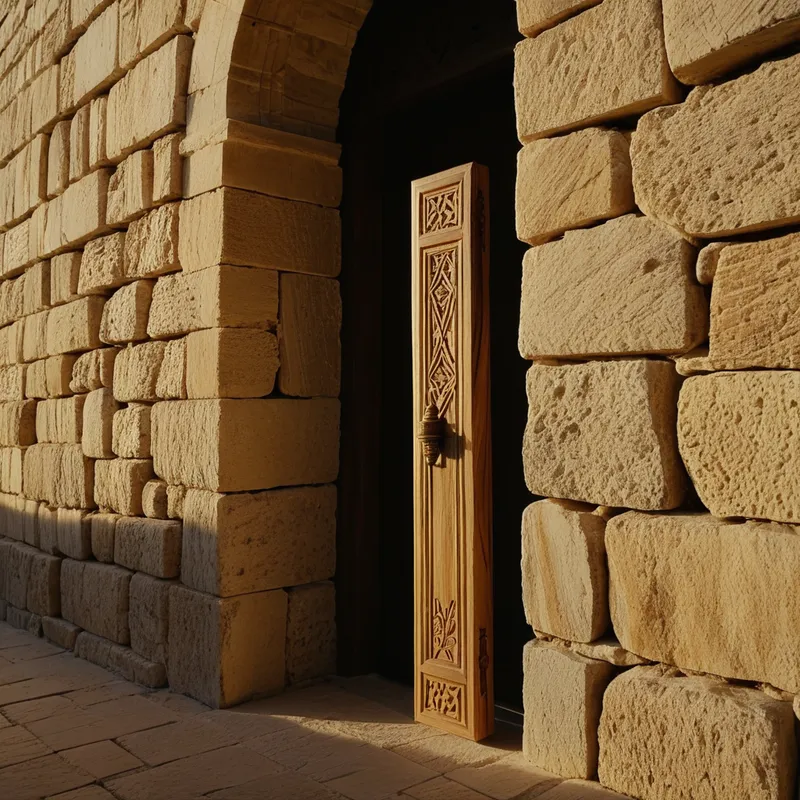
Mezuzah Myth Meaning & Symbolism
A sacred covenant inscribed on a doorpost, transforming a threshold into a sanctuary of memory and divine presence.
The Tale of Mezuzah
Listen. Before a story is told, it is remembered. Before it is remembered, it is lived. And before it is lived, it is commanded.
In the furnace of the desert, under a sky scraped raw by the sun, a people walked. Their backs were bent not just by the weight of their journey, but by the weight of a memory—a memory of bricks without straw, of a river running red, of a sea torn asunder. They were a people born from the rupture between slavery and freedom, and the space between terrified them. It was a vast, howling emptiness. A doorway with no house.
Then came the Voice, not in the thunder that split the mountain, but in the silence that followed. It spoke to the prophet, the lawgiver, the one who stood between the people and the consuming fire. "Hear," the Voice said, and the word itself became a foundation. "Shema Yisrael." This hearing was not with the ear alone, but with the blood, with the bone, with the breath.
And the command unfolded: "You shall love the Lord your God with all your heart, with all your soul, and with all your might. And these words which I command you today shall be upon your heart... You shall write them on the doorposts of your house and on your gates."
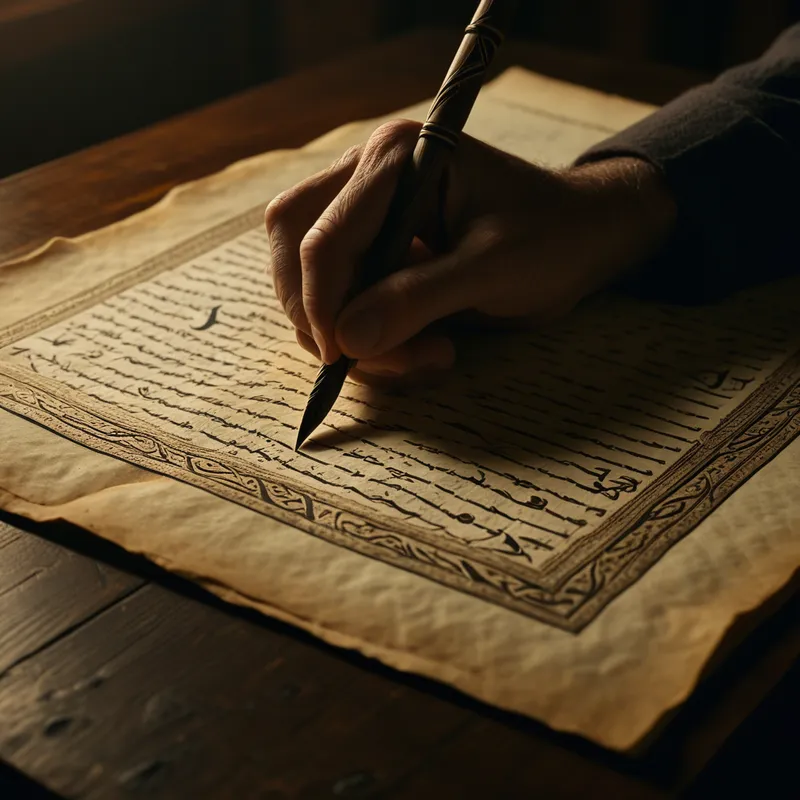
But how does a nomadic soul, shaped by wilderness, build a house that is not just a shelter from the wind, but a sanctuary from forgetting? The answer was not in grand temples—not yet. It was in the liminal space, the point of crossing. The craftsmen took the finest parchment, the skin of a clean animal, prepared with salt and flour and the tannin of gallnuts. The scribe, a man of focused soul, took his quill. Not with haste, but with a trembling reverence that was itself a form of prayer, he began to inscribe. Twenty-two lines of black fire on white ground. The story of the Exodus. The pledge of the covenant. The very name of the Holy One, Shaddai, was written on the back, visible through a small window in the container.
Then, the act of consecration. The scroll, kissed, was placed in a simple case of wood or clay or metal. Not hidden away, but mounted. On the doorpost of every tent, and later, of every house. Not on any post, but on the right-hand side, as one enters. It was placed at a slant, a compromise between ancient schools of thought, a physical symbol of a truth held in tension. A touch. A kiss of the fingers to the lips, then to the casing. A whisper: "May God protect my going out and my coming in, from now and forevermore."
The house was no longer just wood and stone. It was now a vessel for the Word. The threshold was no longer a mere boundary. It had become an altar.
Cultural Origins & Context
The mythos of the Mezuzah is inextricably woven into the fabric of biblical commandment (mitzvah) and rabbinic interpretation. Its primary source is the twice-repeated commandment in the Torah (Deuteronomy 6:9 & 11:20), directly following the recitation of the Shema. This placement is critical—it links the abstract, theological declaration of God’s oneness to a concrete, physical action in domestic space.
Historically, it transformed the Israelite home—and later, the Jewish home throughout the Diaspora—into a mikdash me'at, a "small sanctuary" (Ezekiel 11:16). In a world where holy temples could be destroyed (as the Jerusalem Temples were), the home became the primary locus of holiness. The mezuzah was its marker. It was passed down not merely as a ritual object, but as a story enacted daily. Fathers taught sons, mothers taught daughters, the act of touching it upon entry and exit. The scribes (sofer stam) became custodians of this story, their meticulous writing a sacred technology of memory. Societally, it functioned as both a public declaration of Jewish identity and a private, intimate reminder of the covenant, unifying law (halakha) and heart (kavanah).
Symbolic Architecture
The mezuzah is a masterpiece of symbolic condensation. It is a myth made miniature, a cosmos inscribed on a parchment scroll.
At its core, it represents the sanctification of the threshold. The doorway is the archetypal space of transition, danger, and possibility. By placing the sacred text there, the mundane act of crossing a boundary is elevated into a conscious passage between states of being—between the profane world of commerce and strife ("going out") and the sacred space of family and inner life ("coming in").
The true doorpost is not made of wood, but of attention. The mezuzah is the nail upon which we hang our intention to remember who we are, and in whose story we dwell.
The parchment inside is the hidden, interior truth—the soul of the home. The case is the body, the face presented to the world. The slant represents the tension between heavenly ideal and earthly application. The name Shaddai itself is interpreted as an acronym for Shomer Daltot Yisrael—"Guardian of the Doors of Israel." Thus, the object is not a magical talisman, but a focal point for a psychological and spiritual orientation: awareness. It turns the inhabitant into a guardian of their own consciousness at its most vulnerable point—the point of entry and exit.
The Dreamer's Resonance
When the symbol of the mezuzah appears in modern dreams, it rarely appears as a simple religious artifact. It manifests as the architecture of the liminal self. The dreamer may find themselves before a strange door in an otherwise familiar house, compelled to touch a specific spot on the frame. They may discover a hidden scroll within a wall, its letters glowing or shifting. The somatic feeling is often one of threshold anxiety mixed with a deep, magnetic pull toward remembrance.
Psychologically, this dream pattern signals a process of demarcating psychic territory. The dreamer is negotiating a transition: between life stages, relationships, identities, or internal states (e.g., depression to engagement). The mezuzah in the dream asks: What sacred text have you inscribed on the doorpost of your current life? What core truth (your Shema) must you remember each time you cross from one state of being to another? Its absence in a dream-house can point to a feeling of being spiritually un-homed, lacking a foundational principle. Its presence, especially if it feels potent or alive, indicates the conscious establishment of a boundary defined by sacred purpose, not just fear.
Alchemical Translation
The alchemical process modeled by the mezuzah myth is that of psychic inscription and embodiment. Individuation is not a vague feeling of wholeness; it is the difficult, meticulous work of writing your own "scroll"—your core, non-negotiable values and truths—and then housing it at the very point where you interact with the world.
The prima materia is the chaotic flux of experience and identity. The command ("write these words") is the call from the Self to consciously choose and articulate a guiding principle. The scribe's work is the discipline of introspection and integrity, letter by letter. The act of affixing the scroll to the doorpost is the critical stage of application—taking this inner truth and installing it at the threshold of consciousness, where it can govern the traffic between the inner and outer worlds.
The alchemical gold is not perfection, but a home that is a true sanctuary—a psyche whose boundaries are defined not by walls of defense, but by a consciously chosen and regularly remembered covenant with the deepest Self.
The daily touch is the ritual of return, the antidote to psychic dispersal. In our modern "going out"—into the digital agora, the marketplace of opinions, the performance of social masks—we risk forgetting our foundational "text." The mezuzah’s process teaches that wholeness (individuation) requires a deliberate, physicalized practice of re-membering at the point of transition. We are asked to be our own scribe, our own priest, and our own guardian, turning every crossing into a conscious choice to carry our sanctuary within us, and mark its presence upon the world.
Associated Symbols
Explore related symbols from the CaleaDream lexicon: