Metztli the Moon Myth Meaning & Symbolism
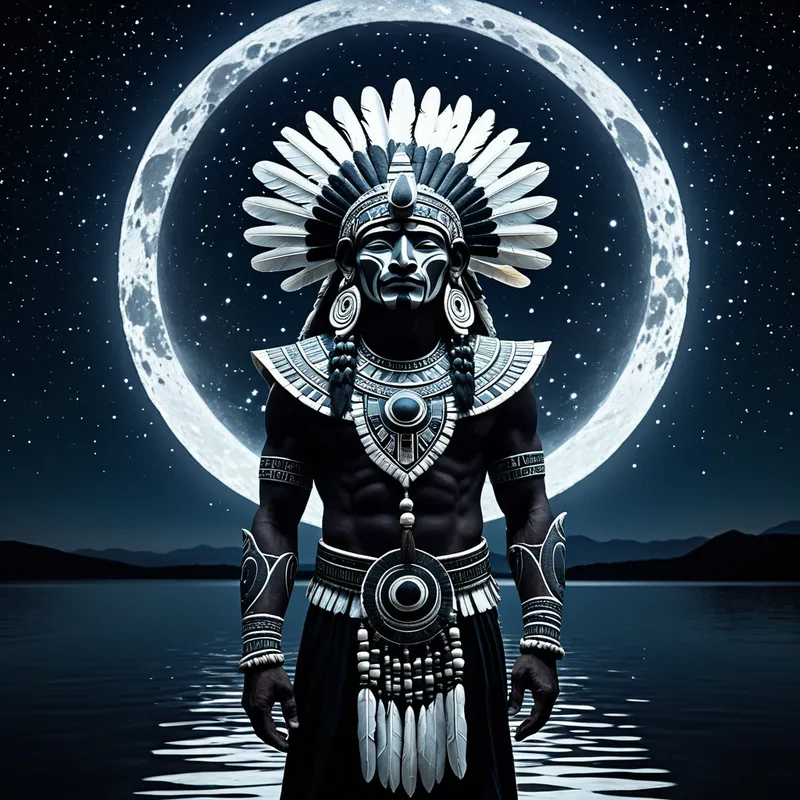
The story of the moon god Metztli, who was dismembered and cast into the sky, illuminating the night and governing the cycles of water and time.
The Tale of Metztli the Moon
In the time before time, when the world was dark and formless, the gods gathered at Teotihuacan. They had sacrificed themselves to bring forth the Fifth Sun, the era of motion, but the night remained a vast, empty cloak. A profound silence ruled the hours between sunset and dawn, a silence so deep it threatened to swallow the new world whole.
Among the divine assembly was Metztli. Some say Metztli was as radiant as a pearl, a gentle light that soothed the chaos of creation. Others whisper that Metztli was proud, their luminosity rivaling that of the newborn Sun itself. The gods knew the sky needed a counterbalance, a softer light to rule the domain of dreams, tides, and the hidden things that grow in the dark. But who would bear this burden?
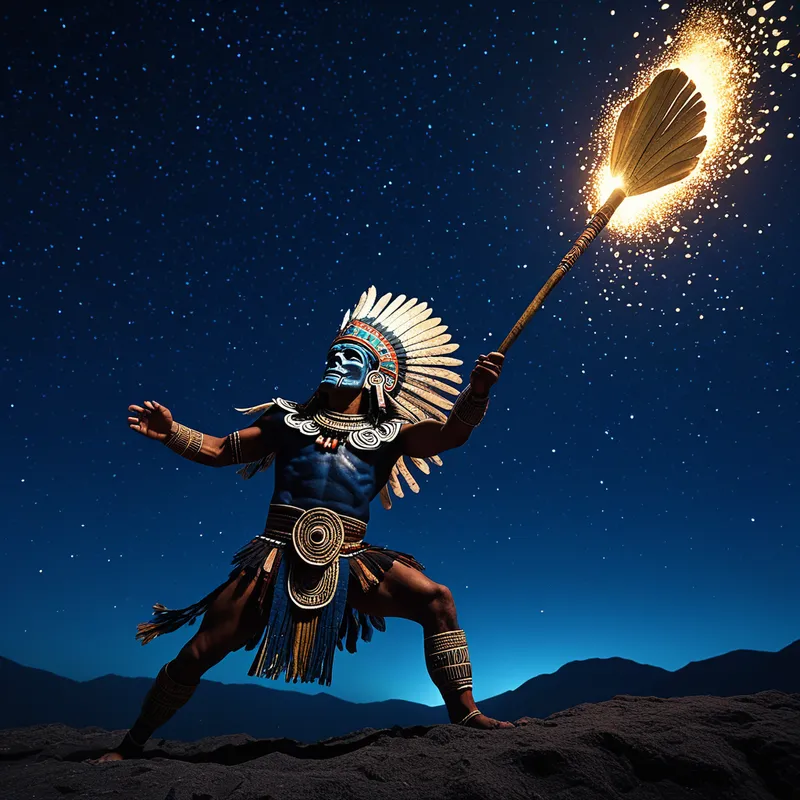
The story is told of a great conflict, a celestial struggle for the honor and the curse of illuminating the night. In one telling, it was the proud god Tezcatlipoca who took on the task. He seized Metztli, and in a moment of terrible, necessary violence, he struck the luminous one down. With a mighty blow, he shattered Metztli’s body. Not to destroy, but to transform.
The pieces did not fall to earth. Tezcatlipoca cast them upward, hurling the fragments into the highest vault of the sky. There, they caught on the fabric of the night. The largest piece, a great, round disc, glowed with a cool, borrowed light—the reflected gaze of the Sun. The other pieces scattered, becoming the stars, but the central disc remained: the Moon.
Yet Metztli was not whole. The moon in the sky was a wounded god, a body dismembered. And so, each month, it would wax, growing full and bright, only to wane and nearly vanish, repeating the cycle of its own shattering. The dark spots on its face? Those are the wounds, the eternal scars of its sacrifice. Metztli did not choose this fate, but in receiving it, became the sovereign of all that the Sun could not rule: the pull of the Ocean, the flow of women’s cycles, the fertile dampness of the night Rain, and the long, silent vigil until dawn.
Cultural Origins & Context
The myth of Metztli comes to us from the Mexica and other Nahua peoples, a cosmology recorded in the post-Conquest era in texts like the Historia de los Mexicanos por sus pinturas and the Florentine Codex. It is crucial to understand that "Aztec" refers to a broad cultural complex, and lunar deities had multiple names and aspects, including Coyolxauhqui (the bells-her-face goddess) and Meztli. The story was not a singular, fixed tale but a living narrative woven into the fabric of a world-view obsessed with cycles, sacrifice, and cosmic balance.
This myth was likely told by tlamatinime (wise ones, philosophers) and priests, not as simple bedtime stories, but as foundational explanations of reality. Its societal function was profound: it explained the lunar cycle, tied human fertility and agricultural rhythms to the cosmos, and reinforced the central tenet that order (teotl) was maintained through sacred violence and transformation. The moon’s monthly "death" and rebirth mirrored the necessity of Sacrifice in their world, making the terrifying beauty of the night sky a constant reminder of this divine contract.
Symbolic Architecture
At its core, the myth of Metztli is an archetypal drama of fragmentation and partial restoration. The moon is not a victor but a victim who becomes a vessel. Its light is not its own, but reflected—a symbol of derived identity and the profound truth that we often become what we are through the actions of others, even violent ones.
The wound becomes the womb of function. The shattered self, cast into the void, becomes the map by which others navigate their darkness.
Psychologically, Metztli represents the part of the psyche that must be broken to serve a greater whole—the innocence that must be lost for consciousness to expand. The Mirror of the moon reflects the sun’s light, just as our conscious ego is illuminated by a deeper, often unconscious, Self. The monthly waning signifies the necessary descent into the unconscious, a periodic dissolution that is not an end, but part of a cyclical process of renewal. The Serpent that sheds its skin is echoed here in the moon’s phases.

The Dreamer's Resonance
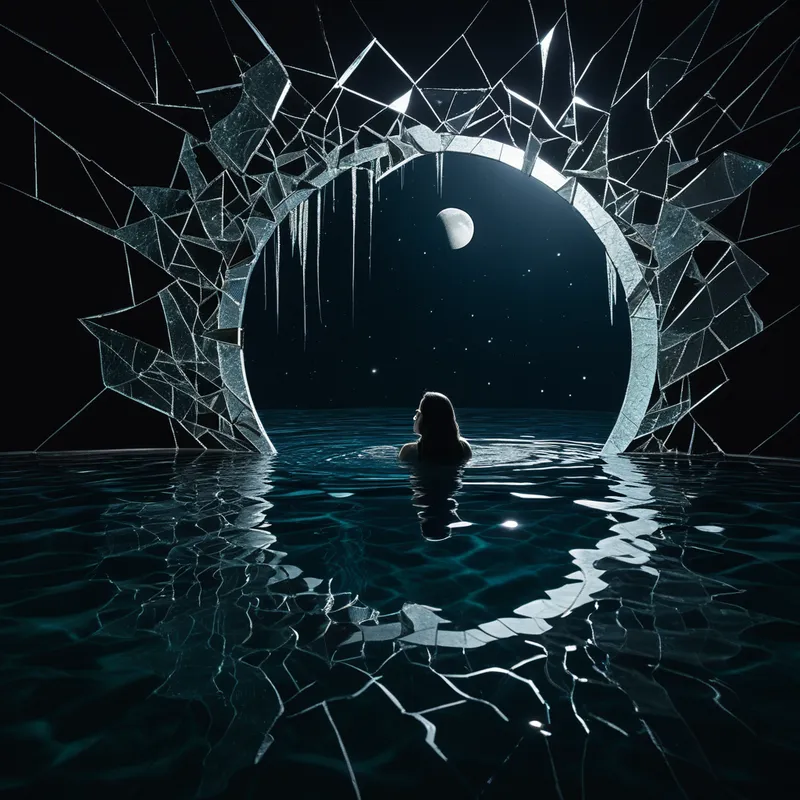
When this myth pattern stirs in the modern Dream, it often manifests as dreams of being shattered, pulled apart, or cast adrift. One might dream of a mirror breaking, of bones scattering, or of being thrown into a night sky. This is not merely anxiety; it is the somatic psyche processing a necessary disintegration.
The dreamer is likely undergoing a phase where an old identity, a once-bright but perhaps naive or inflated sense of self, is being dismantled by a powerful, often unconscious force (the Tezcatlipoca within). The feeling is of being a passive participant in one’s own transformation. The psychological process is one of accommodation—the painful restructuring of the psyche to make room for a new function, a new role that serves a broader ecology of the self, much as the moon serves the cosmic balance. The Cave of the night sky becomes the container for this reassembly.
Alchemical Translation
The alchemical journey mirrored in Metztli’s story is solve et coagula—dissolve and coagulate. The first, violent step is solve: the proud, integrated entity (the potential moon) is dissolved, shattered into pieces. This is the crushing of the ego’s sovereignty, a descent into the Shadow. For the modern individual, this translates to those life events that break us apart: loss, failure, betrayal, or a profound crisis of meaning.
The individuation path demands we offer our wholeness to be broken, so that a different, more conscious wholeness can be assembled from the fragments.
Then comes a paradoxical coagula. The pieces are not gathered back into the original form. They are reconstituted in a new matrix—the sky itself. The individual "fragments" (talents, insights, broken dreams) are integrated not to restore the old self, but to form a new entity that serves a transpersonal function. One becomes a reflective surface for a greater light (the Self), governing the inner tides and cycles. The Circle of the full moon is this hard-won, temporary cohesion. The key is accepting the Destiny of being a reflective body, not the primary source of light, finding sovereignty in one’s appointed place in the greater cosmic order.
Associated Symbols
Explore related symbols from the CaleaDream lexicon:
- Moon — The central symbol of reflected light, cyclical death and rebirth, and the governance of hidden, intuitive, and fluid aspects of reality, directly embodying Metztli’s transformed state.
- Sacrifice — The core action of the myth; the violent giving of oneself for a cosmic purpose, which transforms the victim into an eternal, functional part of the world order.
- Mirror — Represents Metztli’s nature as a reflective body, showing us that our conscious identity is often an reflection of a deeper, unseen source, much like Tezcatlipoca’s smoking mirror.
- Water — Governed by the moon, this symbol connects to tides, emotion, fertility, and the unconscious flow that Metztli rules from the night sky.
- Shadow — Tezcatlipoca is the lord of the shadow, the dark force that executes the necessary, violent transformation, representing the unconscious archetype that dismantles the ego.
- Cycle — The endless, repeating pattern of waxing and waning that defines Metztli’s existence, symbolizing the inescapable rhythms of loss and renewal in life and psyche.
- Fate — The destiny that befalls Metztli, a path not chosen but accepted, which ultimately defines their essential role and sacred function in the cosmos.
- Night — The domain Metztli illuminates, representing the unconscious, the unknown, dreamtime, and all that is hidden from the clear light of solar consciousness.
- Light — Not a primary source, but a reflected gift, symbolizing the derived nature of wisdom and consciousness that comes from engaging with a greater source.
- Rebirth — The monthly return of the moon from darkness, symbolizing the promise that follows dissolution, the new form that emerges from sacrifice.
- Wound — The dark marks on the moon’s face, the eternal scars of transformation that become the source of its identity and its power to evoke feeling.
- Ocean — The vast, mysterious body whose tides are pulled by the moon, representing the deep unconscious psyche that responds to the cyclical pulls of archetypal forces.