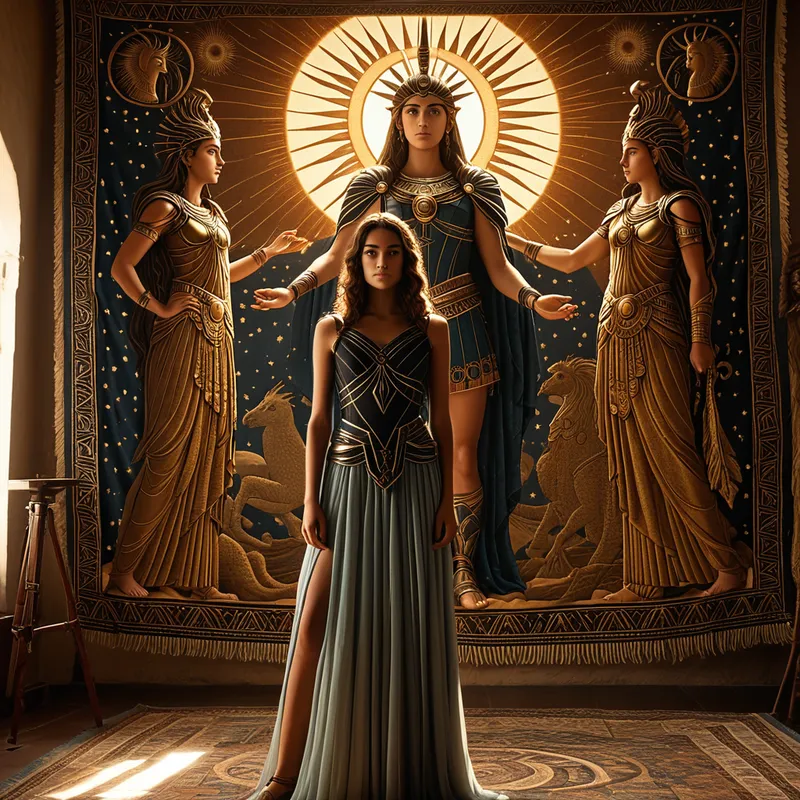
Metamorphosis of Arachne Myth Meaning & Symbolism
A mortal weaver's hubristic challenge to the goddess Athena results in a divine curse, transforming her into the world's first spider.
The Tale of Metamorphosis of Arachne
Listen, and hear the tale spun from threads of pride and divine wrath, a story woven into the very fabric of fate.
In the land of Lydia, where the rivers ran clear and the dyes were the richest in [the world](/myths/the-world “Myth from Tarot culture.”/), there lived a maiden named Arachne. She was not of noble birth, her father a simple dyer of wool, but her hands were touched by [the Muses](/myths/the-muses “Myth from Greek culture.”/) themselves. When she sat at her loom, [the world](/myths/the-world “Myth from Tarot culture.”/) held its breath. The shuttle flew like a hummingbird, and from her fingers flowed not mere cloth, but life. She could weave the dewdrops on a [spider](/myths/spider “Myth from Native American culture.”/)’s web at dawn, the sorrow in a nymph’s eyes, the very breath of the west wind. People came from distant cities to behold her tapestries, and they would whisper, “Surely Athena herself has taught her.” This was the poison seed. Arachne’s pride, as fine and strong as her threads, grew tangled. “I learned from no one,” she would declare, her chin held high. “Not even the goddess could surpass me. Let her come and contest with me if she dares.”
The challenge, flung into the air, was heard on Olympus. Athena, patron of the loom and the cunning mind, was not one to let such hubris pass. Disguising herself as a bent, grey-haired crone, she descended to Arachne’s humble workshop. “Child,” she rasped, “heed an old woman’s counsel. Seek glory among mortals, but always yield place to the gods. Beg the daughter of Zeus for pardon for your rash words.” Arachne, her eyes flashing, barely glanced from her work. “Save your breath, grandmother. Let Athena come. My skill is my own, and the truth of it will be plain in the weave.”
Then the disguise fell away. Light filled the room, and there stood the goddess in her terrible majesty, grey eyes like storm clouds. “She has come,” Athena said, and her voice was the sound of a thousand shuttles. No more words were needed. Two looms were set up, side by side. The contest began.
Athena’s tapestry was a warning and a glory. She wove the very council of the gods in their majesty upon Olympus. At the four corners, she placed vivid scenes of mortals who had dared defy the celestials and been transformed into stones, birds, and mountains—eternal monuments to divine power. In the center shone her own [triumph](/myths/triumph “Myth from Roman culture.”/) over [Poseidon](/myths/poseidon “Myth from Greek culture.”/), gifting the olive tree to humanity. It was perfect, awe-inspiring, a testament to order and reverence.
But Arachne’s work… Arachne’s work was a masterpiece of audacity. She chose for her theme the loves of the gods—not their noble aspects, but their deceits and indiscretions. She depicted Zeus in his many animal guises, seducing maidens; Poseidon courting Amphitrite with duplicity; Dionysus inspiring frenzy. Each scene was wrought with such exquisite, lifelike detail that the figures seemed to breathe, to blush, to sin upon the cloth. The work was flawless, technically peerless, and its subject was a breathtaking insult.
The weaving ceased. Athena examined her rival’s tapestry. In its perfection, she could find no fault of craft, only the ultimate fault of subject—the hubris of a mortal laying bare the follies of heaven. A fury, cold and deep, took the goddess. She tore the glorious, blasphemous fabric from its frame and, with her shuttle of boxwood, struck Arachne three times upon the brow.
The mortal’s spirit, already strained to its limit by her supreme effort, broke under the divine blow. In a fit of shame and despair, Arachne fashioned a noose and sought to hang herself from a rafter. Watching her swing, a pang of pity—or perhaps a darker [justice](/myths/justice “Myth from Tarot culture.”/)—stirred in Athena. “Live on, defiant one,” the goddess pronounced. “But you shall hang forever, you and all your descendants.” She sprinkled her with the juices of a magical herb. Arachne’s body shrank and darkened. Her hair fell out. Her head became tiny, her fingers lengthened into many legs. The rope became a single, shining thread, and from her own belly, she began to spin a new web. The master weaver was transformed into the first arachnid, condemned to weave for all time, an eternal artisan in a new, diminished form.
Cultural Origins & Context
This potent myth comes to us primarily from the Roman poet Ovid, in his epic [Metamorphoses](/myths/metamorphoses “Myth from Greek culture.”/). While Ovid was Roman, the tale is deeply Greek in origin, reflecting Hellenic preoccupations with hubris, [nemesis](/myths/nemesis “Myth from Greek culture.”/), and the perilous boundary between mortals and gods. It functioned as a cautionary narrative within a culture that deeply valued skill (techne) but placed ultimate limits on mortal ambition. The weaver, especially a female one, was a central figure in the domestic and economic life of the ancient world; the loom was a microcosm of fate itself, with [the Fates](/myths/the-fates “Myth from Greek culture.”/) spinning, measuring, and cutting the threads of life. Arachne’s story served to reinforce the social and cosmic order: supreme skill must be accompanied by piety, and challenging the divine patrons of those skills leads not to elevation, but to a profound, shape-shifting punishment that eternally echoes the crime.
Symbolic Architecture
At its core, the myth of Arachne is a profound [allegory](/symbols/allegory “Symbol: A narrative device where characters, events, or settings represent abstract ideas or moral qualities, conveying deeper meanings through symbolic storytelling.”/) of the creative [spirit](/symbols/spirit “Symbol: Spirit symbolizes the essence of life, vitality, and the spiritual journey of the individual.”/) in [collision](/symbols/collision “Symbol: A sudden, forceful impact between objects or forces, often representing conflict, unexpected change, or the meeting of opposing elements in life.”/) with the established order. Arachne represents raw, innate, and ungoverned talent—the daimon of creation that owes no allegiance. Athena symbolizes the structured, cultural, and sanctioned [aspect](/symbols/aspect “Symbol: A distinct feature, quality, or perspective of something, often representing a partial view of a larger whole.”/) of creativity—wisdom applied to craft, tradition, and the boundaries of respect.
The greatest art risks blasphemy, for it must sometimes weave truths the gods have hidden.
The loom is the world, and the [tapestry](/symbols/tapestry “Symbol: The tapestry represents interconnected stories, creativity, and the weaving of personal and collective experiences into a cohesive narrative.”/) is [the self](/myths/the-self “Myth from Jungian culture.”/) we create within it. Arachne’s tapestry, depicting divine flaws, is not merely insult; it is a act of profound psychological [truth](/symbols/truth “Symbol: Truth represents authenticity, honesty, and the quest for knowledge beyond mere appearances.”/)-telling. She weaves the [shadow](/symbols/shadow “Symbol: The ‘shadow’ embodies the unconscious, repressed aspects of the self and often represents fears or hidden emotions.”/) of the Olympians, the repressed lusts and deceits that their glorious personas deny. Her [punishment](/symbols/punishment “Symbol: A dream symbol representing consequences for actions, often tied to guilt, societal rules, or internal moral conflicts.”/), therefore, is not just for pride, but for unveiling an uncomfortable [truth](/symbols/truth “Symbol: Truth represents authenticity, honesty, and the quest for knowledge beyond mere appearances.”/). Her [metamorphosis](/symbols/metamorphosis “Symbol: A profound, often irreversible transformation of form, identity, or state, representing a complete journey from one condition to another.”/) into a [spider](/symbols/spider “Symbol: Represents creativity, feminine energy, and the weaving of destiny, as well as potential feelings of entrapment or anxiety.”/) is a literal embodiment of her [fate](/symbols/fate “Symbol: Fate represents the belief in predetermined outcomes, suggesting that some aspects of life are beyond human control.”/): she becomes her art, forever suspended in the web of her own making. The spider is an ambivalent [symbol](/symbols/symbol “Symbol: A symbol can represent an idea, concept, or belief, serving as a powerful tool for communication and understanding.”/)—a lonely, feared artisan, but also a [creature](/symbols/creature “Symbol: Creatures in dreams often symbolize instincts, primal urges, and the unknown aspects of the psyche.”/) of incredible patience, [strategy](/symbols/strategy “Symbol: A plan of action designed to achieve a long-term or overall aim, often involving competition, resource management, and foresight.”/), and self-sufficiency, spinning its world from its own essence.

The Dreamer’s Resonance
When this myth stirs in the modern unconscious, it often manifests in dreams of exquisite but trapped creation. One may dream of crafting something of breathtaking beauty—a painting, a story, a solution—only to have it criticized, torn, or ignored by an authoritative, faceless, or divine-seeming figure. Somatic sensations might include a constriction in the throat (the noose), a tingling or numbness in the hands and fingers (transforming into legs), or a feeling of being suspended in a vast, sticky network of one’s own thoughts.
Psychologically, this dream pattern signals a critical juncture in one’s creative or professional life. The dreamer is likely grappling with a defiant, brilliant, but unintegrated aspect of their own talent (the Arachne complex), feeling it is stifled by an internal or external “Athena”—be it societal expectations, a critical inner parent, institutional rules, or the fear of reprisal for speaking an inconvenient truth. The dream is a somatic map of the tension between the urge to create authentically and the fear of the consequences of that authenticity.

Alchemical Translation
The alchemical journey modeled here is not one of heroic victory, but of profound, paradoxical transmutation. The old goal—mortal recognition surpassing the divine—is dissolved. In its place comes a new, eternal form of being. This is the individuation path of the Creator archetype pushed to its extreme.
The [nigredo](/myths/nigredo “Myth from Alchemical culture.”/) is Arachne’s burning pride and the ensuing confrontation—the blackening of [the ego](/myths/the-ego “Myth from Jungian culture.”/) in the fire of conflict. The albedo is the moment of her despair and attempted suicide—the whitening, the surrender of the old identity. The citrinitas is often skipped in tales of punishment, but here it can be seen in Athena’s act of “pity”—not a salvation, but the granting of a continued, albeit altered, existence. The final [rubedo](/myths/rubedo “Myth from Alchemical culture.”/) is the metamorphosis itself: the creation of a new, enduring form from the ashes of the old ambition.
The curse is also the gift: to be forever bound to one’s essence, to spin one’s world from one’s own substance, isolated yet utterly self-contained.
For the modern individual, the alchemy lies in accepting the “curse” of one’s unique genius. The transformation into the spider signifies a shift from seeking external validation (winning the contest) to internal, compulsive creation. The web is no longer a tapestry for show, but a functional, living extension of the self—a network of thoughts, relationships, and art that sustains one’s existence. One must learn to inhabit the web, not as a prison, but as a self-spun universe. The triumph is not in defeating the goddess, but in surviving her wrath and continuing to weave, forever changed, yet eternally true to the core drive to create. The poison of hubris is transmuted into the silk of an enduring, if solitary, destiny.
Associated Symbols
Explore related symbols from the CaleaDream lexicon: