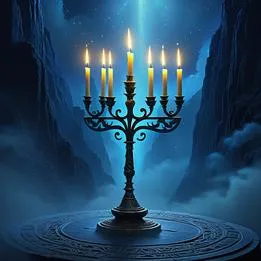
Menorah Dream Meaning
A seven-branched candelabrum central to Judaism, symbolizing divine light, wisdom, and the enduring covenant between God and the Jewish people.
Common Appearances & Contexts
| Context | Emotion | Interpretation |
|---|---|---|
| Lighting the Menorah | Joyful | Celebration of miracles. |
| Broken Menorah | Anxious | Fear of lost faith. |
| Ancient Temple Menorah | Awed | Connection to sacred history. |
| Modern Hanukkah display | Proud | Public affirmation of identity. |
| Extinguishing Menorah | Despairing | Loss of spiritual guidance. |
| Giant Menorah vision | Inspired | Overwhelming divine presence. |
| Crafting a Menorah | Focused | Building personal faith. |
| Menorah in darkness | Hopeful | Light overcoming adversity. |
| Stolen Menorah | Violated | Attack on heritage. |
| Family Menorah lighting | Loving | Generational continuity. |
| Menorah won't light | Frustrated | Spiritual blockage. |
| Menorah as beacon | Guided | Divine direction given. |
Interpretive Themes
Divine Illumination
highCore to its Temple and ritual origins.
Endurance & Resilience
highLinked to historical survival and Hanukkah.
Cosmic Order
mediumSeven branches often tied to days of creation.
Community & Unity
mediumCentral in public and family rituals.
Miraculous Provision
highDirectly references the Hanukkah oil miracle.
Cultural Lenses
Middle Eastern Perspective
View Context →Primarily Jewish symbol of the ancient Temple in Jerusalem and the Maccabean revolt. Represents monotheism, divine law, and miraculous survival. A central ritual object in Hanukkah, celebrating religious freedom.
Jungian Perspective
View Context →Archetype of the Self, symbolizing wholeness and individuation. The seven branches may represent integration of opposites or stages of psychological development. Light signifies consciousness emerging from the unconscious.
Freudian Perspective
View Context →Potentially a phallic symbol representing paternal authority and religious law. Lighting it could symbolize libidinal energy or a desire for paternal blessing and order within the family structure.
Gestalt Perspective
View Context →Represents parts (branches) forming a greater whole (the candelabrum). Dreaming of it may ask: 'What parts of myself need integrating to create a complete, enlightened identity?'
Cognitive Perspective
View Context →A schema for 'faith,' 'heritage,' or 'miracle.' The dream activates associated memories and emotions, possibly processing identity, family traditions, or concepts of hope and perseverance.
Evolutionary Perspective
View Context →Symbolizes control of fire (light, warmth, safety) and social cohesion. The shared light reinforces group identity and cooperation, crucial for tribal survival and the transmission of cultural knowledge.
Modern Western Perspective
View Context →A symbol of Jewish identity, religious freedom, and multiculturalism. Often seen in public holiday displays, representing tolerance and the 'festival of lights' as a universal message of hope.
European Perspective
View Context →Historically associated with Jewish communities and often depicted in Christian art as a symbol of the Old Testament. In modern secular contexts, it's a recognized symbol of Hanukkah celebrations.
Global/Universal Perspective
View Context →A cross-cultural symbol of light triumphing over darkness, wisdom, and sacred number seven. Resonates with universal themes of hope, perseverance, and spiritual enlightenment across many faiths.
North American Perspective
View Context →Emblem of religious pluralism and Jewish-American identity. Central to Hanukkah celebrations, often placed in windows as a public declaration of faith and a symbol of holiday season diversity.
Interpret Your Full Dream
Beyond this symbol, every dream carries a unique story. Share your dream for a personalized AI-powered interpretation.