
Menehune Myth Meaning & Symbolism
A myth of the small, nocturnal people who built impossible structures, representing the hidden, industrious forces of the land and psyche.
The Tale of Menehune
Listen, and let the trade winds carry you back. Before the great voyaging canoes from the south painted their sails on the horizon, the islands were not empty. They were alive with a different breath, a quieter pulse. In the deep, velvet folds of the valleys, under the cloak of Hina's dominion, they worked. They were the Menehune, the people of the hidden places.
They stood no taller than a child, but their shoulders were broad from the weight of the land itself. Their skin held the hue of rich, sun-baked earth, and their eyes held the patient depth of stone pools. They did not speak in the day; their language was the night, the whisper of stone on stone, the soft command passed through the ohia lehua trees. They were the first architects, the original builders whose law was perfection and whose price was secrecy.
Their greatest work was born from a pact. A high chief, a man of the new, daylight people, needed a task impossible for mortal hands. He needed a fishpond, `loko iʻa, but not just any pond. It must be a wall across a bay, mighty enough to hold back the ocean's push, crafted so flawlessly that not even the smallest fry could slip through its seams. He called into the twilight, offering a mountain of food, a feast for a thousand hidden mouths.
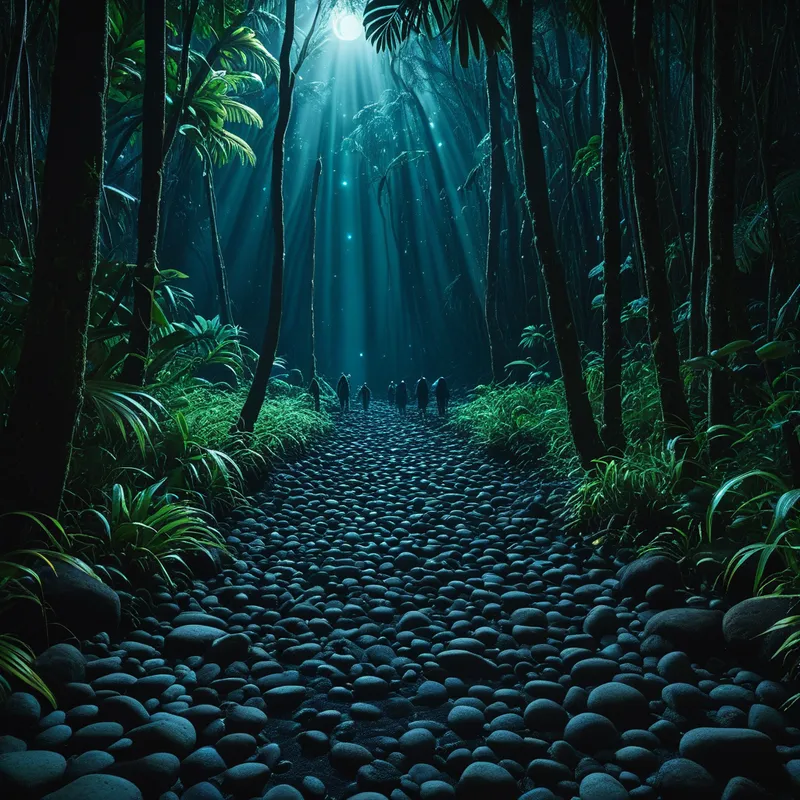
The Menehune listened from the shadows. The challenge called to their essence. That night, as the last crimson bled from the sky, a silent army emerged. Not with war chants, but with purpose. From the mountains to the shore, they formed a line miles long, a human chain of incredible efficiency. Stones, each chosen for its unique fit, passed from hand to hand through the dark forests, down to the waiting water's edge. The sound was not of chaos, but of a single, rhythmic heartbeat—thump, shift, settle.
As they worked, the chief’s people, hidden and watching, felt awe and dread. These were not gods, but something else: the spirit of the land given hands. Just before the first hint of dawn painted the sky, the final stone was set. The wall stood complete, a curved, graceful arm of rock holding the sea at bay, every joint seamless, every angle true. As the sun's first ray touched the highest stone, the Menehune vanished. Gone, as if they had been the night itself. Only their perfect work remained, and the legend of the price: they must never be seen in their labor, for to be witnessed is to be undone, to fade back into the myth from which they came.
Cultural Origins & Context
The Menehune are among the most persistent and tangible legends in Hawaiian folklore. Ethnologists and historians suggest the stories may be fragmented memories of an early migratory wave of settlers, physically distinct and technologically skilled, who were eventually absorbed or displaced by later Polynesian arrivals. In this view, the Menehune mythologizes a real, historical "first people." Their attribution as builders of specific, pre-contact archaeological sites—like the Alekoko Fishpond on Kauaʻi or the intricate ditch systems of Kauaʻi's uplands—anchors them not in fantasy, but in the physical landscape. They are the "why" behind the "how" of ancient, masterful engineering whose origins were lost to time.
Societally, the myth functioned on multiple levels. It explained the inexplicable: who built these magnificent structures before "us"? It enforced ecological and social respect; the Menehune were the genius loci, the protective spirits of particular forests, rocks, and streams. To disturb their places was to invite misfortune. The stories were passed down not as mere bedtime tales, but as ʻōlelo noʻeau (wise sayings) and historical accounts, often cited in native land court testimonies in the 19th century as proof of ancient use and occupation. They were the invisible claimants to the land, a deep memory of belonging encoded in narrative.
Symbolic Architecture
The Menehune are not merely small people; they are the archetype of the unseen foundation. They represent the subconscious, industrious forces that undergird conscious reality. Their work is accomplished in the dark, in silence, and must be completed before the dawn of awareness. They are the psychic "masons" who build the structures of the self—habits, talents, complexes—stone by patient stone, often without the ego's knowledge.
The most enduring structures of the soul are built not in the glaring light of intention, but in the fertile dark of unconscious process.
Their nocturnal nature connects them to the lunar, intuitive, and feminine principle (akin to Hina), contrasting with the solar, conscious world of the daytime chiefs. Their demand for secrecy is crucial; it symbolizes the vulnerability of nascent psychic processes. To shine the full light of critical consciousness on a half-formed intuition or a budding skill can "frighten it away," dissolving its magic. The perfect, seamless fit of their stonework is the symbol of inner integrity—the alignment of different parts of the psyche into a cohesive, functional whole that can withstand the tides of emotion and circumstance.
The Dreamer's Resonance
To dream of Menehune is to receive a message from the psyche's clandestine construction crew. It often surfaces during periods of integration or when a major life project is underway beneath the surface of daily awareness. The dreamer may see small, busy figures repairing something in a basement, building a wall in a backyard jungle, or organizing a chaotic attic.
Somatically, this dream can accompany a feeling of deep, quiet busyness within the body—a sense of restructuring, healing, or re-wiring that operates autonomously. Psychologically, it signals that foundational work is being done on the self. The conflict in such dreams arises if the dreamer tries to directly observe or interfere with the workers; this mirrors our tendency to overthink, micromanage, or demand premature visibility from our inner processes, which can halt their natural, instinctive flow. The dream is an affirmation: trust the night-work. Your inner Menehune are on the job.

Alchemical Translation
The alchemical journey modeled by the Menehune myth is that of opus contra naturam—the work against (or refining of) nature—but here, it is an opus per naturam, a work through nature's hidden laws. The modern individual's path of individuation is not always a heroic, sun-drenched quest. Often, it is the slow, meticulous, and utterly private work of soul-craft.
The first stage is the pact: the ego (the chief) recognizes a need—a container for one's vitality (the fishpond), a boundary against overwhelming forces (the sea). It must humbly petition the deeper, older self (the Menehune), offering the "feast" of attention, energy, and respect. Then, one must step back. The conscious mind must surrender control to the nocturnal psyche.
Individuation is the ego learning to be a benevolent chief who commissions the work, then has the wisdom to retire for the night and let the ancient builders build.
The building itself—the passing of stones in a chain—is the linking of disparate memories, insights, and experiences (the rough stones) into a new, functional structure of personality. This happens in the nigredo, the dark night of the work. The final, pre-dawn completion is the moment of integration, when the new structure suddenly coheres in awareness, seemingly "overnight." The Menehune then vanish, their work done, becoming part of the enduring foundation of the self. The individual is left not with a memory of the struggle, but with the lived-in reality of a stronger, more resilient inner world, a testament to the power of the hidden, collaborative self.
Associated Symbols
Explore related symbols from the CaleaDream lexicon: