Memory Quilts Myth Meaning & Symbolism
A myth of a weaver who stitches the lost moments of a village into a quilt, transforming forgotten grief into a tapestry of collective memory.
The Tale of Memory Quilts
Listen, and let the fire’s crackle become the whisper of the loom. There was a village not on any map, a place where the wind carried not just scents of earth and rain, but the faint, sweet ache of yesterday. In this village, time had a habit of slipping. Not the grand hours or the marked years, but the small moments—the warmth of a shared glance, the exact pitch of a lullaby on a stormy night, the feeling of grass under bare feet on the first day of spring. These moments would fade, not into nothing, but into a grey mist that gathered at the edges of the woods, a fog of forgotten feeling.
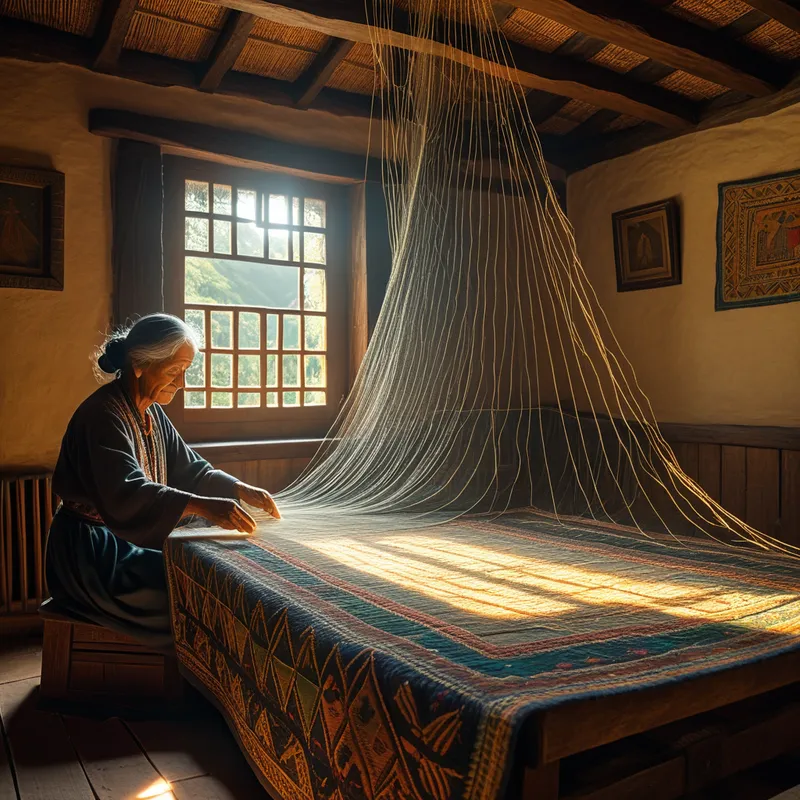
In a cottage at the village’s heart lived the Weaver. They were neither young nor old, their face a map of quiet attention. While others slept, the Weaver worked. Their tools were not ordinary. The spindle was carved from a branch of the World-Tree, the loom’s frame was bone-white driftwood from the River of Hours, and the thread… the thread was spun from moonlight and breath.
The people of the village felt a growing emptiness, a hollow in their chests where joy and sorrow once lived with equal vividness. They brought their troubles to the Weaver. An elder mourned the sound of his wife’s laughter, now only a shape without a sound. A child wept for the memory of a lost wooden toy, the feeling of its smoothness entirely gone. The Weaver listened, their eyes reflecting the fading light within each person.
Then, they began. The Weaver did not ask for the whole memory. They asked for the trace—the chill where the laughter had been, the hollow shape of the grief. With fingers that knew the language of absence, the Weaver would pluck at the air around the person, gathering not the thing itself, but its ghost, its silhouette. This silvery, intangible residue was wound onto the spindle.
Night after night, the loom clacked a soft, rhythmic heartbeat. The Weaver stitched the silhouette of lost laughter into a patch of sky-blue wool. The ghost of the wooden toy became a patch of polished amber cloth. A forgotten promise was a stitch of dark red thread. Each patch was a vessel, not for the memory, but for the space it left behind. The quilt grew, a heavy, magnificent, and sorrowful thing. It was beautiful, but its beauty was of graves and sunsets—final and full of longing.
One night, as the Weaver added a patch for a community’s lost harvest festival, a great sigh seemed to move through the quilt. It grew heavier than stone. The Weaver realized the truth: they were not weaving memory; they were weaving a tomb for loss. The quilt was a catalogue of absences, and its weight was pulling the very heart from the village.
In despair, the Weaver did the only thing left. They took the colossal quilt and, with a strength that came from the depths of their craft, they did not fold it, but wrapped it around the village’s central hearth—not to smother the fire, but to infuse it. As the fabric touched the living flame, a miracle of transmutation occurred. The silhouettes were not burned away, but filled. The blue patch echoed with real, echoing laughter. The amber cloth warmed with the sense of smooth wood. The red stitch hummed with the intent of the promise. The quilt was no longer a record of what was gone, but a living, breathing tapestry of what had been, integrated, alive in a new form. The grey mist at the edge of the woods receded, not because the memories returned to their owners, but because the village now wore its past as a garment of collective soul, light as air, strong as stone.

Cultural Origins & Context
The myth of the Memory Quilts does not belong to a single culture, but emerges like a pattern repeated across the loom of global folk tradition. It is found in the echoes of Appalachian storytelling, where quilting bees were sites of communal narrative; in the patchwork tales of Western African textile traditions, where cloth carries history; and in the nomadic legends of Central Asia, where felted textiles hold the spirit of the clan. It was never a formal, priestly myth. It was a hearth-tale, told by grandmothers and crafters, passed down alongside the very skills of sewing, weaving, and embroidery.
Its tellers were the keepers of practical magic—the spinners, weavers, and quilters—who understood that their craft was more than utility. It was a metaphysics of connection. The myth served a crucial societal function: it provided a container for the existential pain of impermanence. In communities where life was hard and loss was frequent, the story offered a model for processing grief that was active and creative. It taught that personal loss, when witnessed and crafted by the community, could become a source of collective strength and identity. The myth ritualized the act of remembering, transforming it from a passive, internal sorrow into an active, shared creation.
Symbolic Architecture
At its core, the myth is a profound map of the psyche’s relationship with loss and integration. The Grey Mist of Forgotten Feeling symbolizes the unconscious—specifically, the personal and collective shadow where unprocessed experiences, traumas, and abandoned joys reside. These are not gone; they are psychically "fugitive," draining vitality by their unattended presence.
The Weaver represents the Ego-Self axis in its role as an artisan of consciousness. The Weaver does not possess the memories but has the craft to handle their absence. This is critical: the work begins not with the recovered memory, but with the honest acknowledgment of the void it left—the "silhouette." The loom and tools symbolize the structured, disciplined processes (therapy, art, ritual, reflection) necessary for psychic work.
The quilt is the nascent Self, but only when it is a mere collection of sorrows, it is the "false self" or the complex-ridden personality—beautiful but burdensome.
The final, crucial alchemical act is the application of the Living Flame. This represents libido, or psychic energy, applied with conscious intent. Wrapping the quilt of fragments around the fire is the act of integrating these lost parts back into the core of one’s life energy. The memory is not returned to its original state; it is transmuted. It becomes part of the fabric of the psyche itself, losing its painful, isolated charge and becoming a thread in the larger, strengthening pattern of who one is.
The Dreamer's Resonance
When this myth stirs in the modern dreamer, it often manifests as dreams of searching through attics filled with forgotten boxes, of trying to piece together a torn document or photograph, or of wearing or being wrapped in a heavy, elaborate garment. One may dream of trying to sew, but the thread is endless or tangles, or of a room where the wallpaper is made of moving, faded images.
These dreams signal a somatic and psychological process of recollection in the literal sense—a re-gathering of the scattered parts of the self. The heavy quilt in a dream points to the burden of unprocessed history, perhaps familial or personal trauma that one carries without understanding its pattern. The act of sewing or piecing signifies the ego’s attempt, often clumsy at first, to engage in the work of integration. The frustration with thread symbolizes the difficulty of connecting disparate emotional events into a coherent narrative.
Such dreams invite the dreamer to ask: What have I consigned to the Grey Mist? What losses, disappointments, or even small joys have I not properly mourned or celebrated? The dream is the psyche’s initial, symbolic gesture toward becoming its own Weaver, initiating the process of gathering the silhouettes of experience before they dissipate entirely.

Alchemical Translation
The myth of the Memory Quilts provides a masterful model for the Jungian process of individuation—the psychic transmutation of the lead of fragmented experience into the gold of an integrated Self. The modern individual lives in a culture of the Grey Mist: we are encouraged to move on, to optimize, to forget. Our lost moments—of failure, vulnerability, "unproductive" joy—are discarded, creating a psychic landscape of absences that haunt us as anxiety, depression, or a sense of emptiness.
The first step of the alchemy is to apprentice oneself to the inner Weaver. This means developing the craft of attention. It is to sit with the hollow feeling, the trace of the memory, without immediately trying to fill it with distraction or false narrative. It is the discipline of journaling, of therapy, of artistic expression—the loom on which we place our silences.
One does not heal by recovering a pristine past, but by weaving the very fact of its loss into the substance of the soul.
The collection of patches—the work on complexes, the understanding of patterns—is necessary but insufficient. This is the stage of analysis, which can become a burdensome catalogue of wounds if it remains intellectual. The final, transformative stage is the application of the Living Flame. This is the courageous act of bringing those understood fragments back into the heat of present life. It is to share one’s story, to create art from pain, to enact a ritual that honors a loss, to allow a reclaimed vulnerability to inform current relationships. The memory, once a isolated shard of pain, becomes a thread of connection, wisdom, and depth. The individual is no longer patched together, but becomes a whole, resilient, and unique tapestry. They have not escaped their history; they have woven it into a garment of meaning that allows them to move through the world with both weight and grace.
Associated Symbols
Explore related symbols from the CaleaDream lexicon: