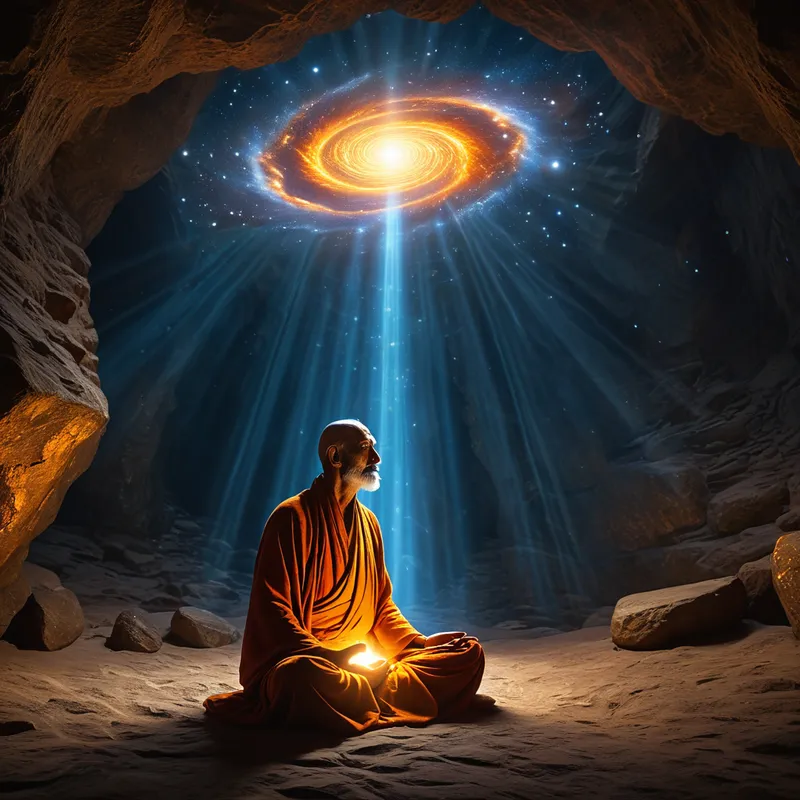
Meditating Ascetics Myth Meaning & Symbolism
A tale where ascetics' deep meditation generates such immense inner power that it threatens the cosmos, forcing the gods to intervene.
The Tale of Meditating Ascetics
Listen. In the high, silent places of the world, where the air is thin and the stones remember the first dawn, there are those who sit. They are not men as you know men. They are vessels of will, hollowed out by breath and focus, their bones become mountain roots, their breath the whisper of the wind through ancient pines. They are the tapasvin, the wielders of tapas.
Once, in an age of giants, such a one sat. His name is lost, for names are for those who still cling to form. He was simply the Ascetic. For years uncounted, he sat beneath a great pipal tree, his body gathering dust and dew, his mind turned inward upon the single, burning point of consciousness. He ate nothing. He drank nothing. His only sustenance was the fire of his own resolve. And as he sat, a power began to gather. It was not magic, not in the way of spells. It was the heat of pure being, concentrated into a white-hot point. It rose from him like a column of invisible flame, scorching the very air. The leaves of the great tree did not wither; they glowed with an inner light. The animals did not flee; they sat in silent circles, their eyes reflecting a deep, unsettling peace.
The column of tapas pierced the canopy, pierced the sky, and arrowed its way into the highest heaven, the realm of Indra. In his celestial city, Amaravati, the throne of the king of gods grew warm. Then hot. The perfumed breezes turned dry and parching. The kalpavriksha, the wish-fulfilling trees, began to droop. A tremor of existential fear ran through the court of the devas. For the power rising from that silent man on earth was a challenge not of arms, but of essence. It was the power of consciousness itself, threatening to unmake the established order, to burn away the very distinctions between heaven and earth, god and mortal.
Indra summoned his council. "This heat," he said, his voice uncharacteristically thin, "is the heat of a new creation. If he continues, he will generate enough merit, enough concentrated will, to create a universe of his own design. Our heavens will be obsolete. He may even usurp my throne." The solution was not battle. You cannot fight a mountain. You cannot slay a silence. The only way to break a meditation of such intensity is through distraction, through the re-introduction of the world he had so utterly transcended.
And so, Indra sent down the most potent weapon in the celestial arsenal: not a thunderbolt, but an apsara. Her name was Menaka. She descended from the clouds like a sigh, her form the very embodiment of everything the ascetic had forsaken—beauty, scent, rhythm, the tantalizing promise of connection. She danced at the edge of his perception. The wind carried her perfume of jasmine and desire. The rustle of her silks was a language older than speech. She sang a wordless song that spoke directly to the blood and bone.
For a moment, the column of tapas flickered. The ascetic’s eyelids, sealed for millennia, trembled. A single, human breath escaped his lips—a sigh not of defeat, but of profound, heartbreaking recognition. The spell of absolute unity was broken. The world, in all its terrible, beautiful particularity, rushed back in. He opened his eyes and saw her. In that seeing was the end of his cosmic ambition and the beginning of a different, more human story. The inner fire, no longer focused to a universe-shattering point, dissipated into the warm, creative energy of life. The crisis of the heavens passed. The ascetic stood, his legs stiff, his heart newly vulnerable, and took his first step back into the stream of the world.

Cultural Origins & Context
This is not one myth, but a pattern, a deep archetypal narrative etched into the spiritual bedrock of the Indian subcontinent. It appears and reappears throughout the Vedas, the Puranas, and the Jatakas, with different names—Sage Vishvamitra, the Buddha under the Bodhi tree facing the assaults of Mara, countless unnamed rishis and yogis. It was a story told by brahmins to illustrate the dangerous potency of spiritual practice, by kings to warn of powers beyond their temporal control, and by teachers to students as a paradoxical lesson: the greatest power can be undone by the simplest, most human vulnerability.
Its societal function was multifaceted. It served as a cosmological safety valve, explaining why even the most powerful ascetics don't constantly overthrow the gods. It framed spiritual power (tapas) as a real, tangible force with cosmic consequences, making the hermit in the forest a figure of awe and potential terror. Most importantly, it established a fundamental tension: the absolute, world-renouncing concentration of the ascetic versus the binding, beautiful, distracting power of life itself, samsara. The myth asks if enlightenment means transcending the world or being ultimately seduced by it.
Symbolic Architecture
At its core, this myth maps the terrifying and glorious architecture of concentrated consciousness. The ascetic is not merely a holy man; he is the human psyche in its most radical, contracted state. He represents the ego's attempt to withdraw all projections, to recall every fragment of libido (psychic energy) from the outer world and focus it inward.
The meditation is not peace; it is a forge. The self is both the blacksmith and the metal, hammered in the silence until it threatens to become the hammer itself.
The generated tapas is this superheated psychic energy. It is pure potential, capable of "creating a new universe"—which, psychologically, is the birth of a wholly new conscious standpoint, a Self that could render the old ego-identity (symbolized by Indra's kingdom) obsolete. This is the moment before a revolutionary insight, a transformation so complete it feels apocalyptic to the existing psychic order.
Indra and the apsara represent the counter-pull of the established psyche. Indra is the ruling complex, the "king of the gods" within us—our dominant attitudes, values, and self-concepts that feel threatened by fundamental change. He does not attack directly but employs the apsara, who symbolizes the allure of the anima, the soul-image, and the entire forgotten world of feeling, relatedness, and eros. The distraction is not a failure of spirit, but a reassertion of wholeness. The psyche cannot sustain itself in a state of absolute, fiery singularity. It must relate. It must descend.

The Dreamer's Resonance
When this myth stirs in the modern dreamer, it often manifests not as a literal sage, but as a profound somatic and psychological process. You may dream of generating a powerful, dangerous energy—a reactor core in your chest glowing out of control, a light so bright it burns your surroundings, or a focused silence that makes the dream world crack and peel away. There is a sense of immense, isolating power and simultaneous terror.
This is the psyche's depiction of a deep introversion, perhaps during a period of intense study, recovery, or introspection, where you have withdrawn your energy from relationships and the external world to focus on a single, inner point. The body in the dream may feel rigid, stone-like, or electrified. The conflict arises as the "gods" intervene: an old friend calls, a memory of a lost love surfaces, a simple bodily need or emotion erupts with unexpected force—these are the apsaras of the modern soul. The dream signals that the period of pure, fiery concentration is reaching its natural limit. The Self is forcing a return to the human realm, not as a failure, but as the next necessary stage of integration.

Alchemical Translation
The myth models the alchemical process of solutio—the dissolution that follows the calcinatio (the burning fire of asceticism). The psychic transmutation it outlines is not a straight path to transcendence, but a cyclical drama of individuation.
First, the individual, driven by a desire for perfection or escape, withdraws and concentrates their life force (nigredo/calcinatio). This generates immense power and potential (the heat of tapas). But this state is inhuman, a psychic monolith. The intervention of the "gods"—the other complexes in the unconscious—forces a solutio, a melting or dissolving. The apsara's dance is this dissolving agent: the waters of emotion, relationship, and vulnerability that quench the tyrannical fire of pure spirit.
The triumph is not in maintaining the meditation, but in having the courage to open one's eyes. The victory is in the sigh, the recognition of the other, and the acceptance of the flawed, beautiful human journey that follows.
The ascetic who stands up, stiff-limbed, and engages with the world is the integrated individual. He has not lost his power; he has transformed it. The universe-shattering tapas becomes the warmth of compassion, the creative fire of art or work, the steady light of insight applied to daily life. He has learned that the ultimate power is not that which threatens the heavens, but that which can willingly descend from the mountain, carrying a spark of that fire into the marketplace. The myth teaches that individuation is not about becoming a god, but about becoming a fully human vessel capable of holding, without being consumed by, the divine fire. The true alchemy is the translation of isolated, scorching intensity into connected, illuminating warmth.
Associated Symbols
Explore related symbols from the CaleaDream lexicon: