
Mbira Myth Meaning & Symbolism
A myth of a sacred instrument born from a king's grief, bridging the human and spirit worlds to restore harmony through the language of vibration.
The Tale of Mbira
In the time when the earth was still soft with the breath of the first dawn, there lived a great king named Murenga. His rule was just, his lands were fertile, but a profound silence had settled over his spirit. His beloved queen, Nyadenga, whose laughter was the rain that nourished the soil of his heart, had journeyed beyond the veil of the living. Her absence was not an empty space, but a heavy, soundless weight that pressed upon the king’s chest, silencing the song in his own breath.
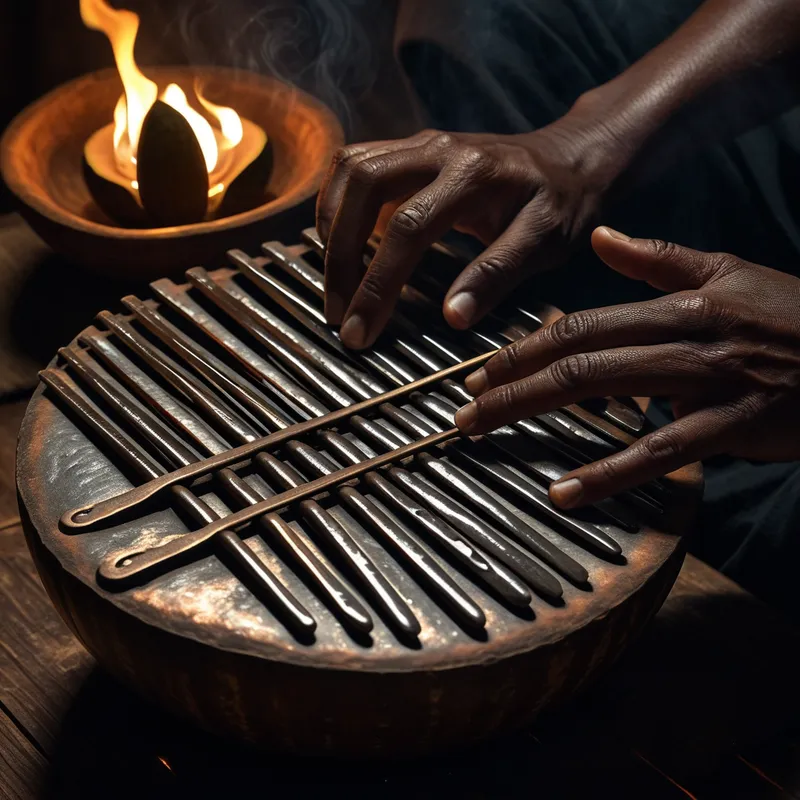
Murenga wandered from his court, drawn to a quiet grove where the Vadzimu were said to whisper. There, beneath the ancient limbs of a Muonde tree, he sat with his grief. He took a piece of iron, hard and cold as his sorrow, and began to shape it. He did not know what he was making. His fingers, guided by a memory deeper than thought, fashioned slender tongues of metal. He found a hollowed gourd, the body of the earth itself, and attached the iron tongues to a wooden platform atop it.
Despairing, his tears fell upon the silent keys. As the salt water touched the iron, a miracle of resonance occurred. He brushed his thumb against a key. A sound emerged—not a note from this world, but a vibration that seemed to come from the marrow of the earth and the dust of the stars. Ting… shuu… It was the sound of a single drop of water falling into a bottomless well in the spirit world.
He played another, and another. The sounds wove together, a complex, interlocking pattern of plaintive highs and resonant, humming lows. He was not playing a song he knew; he was listening. The patterns became a language, a bridge. As the twilight deepened, the air in the grove began to shimmer. From the shadows of the Muonde, forms emerged—not quite solid, but present. The Vadzimu, the ancestral spirits, drawn by the vibration. And among them, a familiar presence, a warmth that eased the weight on his chest. Nyadenga’s essence did not speak with words, but with a flood of memory, love, and reassurance that flowed through the sound waves.
The king played through the night. His grief did not vanish, but it was transformed. It was no longer a silent stone, but a flowing river within the music—a bittersweet, beautiful part of a larger, eternal harmony. By dawn, the instrument, now named Mbira, was no longer an object he held. It was a living threshold. He had not crafted an instrument to express his loneliness; he had built a door so that he would never be alone again.
Cultural Origins & Context
The myth of Mbira’s origin is the soul-history of the Shona people of Zimbabwe and Mozambique. It is not a single, fixed text, but a living narrative carried in the vibration of the instrument itself, passed down through generations of gwenyambira. The story is told in the ceremony, in the all-night spirit possession rituals called Bira.
Here, the myth becomes reality. The complex, interlocking cycles of the Mbira’s music are not mere entertainment; they are a sonic architecture designed to call the Vadzimu. The instrument is the vehicle, the players are the conductors, and the community participants are the welcoming circle. The myth explains the instrument’s supreme societal function: it is the primary technology for communion with the ancestral world, essential for seeking guidance, healing illness, resolving disputes, and ensuring ecological and social balance. The king’s personal grief in the myth mirrors the community’s collective needs—both require reconnection with the foundational source of wisdom and life, the ancestral realm.
Symbolic Architecture
At its core, the Mbira myth is a profound map of psychic repair through sacred sound. The king’s unvoiced grief represents the modern condition of the disconnected psyche, suffering in isolation.
The instrument is not forged to play to the void, but to vibrate with it, transforming silence into a field of connection.
The iron keys symbolize the hard, resistant facets of our pain and individuality—our "complexes." The hollow gourd represents the receptive, containing vessel of the soul and the community. The act of playing—the thumb striking the key—is the conscious effort to engage with our inner hardness. The resulting sound is the third thing, the transcendent function that emerges when consciousness touches the unconscious. The interlocking, cyclical patterns of the music symbolize the non-linear, recursive nature of psychological healing and the eternal dialogue between the living and the dead, the ego and the Self.
The Vadzimu are not external ghosts, but the internalized totality of our lineage—the psychic inheritance of patterns, wisdom, and wounds that dwell within us as the collective unconscious. The Mbira’s music is the specific frequency that allows this inner council to be heard.
The Dreamer's Resonance
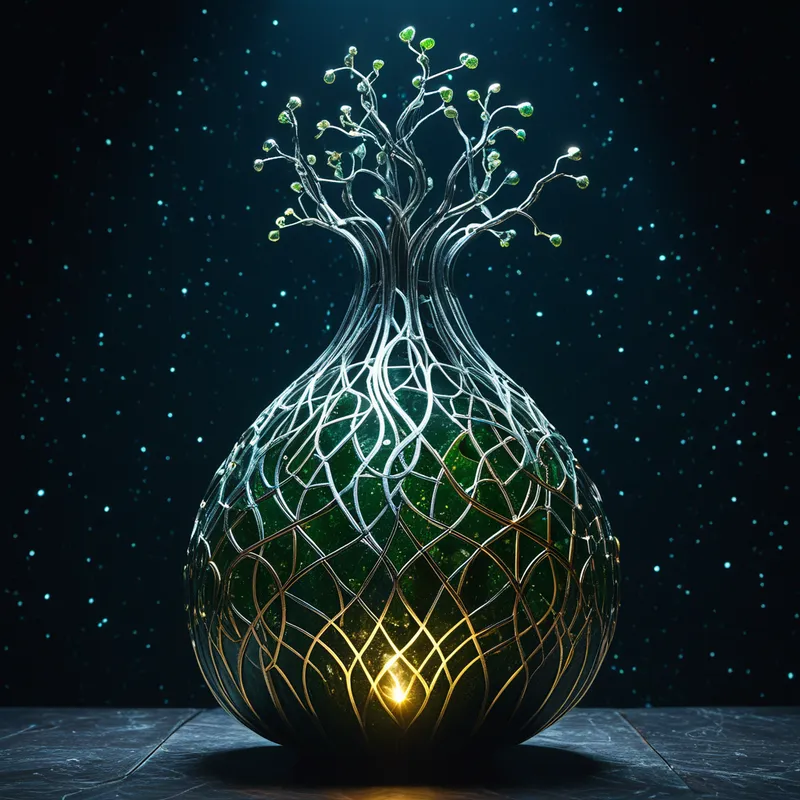
When this myth pattern activates in the modern dreamer, it often manifests as dreams of finding a strange, intricate object—a box with moving parts, a machine made of organic materials, a forgotten instrument. The dreamer feels compelled to interact with it, to make it work or sound. There is a somatic quality of tension in the chest or throat, a feeling of something needing to be expressed that has no words.
Psychologically, this signals a process where a deep, perhaps ancestral, grief or unprocessed emotional pattern is seeking a channel to consciousness. The "instrument" in the dream is the nascent symbol for a new psychic function—a way to translate the silent, somatic pressure of the unconscious into a form that can be "heard" and integrated. The struggle to play it reflects the ego’s initial awkwardness in engaging with this unfamiliar inner technology. Success in the dream, even a single clear note, points to the beginning of this transmutative process, where buried pain starts to become articulate soul-language.

Alchemical Translation
The alchemy of the Mbira myth is a masterclass in individuation. It begins with the nigredo: the king’s black despair, the leaden weight of unexpressed loss. His retreat to the sacred grove is the necessary withdrawal into the unconscious (the forest of the soul).
The crafting of the instrument is the albedo—the whitening. Here, conscious effort (shaping iron) is applied to unconscious material (the gourd, the guided memory). He creates a conjunctio, a sacred marriage of hard and soft, metal and wood, individual and collective. But the true catalyst is the citrinitas, the yellowing: the tears. The salt water—the emotion made physical—is the solvent that activates the metal. This is the critical step: intellectual or artistic creation alone is insufficient; it must be baptized with genuine feeling.
The goal is not to escape the grief, but to let it become the resonator through which a more profound connection is possible.
Finally, the arrival of the spirits and the restoration of harmony is the rubedo, the reddening or culmination. The king’s personal psyche is reintegrated into the larger psychic ecosystem of the ancestral Self. For the modern individual, this translates to the process of finding one’s unique "instrument"—be it art, dialogue, therapy, or ritual—that can specifically vibrate in resonance with one’s deepest wounds and history. By learning to "play" this instrument, we do not solve our pain in a linear way; we incorporate it into a more complex and beautiful pattern of being. We stop speaking from our isolation and begin listening into our connection, discovering that what we thought was an echo of our own loneliness is actually the first note of a vast, eternal conversation.
Associated Symbols
Explore related symbols from the CaleaDream lexicon: