May Queen Myth Meaning & Symbolism
A myth of the sovereign goddess who rules the fertile summer, defeated by the Holly King to ensure the necessary death that precedes all renewal.
The Tale of the May Queen
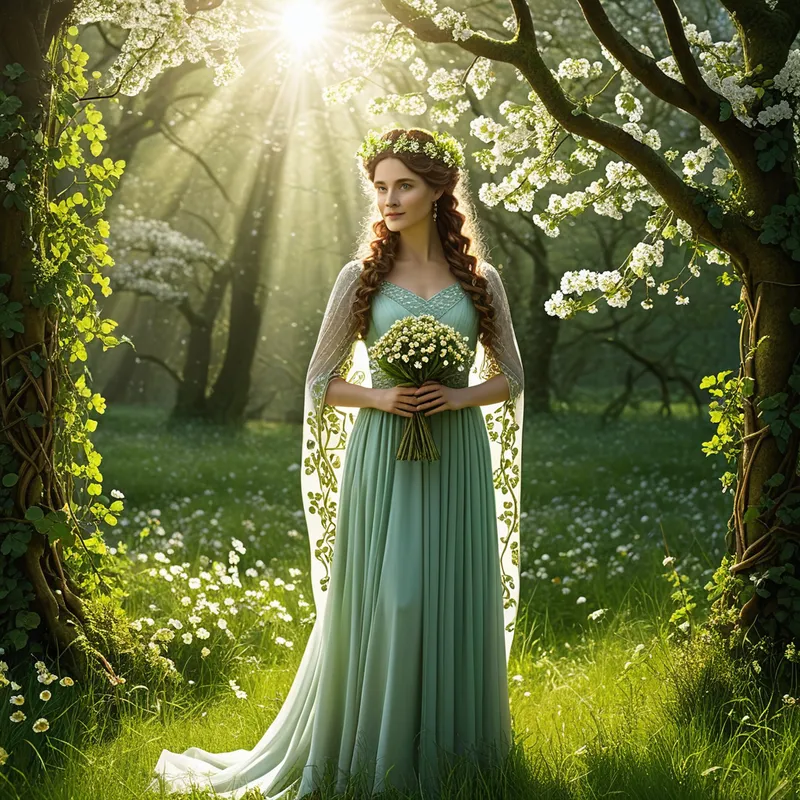
Listen. The wheel of the year turns on a hinge of breath and bone. In the greening heart of Beltane, when the hawthorn bleeds white upon the branch and the fires are lit upon the hills, she arrives. She is the May Queen. Her breath is the scent of meadowsweet; her footsteps call forth bluebells from the damp earth. Her crown is woven from the first hawthorn blossoms—the May itself—and her cloak is the deep, promising green of the oak. She is the land’s beloved, the sovereign of the bright half of the year.
For a time, the world basks in her rule. The sun lingers, the cattle grow fat, and the grains stretch tall towards the sky. In her presence, desire is sacred, and life pours forth in an unchecked, joyful stream. She dances in the circles of stone, and the people dance with her, their bodies remembering the pulse of a world utterly alive.
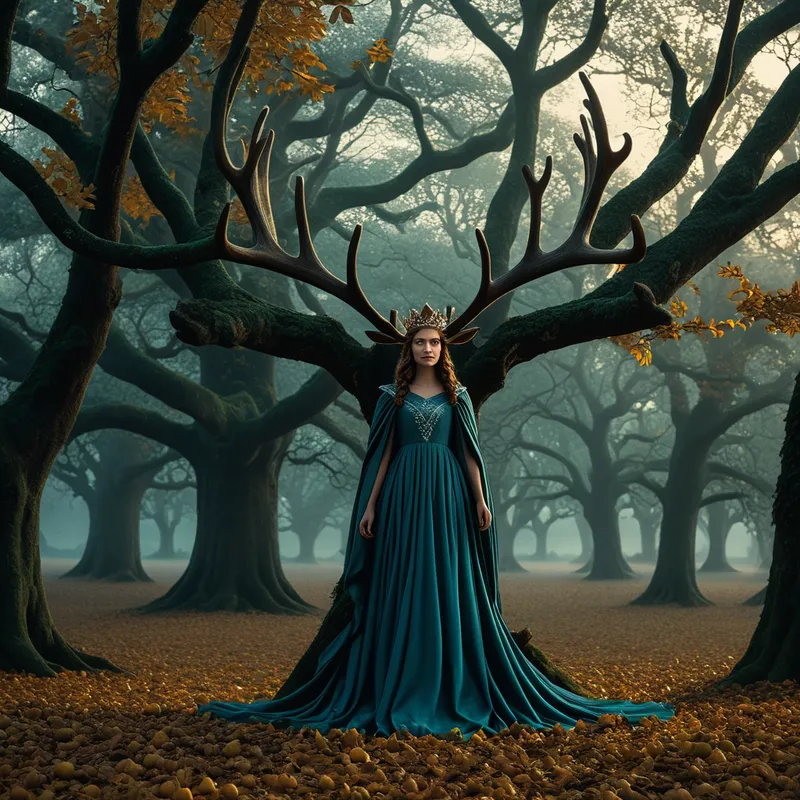
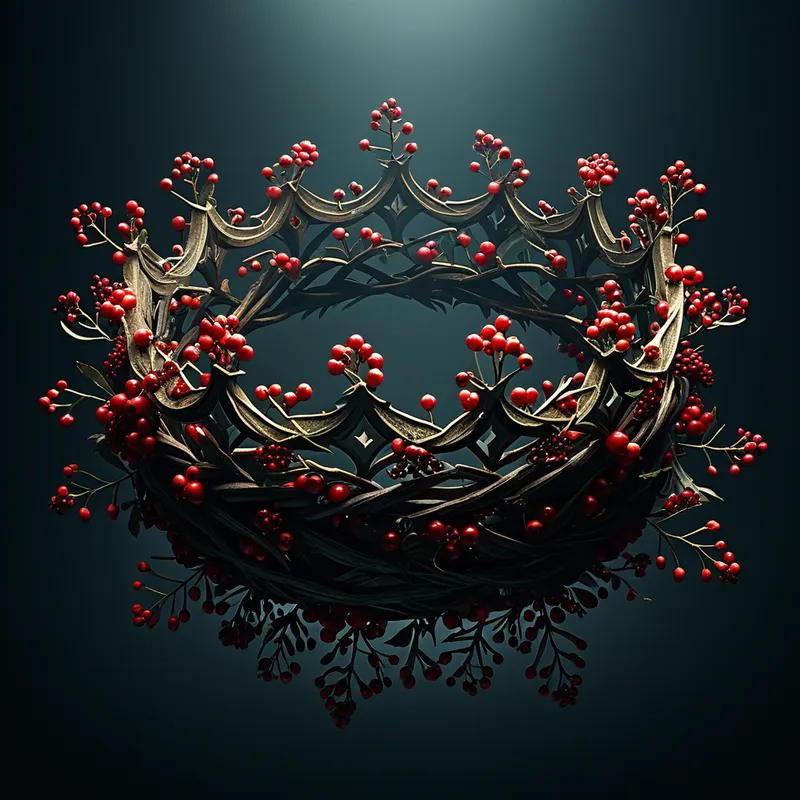
But the wheel turns. The sun, in its zenith, begins its long, slow sigh towards the horizon. In the lush greenwood, a shadow gathers. It is the shadow of the Green Man, but his leaves are darkening. From the deepest thicket, where the sun never fully reaches, another king stirs. He is the Holly King. His crown is of sharp, waxy leaves and blood-red berries; his cloak is the deep green of the eternal forest, untouched by summer’s frail gold. He is brother and rival, the other face of the year’s soul.
They meet not in battle, but in a solemn, inevitable exchange. The air grows crisp. The Queen’s vibrant greens begin to fade to gold and russet. She stands in a clearing, the first fallen leaves a carpet at her feet, and faces him. There is no malice in his gaze, only the terrible necessity of the cycle. He does not strike her down in fury, but claims his kingship as the light fades. Her sovereignty wanes; his begins. The vibrant, externalized life she championed retreats into the root, into the seed, into the dark. The May Queen’s reign ends at Samhain, when the veil thins and the world turns inward. She is not slain, but subdued, her essence drawn back into the sleeping earth, a promise held in the frozen ground.
Cultural Origins & Context
This mythic pattern is not a single, codified story from a ancient text, but a tapestry woven from fragments of Celtic belief, later folk customs, and the enduring logic of the agricultural year. The Celts perceived time as cyclical, not linear, marked by great seasonal festivals. The figure of the May Queen likely derives from earlier goddesses of sovereignty and the land, such as the Irish Medb or the Welsh Dôn. Her ritual marriage to a king or a god-consort was essential for the land’s fertility and the tribe’s prosperity.
The myth was lived, not merely told. It was enacted through folk customs where a young woman was crowned Queen of the May, leading processions and dances. This was not mere pageantry but a serious ritual of sympathetic magic, inviting the goddess’s blessing. The opposing figure, the Holly King, finds his echoes in the "wild man" of winter folk plays and the enduring icon of the antlered Horned God. The story was passed down through seasonal rites, songs, and the very rhythm of planting and harvest. Its societal function was profound: to explain the necessary death in nature, to ritually participate in the cycle, and to assuage the deep human anxiety about the sun’s disappearance by framing it as a sacred, ordered exchange.
Symbolic Architecture
At its core, this is a myth of the necessary sacrifice of one mode of being for another. The May Queen represents the psyche in its state of Eros—outward, connected, fertile, and in full bloom. She is consciousness identified with growth, relationship, production, and sensual engagement with the world.
The flower must wilt so the berry can form; the outward expansion must contract so the seed of wisdom can be nourished in the dark.
The Holly King symbolizes the principle of Logos in its separating, defining, and inward-turning aspect. He is the boundary-setter, the bringer of cold clarity, the force that cuts back the prolific growth of summer to reveal essential structure. Their conflict is not good versus evil, but the eternal tension between two vital poles of existence: blossoming and pruning, expression and introspection, life force and death force.
Psychologically, the May Queen embodies what we might call the Solar Ego—the conscious personality that thrives in the light of day, seeks achievement, connection, and visible vitality. Her defeat is the inevitable encounter with the Shadow King, the aspects of life and self we often reject: limitation, decline, solitude, the end of things. The myth teaches that this "defeat" is not a failure, but a crucial initiation into a deeper layer of being.
The Dreamer's Resonance
When this myth stirs in the modern dreamer, it often signals a profound seasonal shift within the psyche. One does not dream of a literal May Queen, but of her essence. A dream of a vibrant, flourishing garden suddenly visited by an early frost. A dream where a celebratory feast is interrupted by a solemn, silent figure at the door. A dream of wearing a crown of flowers that slowly withers and turns to thorn.
Somatically, this may accompany feelings of life force ebbing, a natural depression or fatigue that follows a period of great creative or social output. Psychologically, it is the process of enantiodromia—the swing to the opposite. The dreamer who has been identified with the May Queen (the ever-productive, ever-social, ever-bright self) is now being called, often reluctantly, to the Holly King’s realm. This is the psyche’s instinct to balance itself. The dream images are not portents of literal doom, but symbolic invitations to surrender a current identity, to allow a phase of life to end, and to consciously enter a period of hibernation, introspection, and release.

Alchemical Translation
For the individual on the path of individuation, the myth of the May Queen models the alchemical stage of mortificatio or nigredo—the blackening, the necessary death. Our modern culture worships the eternal May Queen: perpetual growth, constant positivity, endless summer of the self. To individuate is to accept the full cycle.
The conscious ego, playing the role of the May Queen, must willingly surrender its crown at the appointed time. This is the alchemical translation: the triumph is in the graceful surrender. It is giving up the need to always be fertile, always be "on," always be in bloom. The "defeat" by the Holly King is, in truth, an integration of the shadow principle. One learns to rule the inner winter—to find richness in stillness, creativity in gestation, and strength in boundaries.
Individuation requires not just the cultivation of the flowering self, but the courageous kingship over the inner dark.
The promise of the myth is that this is not the end. The May Queen’s essence is preserved in the seed, in the root. After the Holly King’s reign comes the child of light, the reborn sun at the winter solstice. Psychically, this means that after a period of introspective mortificatio, a new, more integrated consciousness emerges—one that has made peace with both blossom and berry, light and dark, expansion and contraction. The individual no longer identifies solely with the May Queen or fears the Holly King, but becomes the sovereign of the entire turning wheel, embodying the whole year of the soul.
Associated Symbols
Explore related symbols from the CaleaDream lexicon: