Mavka Myth Meaning & Symbolism
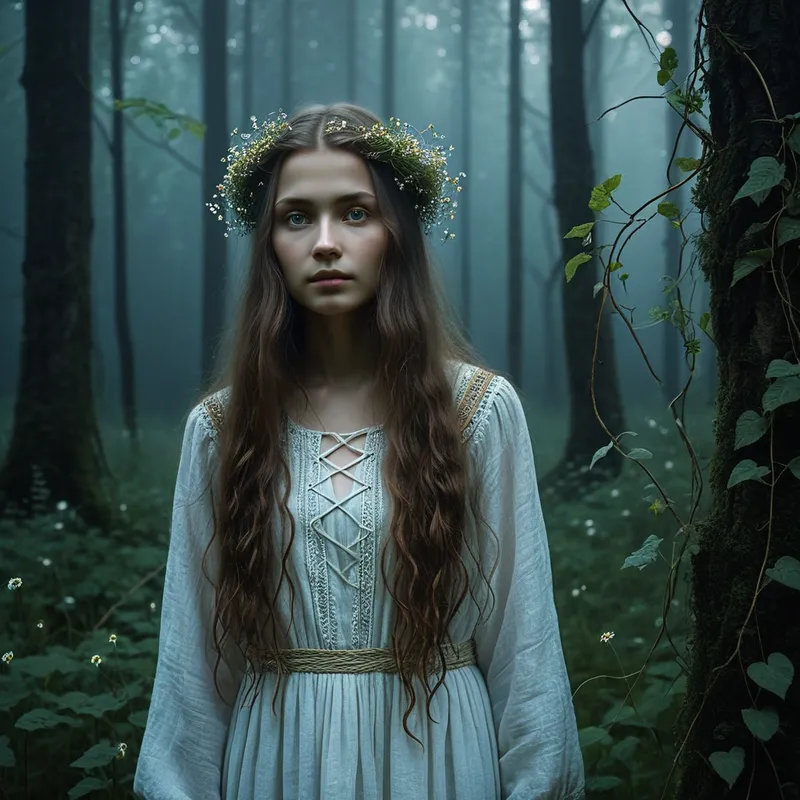
A spirit born from the untimely death of a young woman, the Mavka is a beautiful, sorrowful guardian of the deep forest, eternally caught between life and death.
The Tale of Mavka
Listen, and let the pine needles whisper it. In the time when the world was younger and the forests were kingdoms unto themselves, there lived a sorrow deeper than the roots of the oldest oak. It was the sorrow of a girl who died before her time—not from illness or age, but from a cruel twist of fate, a betrayal by love or a violent severing from life’s thread. Perhaps she was a maiden drowned by a jealous suitor, or a bride struck down on her wedding day. Her soul could not find the path to Nav. It was refused by the earth, which had not received her body with proper rites, and rejected by the sky, which had not heard her final prayer.
And so, her spirit did not depart. It lingered in the liminal breath between worlds, drawn to the deep, shadowed places where the boundaries are thin. The forest, that great, breathing entity, took pity on her. It wrapped her unquiet soul in moss and moonlight, in the scent of damp earth and blooming night flowers. She became a Mavka.
Do not mistake her for a mere ghost. She is a daughter of the woodland now. Her hair is the cascade of willow branches, her eyes hold the deep, still pools of forest springs, and her voice is the rustle of leaves in a wind no mortal can feel. She is heartbreakingly beautiful, a vision of the youth and vitality stolen from her. She dwells in the thickest groves, by the oldest trees, and in the clearings where moonlight falls like silver rain.
She is not evil, but she is dangerous. For her existence is a question that has found no answer, a song that ends on a dissonant chord. She is loneliness incarnate. And so, she sings. Her song is an echo of lost love and forgotten lullabies, a melody that seeps into the bones of any traveler who strays too far from the sunlit path. It pulls at the heart, promising solace, companionship, a love that understands all sorrow.
Men, lured by the beauty and the haunting song, follow it into the green gloom. They see her, this perfect, sorrowful maiden, and are captivated. But to embrace a Mavka is to embrace death itself. Some tales say her back is hollow, like rotten wood, revealing the truth of her nature. Others say that to kiss her is to have one’s life force drawn out, a final, fatal communion. The man who succumbs is never seen again, or is found days later, wandering, mind shattered, his soul forever entangled in the roots of the forest. The Mavka, for a moment, is less alone—but her hunger is for a wholeness she can never again possess, and so the cycle of longing and loss continues, as eternal as the forest itself.
Cultural Origins & Context
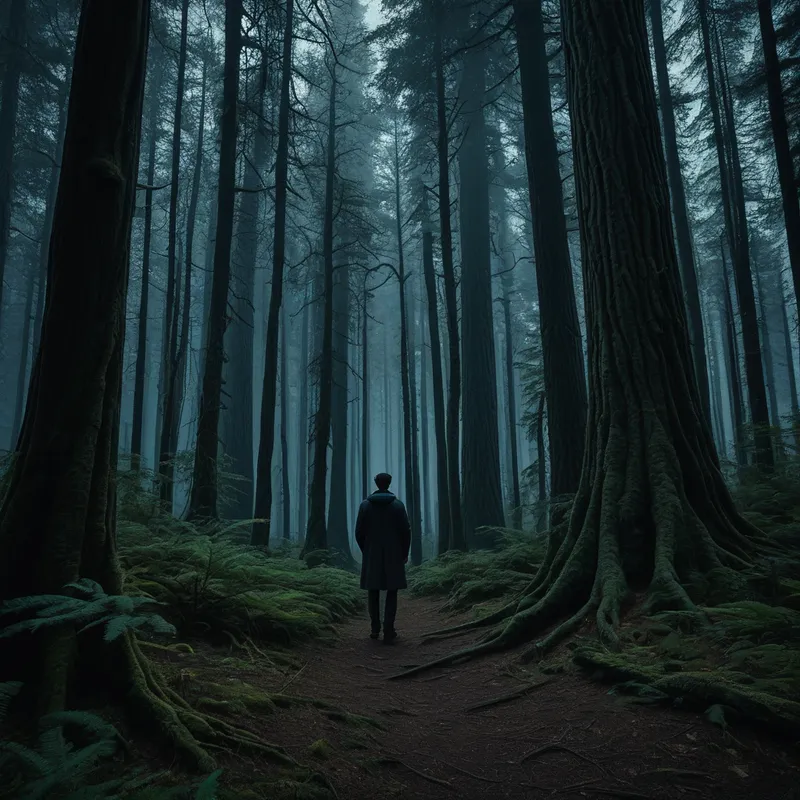
The Mavka belongs to the vast and intricate family of Slavic Rusalki and forest spirits, but with a distinct and poignant etymology. Her name is thought to derive from the Proto-Slavic navь, meaning the dead, or the underworld, linking her directly to the realm of Nav. Unlike the more universally known Rusalka, often associated with water and specific seasonal rites, the Mavka is fundamentally a spirit of the forest, a place of both sustenance and profound danger for agrarian and woodland Slavic communities.
These stories were not mere entertainment; they were ecological and psychological maps. Told by elders around the hearth, or whispered as warnings to children, the myth of the Mavka served critical functions. It personified the very real peril of the deep wilderness—getting lost, succumbing to exposure, or encountering predators. It enforced social and ritual order, emphasizing the catastrophic spiritual consequences of a "bad death" (unnatural, violent, or without proper burial rites) and the vital importance of community ritual in guiding souls to peace. Furthermore, it acted as a cautionary tale about the dangers of unchecked desire and the seductive pull of the unknown, which could lead one away from the safety of the village and into the consuming embrace of the wild.
Symbolic Architecture
The Mavka is a master symbol of the unfinished. She is a soul caught in a tragic interim, a psychological state made manifest. Her myth speaks to the parts of ourselves that have been traumatized, abruptly severed, or denied proper closure.
She is the eternal orphan of the psyche, the complex that was never integrated, the potential that died before it could bloom.
Her beautiful, alluring front represents the captivating face of unresolved grief or trauma—it can appear as nostalgia, as a longing for a lost past, or as a melancholic beauty that draws us in. The hollow back, or the lethal kiss, reveals the truth: that to identify with this state, to try to possess or be possessed by it, is to be consumed by it. The forest is the deep, untamed unconscious, and the Mavka is its most poignant resident: a memory or a self that has become a place, forever wandering its own labyrinth.
She symbolizes the betrayal not just by others, but by life itself—by fate or circumstance that cuts a story short. Her song is the siren call of regression, the desire to return to a state of innocence or union that no longer exists, a call that leads not to healing, but to a psychic death.
The Dreamer's Resonance
When the pattern of the Mavka stirs in modern dreams, it signals a profound encounter with what psychologist James Hillman called the "poetics of pathology." The dreamer may not see a literal forest spirit, but the archetypal dynamics are present.
One might dream of a profoundly beautiful but melancholic person in a liminal space—an abandoned house, a train station at night, a shoreline. There is a powerful magnetic pull toward this figure, a feeling of deep, soul-recognizing connection. Engaging with them feels like coming home to a forgotten sorrow. The somatic experience is crucial: a feeling of being drained, of coldness seeping in during the embrace, or a terrifying revelation of emptiness (a hollow back, a face turning to bark or mist). Alternatively, the dreamer is the Mavka—wandering a beautiful but lonely landscape, singing a song no one truly hears, feeling eternally separated from the vibrant, "living" world by an invisible, sorrowful veil.
This dream imagery points to a psychological process where a part of the psyche—often related to early trauma, a lost relationship, or an abandoned creative self—is active. It is calling for witness, not for fusion. The danger is in the temptation to romanticize the melancholy and become identified with the "beautiful wound," thus stalling one's own vitality.
Alchemical Translation
The individuation process modeled by the Mavka myth is not one of heroic conquest, but of sacred witnessing and conscious grieving. The Mavka cannot be slain, rescued by a prince, or forced into the light. She is a fact of the inner landscape.
The alchemical work is to visit the edge of her grove, to hear her song without being lured in, and to acknowledge her truth without becoming her prisoner.
The first step is Nigredo, the blackening: recognizing and naming the "bad death" within—the betrayal, the abrupt ending, the potential that was crushed. This is the dark forest of depression or grief. The Mavka is the personification of this state. The modern seeker must do what the mythic travelers failed to do: maintain consciousness. They must feel the pull of the sorrow, the seduction of the unresolved, but hold the tension of knowing it is a part, not the whole.
The Albedo, or whitening, occurs in the act of reflection. This is the moment of seeing the Mavka’s hollow back—facing the emptiness and the truth of the loss without illusion. It is a bitter purification. The final transmutation is not about making the Mavka "live again," but about giving her a proper place in the psychic ecology. It is a ritual of inner burial: acknowledging the loss, mourning it with full consciousness, and finally laying that specific identity to rest. In doing so, the raw, trapped energy—the fierce guardianship of the forest that the Mavka also represents—is liberated. It transforms from a haunting ghost into a protective, instinctual wisdom. The forest remains, but one is no longer lost in it. The song of the Mavka becomes not a lure to dissolution, but a bittersweet melody woven into the larger symphony of the Self, a reminder of depth, resilience, and the sacredness of all transitions, even the broken ones.
Associated Symbols
Explore related symbols from the CaleaDream lexicon:
- Forest — The deep, untamed unconscious mind and the realm of instinct, where lost parts of the soul reside and boundaries between self and other blur.
- Death — Not merely an end, but specifically an unnatural or unresolved ending that creates a psychic "stuckness," a soul unable to move on to its next state.
- Spirit — The disembodied essence of a being, caught between states, representing unresolved emotional energy and memory that haunts the present.
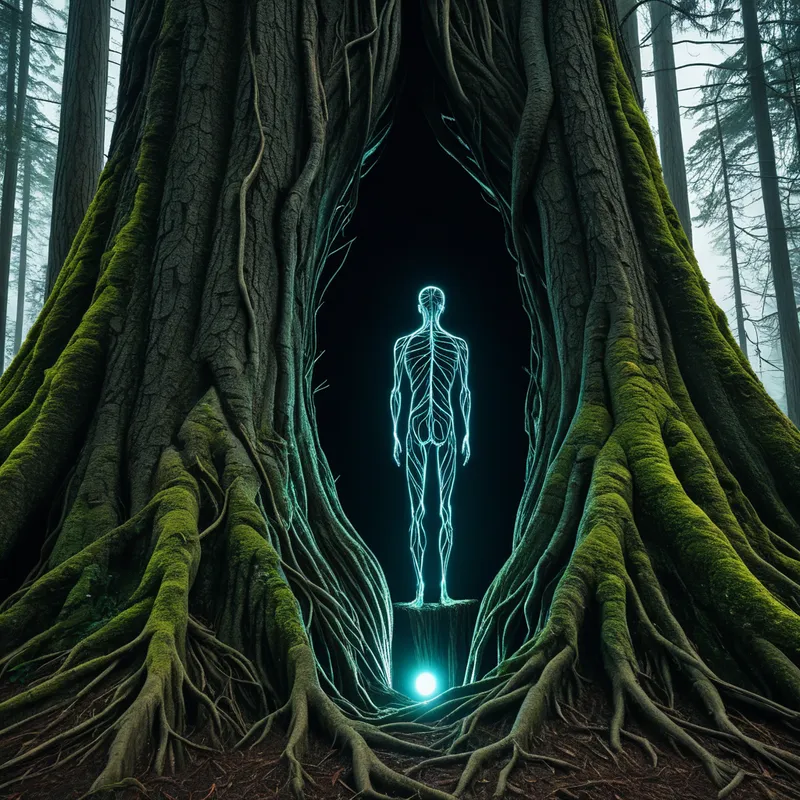
- Tree — The axis of life, death, and rebirth; the Mavka is often merged with trees, symbolizing how trauma can root a part of the psyche in a single moment of time.
- Water — The fluid medium of emotion and the unconscious; the Mavka's origins are often tied to drowning, symbolizing being overwhelmed by feeling.
- Mirror — The Mavka’s beautiful face reflects the dreamer's own unresolved grief and longing, while her hollow back reveals the terrifying truth behind the reflection.
- Grief — The core emotional state of the myth, the unprocessed sorrow that gives the spirit its form and its haunting, compelling power.
- Bridge — The failed transition; the Mavka exists because the bridge between life and a proper death was destroyed, leaving her in the liminal space.
- Song — The seductive call of the unresolved past, a melody that promises understanding and connection but leads to entrapment.
- Shadow — The Mavka is a poignant aspect of the personal and cultural shadow—the beautiful, sorrowful, and dangerous parts of experience we have failed to integrate.