Maui Fishes Up the Islands
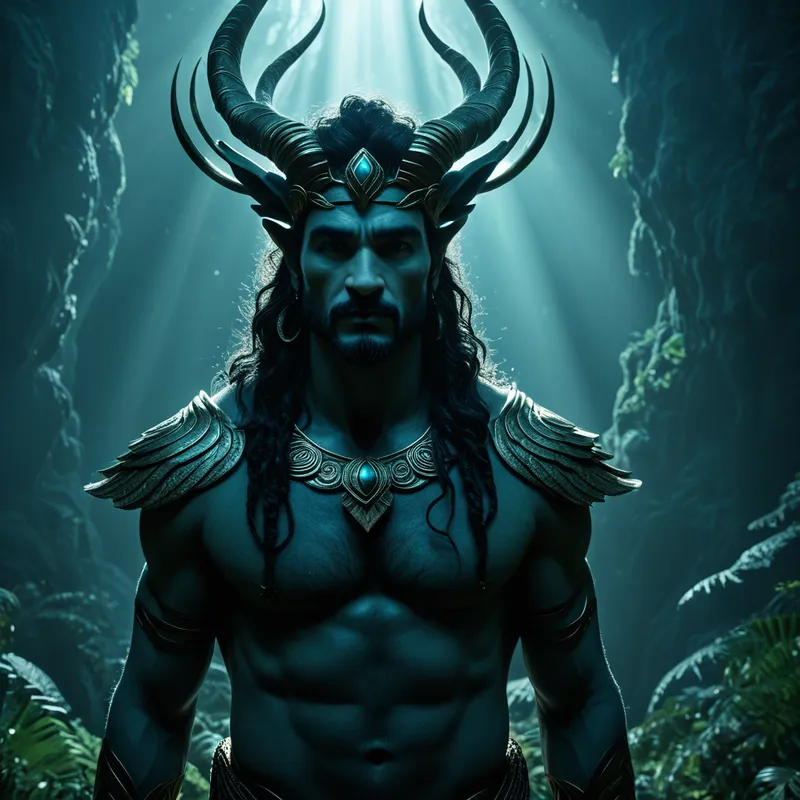
The Hawaiian trickster demigod Maui uses his magical fishhook to pull the islands from the ocean depths, creating the archipelago through cunning and supernatural power.
The Tale of Maui Fishes Up the Islands
The world was smaller then, a tighter circle of known shores. Maui, the youngest, the clever one, watched his older brothers set out each dawn in their canoe, returning with fish enough for the day but never more. Their world was bounded by the horizon, a flat plate upon the endless sea. But Maui, whose blood was a mingling of mortal and divine, felt a restless pull in his bones—a sense of latent, sleeping forms beneath the waves.
He bided his time, practicing his arts. From his wise grandmother, he learned secrets. He fashioned a fishhook, but not from any ordinary bone. He used the sacred jawbone of his ancestor, anointing it with potent mana and chanting prayers that bound intention to form. Manaiakalani, he named it: "The Heaven-Bringer." To this hook, he attached a line plaited from the strongest coconut fiber, a cord that was both physical and a thread of his own will.
One morning, he hid in the hull of his brothers' canoe. Far out, beyond the fishing grounds, he revealed himself. His brothers were angry, fearful of the deep, uncharted waters. But Maui, with the persuasive trickery of the trickster, calmed them. He took his magical hook, baited it not with food, but with a potent symbol—some say a dark nectar from the underworld, others say a fragment of his own divine shadow. He cast the line. It unspooled, down through the liquid blue, through the cold, silent darkness, until it caught.
Not on a fish, but on something vast, slow, and ancient. The canoe shuddered. Maui braced himself, planting his feet against the gunwales, his muscles straining not against mere weight, but against the very foundations of the world. He chanted a pull-strong chant, a song to awaken the slumbering land. "E ʻai ē kāua i ka iʻa nui ē!" he cried. "Let us two eat of the great fish!"
The sea began to boil. The brothers, terrified, hauled on the line with him. Up from the abyss, land broke the surface—first a peak, then ridges, valleys, and shores streaming with waterfalls of ocean. Island after island, Maui hauled them forth: Hawaiʻi, Maui, Kahoʻolawe, Lānaʻi, Molokaʻi, Oʻahu, Kauaʻi. Each one, a great fish transformed into earth, still warm from the deep fire of its birth.
But the work was not complete. As he pulled the last and mightiest island, perhaps the future Hawaiʻi, one of his brothers, overcome with awe or fear, looked back. The sacred tension broke. The line snapped. The great fish, only half-revealed, settled into its current form. The archipelago was born, beautiful and fragmented—a chain of possibilities, with the greatest left submerged. Maui’s act was one of supreme creation, yet it carried within it the echo of incompletion, a testament to both divine ambition and human limitation.
Cultural Origins & Context
This myth is central to the Hawaiian moʻolelo, the narrative tradition that maps identity onto landscape. It is not merely an etiological tale explaining geography, but a cosmological charter. The islands are not inanimate rock; they are āina, land that feeds, born from the ocean (kai), which is both source and separator. This origin story establishes a familial, reciprocal relationship between the people and the land—the islands are kin, fished up by an ancestor.
Maui himself is a pan-Polynesian demigod, a figure of immense cultural significance. In Hawaiʻi, he is less the purely mischievous troublemaker of some other traditions and more a culture hero whose cunning (akamai) is directed toward profound, life-giving ends. His act of fishing up the islands is his greatest feat, a definitive moment of world-shaping. The story was preserved and recited by kūpuna (elders) and kahuna, embedding within it values of ingenuity, perseverance, and the proper use of supernatural power (mana). It teaches that the world as known is not a given, but an achievement, wrested from the unknown through a combination of ancestral wisdom, personal daring, and ritual precision.
Symbolic Architecture
The myth is a dense tapestry of symbols speaking to the psyche’s creative process. The ocean represents the primordial, unconscious depths—the teeming, unformed potential of the psyche and the world. Maui’s fishhook, Manaiakalani, is the focused tool of consciousness, crafted from ancestral wisdom (the jawbone) and directed by will. The fishing line is the thread of attention and intention that connects surface awareness to deep, archetypal contents.
The islands are not caught, but awakened. They are latent forms within the collective deep, awaiting the hook of a conscious question, the tension of a creative struggle to be brought into the light of day.
The act itself is one of profound mediation. Maui, a hybrid being, stands between heaven and earth, the human and the divine, the known and the unknown. He translates the formless into form. The brothers’ participation, and ultimately their failure in looking back, symbolizes the necessary yet flawed role of the collective ego in any great creative or transformative act. The ego aids in the hauling, but its fear or premature awe can fracture the wholeness of what is being born, leaving the creation magnificent yet incomplete—a reality mirrored in every human endeavor and in the very landscape of the islands themselves.
The Dreamer's Resonance
To dream of pulling something immense from the water is to touch this mythic pattern. It speaks to a moment in the personal psyche where a great, buried structure of the self—a talent, a memory, a new phase of life—is ready to surface. The dreamer is Maui in that moment, feeling the strain and the exhilaration of birthing a new inner landscape.
The myth resonates with anyone who has engaged in a profound creative act: the writer hauling a novel from the subconscious, the entrepreneur pulling a vision into reality, the therapist helping a client fish up a lost trauma into the light of awareness. It validates the feeling of struggle, the sense of grappling with something vast and ancient within oneself. It also normalizes the experience of incompletion—the snapped line. Our greatest personal "islands," our most ambitious projects of self-becoming, are often only partially realized. Yet their emergent form is still sacred, still āina that can nourish us. The myth suggests that the act of fishing itself, the courageous engagement with the depths, is as important as the perfect finished form.
Alchemical Translation
Psychologically, this is an alchemical drama of solve et coagula—dissolving the old boundaries and coagulating new substance. The oceanic unconscious (massa confusa) is "solved" or activated by the hook of focused consciousness. The islands are the "coagulated" result, new stable forms of psychic territory emerging from the flux.
The broken line is not a failure, but a signature of the human condition. It marks the point where divine inspiration meets mortal limitation, where the infinite potential of the unconscious becomes the finite, beautiful reality of conscious life. The fragment is the price of form.
Maui’s work is the archetypal act of the transcendent function. He creates a third thing—the inhabited, known world—from the tension between the deep, unknown sea and the shallow, known surface. His trickery is the necessary cunning to bypass the ego’s initial resistance (his brothers’ fear) to engage with the profound. The resulting archipelago is a symbol of the individuated Self—not a monolithic continent, but a chain of distinct yet connected psychic landmasses, each with its own character, born from a sustained engagement with the depths.
Associated Symbols
Explore related symbols from the CaleaDream lexicon:
- Ocean — The primordial, unconscious source of all potential and the great unknown from which conscious forms are drawn.
- Fish — The latent, autonomous content of the deep psyche, a form of life and nourishment waiting to be "caught" by consciousness.
- Trickster — The boundary-breaking archetype of cunning and transformative wit, essential for creative acts that defy conventional order.
- Hero — The aspect of the psyche that undertakes a seemingly impossible task for the benefit of the wider world or self.
- Island — An emergent, isolated consciousness born from the unconscious; a distinct psychic complex or achieved state of being.
- Land — The realm of the manifested, solid, and nourishing; achieved reality and grounded consciousness.
- Hook — The focused tool of intention, attention, or inquiry that connects the surface ego to deep, archetypal contents.
- Journey — The necessary voyage beyond familiar boundaries into the unknown, which precedes any great act of creation or discovery.
- Ancestor — The internalized wisdom of the past, the lineage of knowledge and power from which transformative tools are fashioned.
- Creation — The fundamental act of bringing new order, form, or reality into existence from a state of potential or chaos.
- Nature — The encompassing, non-human world and its processes, of which human consciousness is both a part and a shaper.
- Dream — The native language of the deep ocean within, where future islands first take shape as images and intuitions.