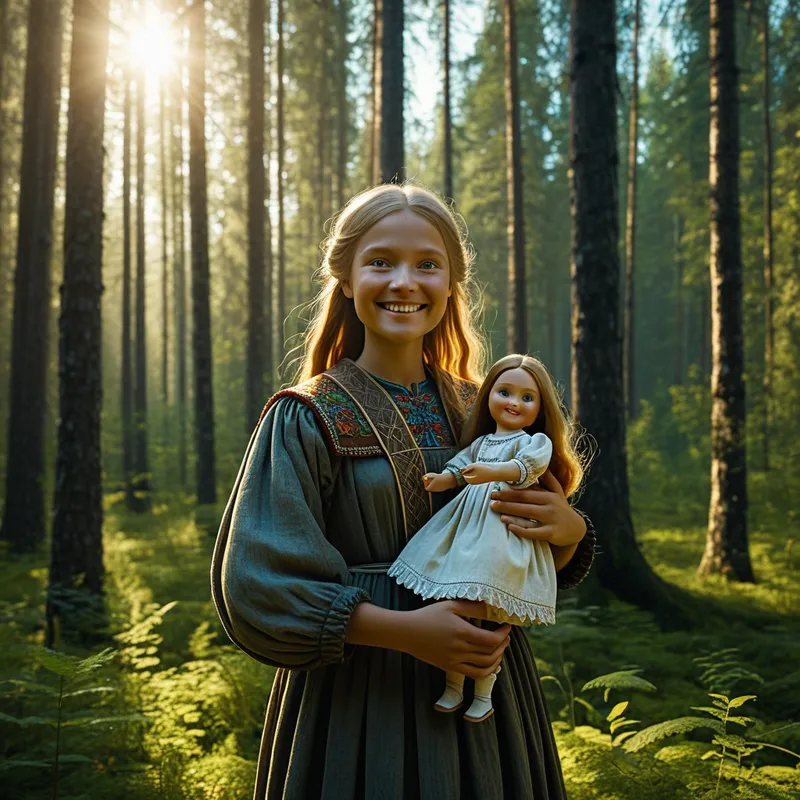
Matryoshka Dolls Myth Meaning & Symbolism
A tale of a wooden maiden whose true self is hidden within, revealing layers of ancestral memory and the soul's journey toward wholeness.
The Tale of Matryoshka Dolls
Listen, and hear the tale that is not carved in stone, but in wood and memory.
In the time when the birch leaves whispered secrets to the Veter and the earth slept beneath a thick blanket of snow, there lived a woodcarver named Miron. His hands were gnarled like old roots, but they held the wisdom of the grain. He lived on the edge of the deep, silent forest, a place where the shadows held the shapes of old gods and the air tasted of pine and possibility.
One winter, a great stillness fell. The world seemed hollow, waiting. Miron felt a longing in his chest, a pull toward his bench and a single, perfect block of lime wood that had been seasoning by his hearth for years. It was not a block for a spoon or a toy. It called for a vessel. As his knife bit into the pale wood, he did not think of form; he thought of his grandmother, Sofia, her face a map of kindness, her songs the bedrock of his childhood. The wood began to take shape under his weeping knife—a woman, round and sturdy, with a serene, painted smile and a scarlet babushka.
But when he held the finished figure, it felt… incomplete. It was beautiful, yet it was only a shell. The longing in his chest did not abate; it grew. That night, by the fire’s glow, he heard a voice like rustling leaves. “What is held within?” It was the spirit of the tree itself. Startled, Miron looked at the doll. With a careful, trembling hand, he found a nearly invisible seam around its middle. Using his smallest blade, he turned the two halves apart.
There, nestled perfectly within the hollow of the first, was a second, smaller doll. Identical in every detail, yet undeniably her own being. His breath caught. He opened the second, and within her, a third. Again and again, his world shrinking to the circle of firelight and the miracle in his hands, until he held the seventh and final doll. This one was solid, no seam to be found, carved from the very heartwood of the block. She was tiny enough to rest in the cup of a child’s palm, yet her painted eyes held the depth of the first frost and the warmth of the summer sun.
As he placed the final doll inside the sixth, and that inside the fifth, rebuilding the original woman, the air in his hut changed. It grew thick with the scent of baking bread, of dried herbs, of a perfume long forgotten. He saw not one face in the painted smile, but many: his grandmother Sofia, her mother before her, and mothers beyond counting, their stories and silences now held safe within this wooden form. The great hollow stillness of winter was filled. He had not carved a toy; he had built a nest for the soul.
Cultural Origins & Context
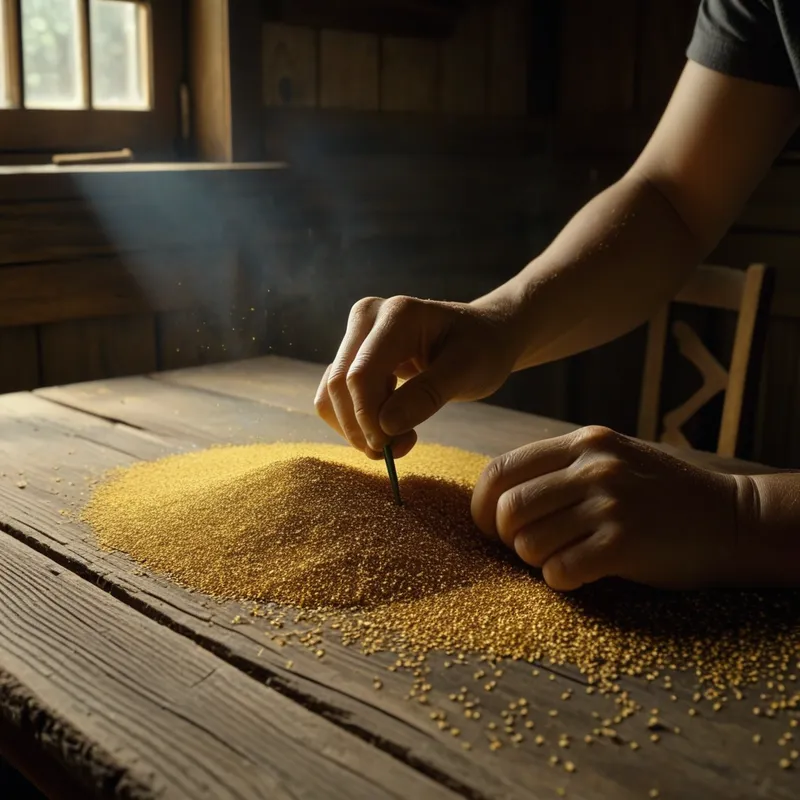
While the physical Matryoshka is a artifact of the late 19th century, inspired by Japanese Fukuruma dolls and championed by patron Savva Mamontov, its soul is ancient. It is a perfect vessel for a much older, deeply Slavic worldview. This was not a myth told in epic verse, but one lived in the daily rhythm of the dvor and whispered in the banya.
The figure of the matron, the Matryona (from which "Matryoshka" derives), was the cornerstone of family and survival. She was the keeper of the hearth, the recipes, the lullabies, and the lineage. Knowledge and identity were not stored in books, but in layers of lived experience, passed from mother to daughter, contained within the very body and memory of the family. The doll’s form gives physical shape to this concept of embedded wisdom. Its creation and use were a folk art, a craft taught hand-to-hand, itself a ritual of embedding skill within the practitioner—another layer of the nesting.
Symbolic Architecture
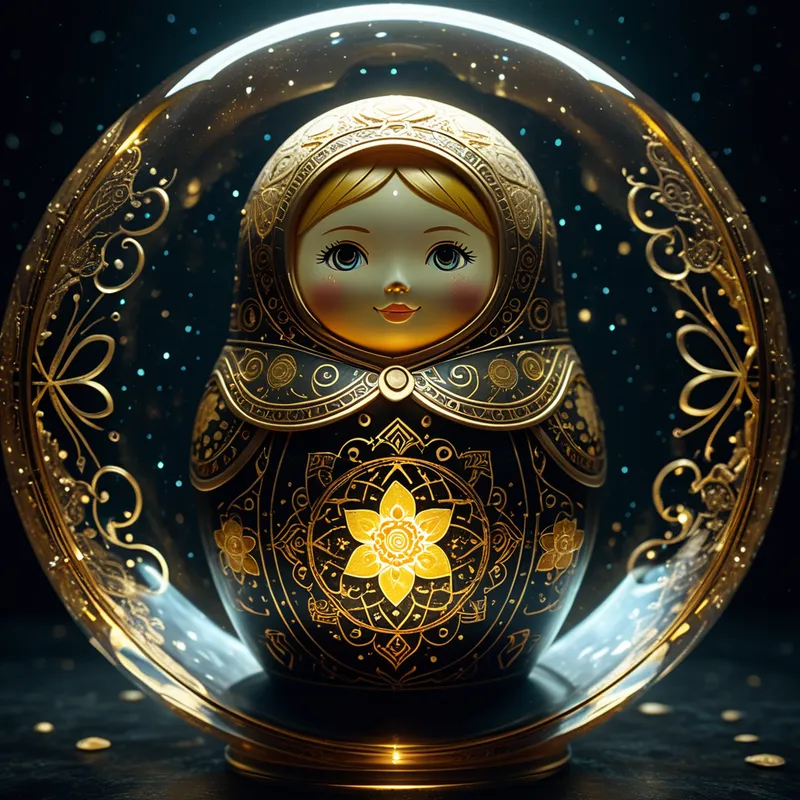
The Matryoshka is a perfect symbolic engine for the architecture of the self. Its primary teaching is that of envelopment and protected revelation.
The true self is not found by building outward, but by a respectful turning inward, where each layer guards the sanctity of the next.
The outermost doll represents the Persona—the face shown to the world, sturdy, painted with the colors of our roles and responsibilities. The act of opening it is an act of vulnerability, of moving past the social shell. Each subsequent layer can be seen as a sub-personality, a historical self, a forgotten talent, or a bundle of inherited traits. They are not random; they fit perfectly inside one another, suggesting an inherent, if hidden, order.
The final, solid core is the ultimate symbol. It is the irreducible self, the Self in the Jungian sense. It cannot be taken apart because it is the fundamental essence, the seed from which all the outer layers grew. It is both the beginning and the end of the journey.
Furthermore, the doll is a profound symbol of the feminine principle—not as gender, but as the archetypal principle of containment, nurture, and inner space. It is a womb-like series of chambers, protecting and sequencing life and identity. It also mirrors the Slavic folk belief in multiple souls or the layered soul, where one aspect might be tied to the body, another to the breath, and another to ancestral memory.
The Dreamer's Resonance
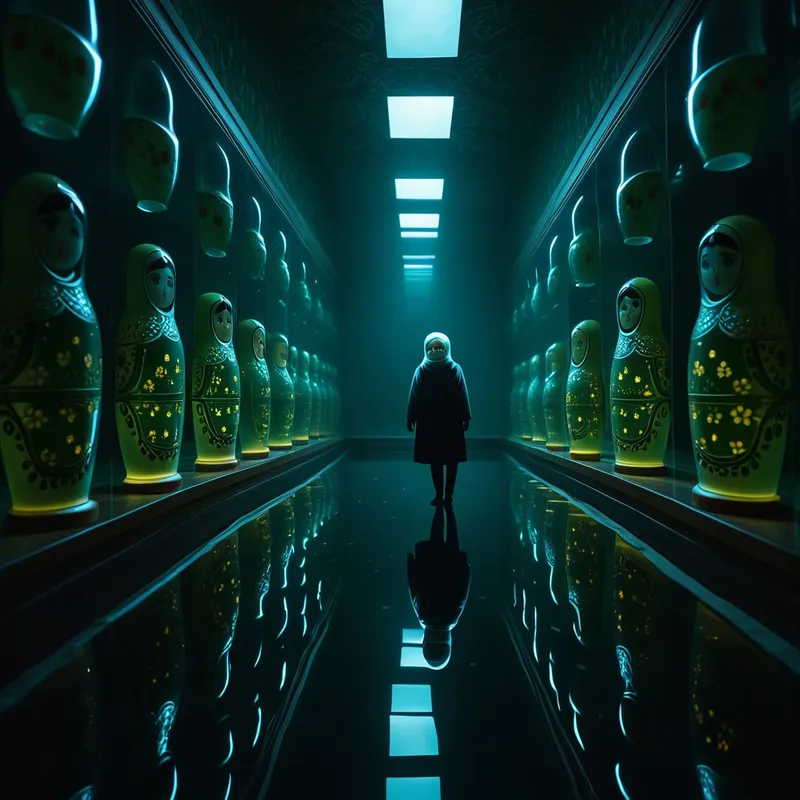
To dream of Matryoshka dolls is to dream of introspection made tangible. The somatic sensation is often one of curiosity mixed with trepidation—a compulsion to open, to see what’s inside, paired with a fear of breaking something precious or finding nothing at all.
If one dreams of endlessly opening dolls that never get smaller, or that become empty, it speaks to a psychological process of feeling perpetually superficial, of fearing there is no solid core to one’s identity—a confrontation with the void. Conversely, dreaming of a beautiful outer doll that cannot be opened may reflect a sense of being trapped in one’s persona, unable to access deeper feelings or truths.
A potent modern variation is dreaming of opening a doll to find not a smaller one, but a scene from one’s own childhood, or the face of a parent or grandparent. This is the psyche directly illustrating the concept of psychic inheritance. The dream is showing that within your current "layer" of adulthood resides the intact experience and influence of earlier selves and ancestors. The process is one of mapping the internal family, acknowledging that we are not singular, but nested communities.
Alchemical Translation
The myth of the Matryoshka provides a serene, non-heroic model for the alchemical work of individuation. Unlike the epic quest with dragons and battles, this is the opus of careful, patient interiority. The goal is not to slay or acquire, but to assemble.
The alchemical stages are mirrored in the process: the initial longing (nigredo, the blackening, the sense of incompleteness) leads to the careful work of separation (separatio)—distinguishing the outer layer from the inner. Each opening is a minor dissolution and analysis. As one proceeds, understanding deepens (albedo, the whitening). One begins to see the pattern, the perfect fit of one’s experiences and traits.
Individuation is the reassembly of the self with conscious awareness, holding all the layers together in one hand, finally understanding their necessary sequence.
The final stage (rubedo, the reddening) is not just finding the solid core, but the act of putting all the pieces back together. The integrated individual is not the tiny core doll alone, isolated. She is the complete set, from largest to smallest, reassembled. The outer persona, once a mere shell, is now known to be the guardian of an inner universe. It is re-consecrated. The struggle is the courage to turn oneself inward; the triumph is the realization of profound, structured depth. One becomes both the carver, the doll, and the nested lineage within—a vessel of becoming, whole at last.
Associated Symbols
Explore related symbols from the CaleaDream lexicon: