Matronae Myth Meaning & Symbolism
The myth of the Matronae, the Roman Mothers of Fate, who weave destiny at the crossroads of life, death, and the sacred hearth.
The Tale of Matronae
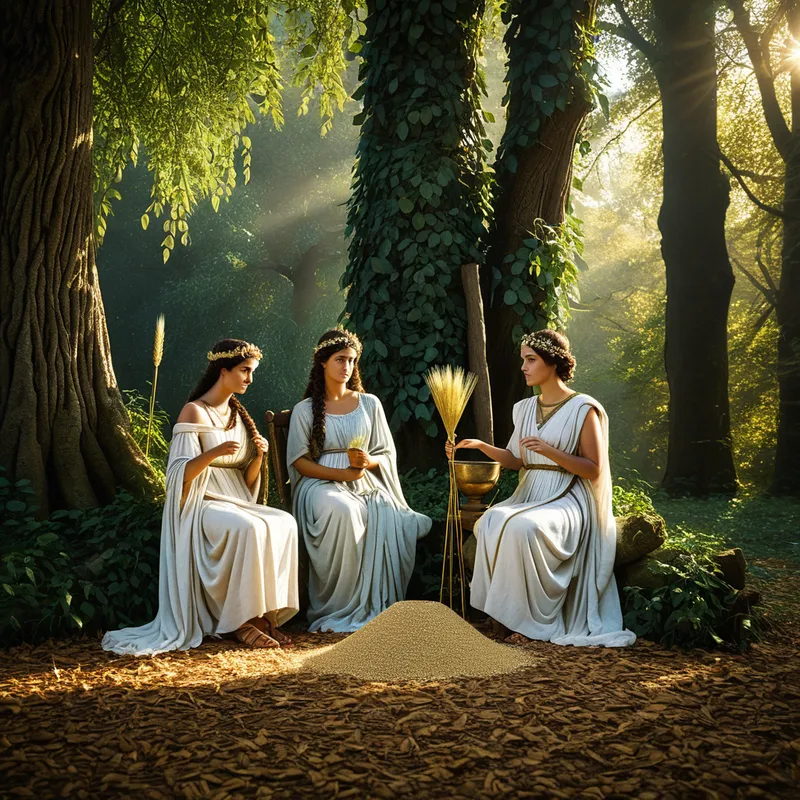
Listen. The air is thick with the scent of baking bread and crushed myrtle. Not in the marble halls of the Capitol, but here, where the cobbled street gives way to the beaten earth path. Here, where the boundary stone stands, half in the world of men, half in the world of the numinous. This is the domain of the Matronae.
They are Three. They are always Three. You do not see them arrive; you feel their presence settle like dew. The first sits with her back against the ancient oak, her fingers never still. From a distaff of cloud-wool, she draws the thread. It is not flax, nor wool, nor silk. It is the substance of a life—gossamer at its start, strong in its middle, fraying at its end. Her spindle whirls, a low hum that is the sound of time itself being drawn out and given form.
The second kneels at the hearth-stone, though no fire is lit. In her cupped hands, she does not hold flame, but sustenance. From the void, she coaxes forth not bread, but the capacity for bread; not wine, but the promise of the vine. She is the silent yes to the seed in the soil, the quickening in the womb, the strength in the weary bone. Her offering is not a thing, but a potential—a nourishing emptiness waiting to be filled.
The third stands at the crossroads, her eyes holding the depth of a well-shaft leading to the underworld. She holds no tool, only a gaze that measures. She watches the path the thread takes, sees where it dips and where it strains. She observes what is poured from the bowl of the second, noting what is received, what is spilled, what is shared. Her role is not to cut, but to acknowledge the final knot, the point where the thread ends and is gathered back into the source.
A woman approaches, her face lined with the dust of the road and the quiet fear of the barren. She places her offering—a honeycake, a twist of wool from her first lamb, a lock of her mother’s hair—on the flat stone before the Three. She speaks no prayer aloud, but her heart’s plea hangs in the air: Let the thread hold. Let the bowl be full. Let my path be blessed.
The Spinner pauses. Her eyes, the color of a winter sky, meet the supplicant’s. She plucks a new, bright filament from the air and, with a breath, ties it to the existing thread of the woman’s lineage. The thread strengthens, gains a new luster.
The Nourisher smiles, a warmth radiating from her that has nothing to do with the sun. She passes her hand over the woman’s own empty bowl—the bowl of her womb, the bowl of her hearth. A single, perfect grain of wheat appears within it, glowing with latent life.
The Witness at the crossroads simply nods, a gesture that contains both the weight of inevitability and the grace of acceptance. The path ahead for the woman does not suddenly become easy, but it becomes hers, recognized and sanctified.
The Matronae do not speak. Their work is in the spinning, the filling, the seeing. The myth is not an epic of clash and conquest, but a silent, perpetual ritual at the threshold of every home, every field, every birth, and every death. It is the story of the quiet forces that hold the world together, stitch by stitch, seed by seed, breath by breath.
Cultural Origins & Context
The Matronae were not Olympians with grand Homeric tales. They belonged to the stratum of Roman religion that was older, deeper, and fundamentally local—the world of the numina, the indwelling spirits of place and function. Their worship was particularly fervent in the provinces of the Rhineland and Gaul, where thousands of dedicatory stones and altars have been found, offered by soldiers, merchants, families, and guilds.
These were not state-sponsored myths recited by poets, but living traditions of hearth and homeland. The stories of the Matronae were told in actions, not words: in the placement of an extra setting at the table for the ancestral mothers, in the libation poured at the boundary stone of the farm, in the votive figurines of three seated women left at wayside shrines. They were the divine embodiment of the matron, the married Roman woman who was the custodian of the family’s continuity, its religious rites, and its material well-being. To honor the Matronae was to honor the source of lineage, fertility, and social stability itself. Their cult was a grassroots theology of gratitude and supplication, addressing the most fundamental human concerns: will our line continue? Will we be fed? Will our journey be seen and blessed?
Symbolic Architecture
Psychologically, the triad of the Matronae represents the threefold nature of fate and nourishment that every individual and community must negotiate.
The Spinner is the archetype of Becoming. She symbolizes the raw, unmanifest potential of life being drawn into the linear reality of time and experience. Her thread is not just destiny imposed, but the very fact of our existence—our innate talents, our constitutional strengths and weaknesses, the core pattern of our psyche.
The thread is not a prison, but the loom on which the self is woven.
The Nourisher is the archetype of Sustenance. Her bowl represents the receptive principle—the womb, the heart, the community, the earth itself. She symbolizes all that feeds and supports the thread of life: love, resources, mentorship, culture, and literal nourishment. Her power is in fertile emptiness, the capacity to receive the seed and transform it into growth.
The Witness is the archetype of Consciousness. She embodies the necessary, often feared, aspect of limitation and ending. Her crossroads represent critical junctures and final thresholds. Her gaze is the act of conscious recognition—of consequences, of mortality, of the completion of cycles. She does not wield a shears, but her seeing is what gives meaning to the cut, making an end not a mere cessation, but a concluded chapter.
Together, they form a complete psychic circuit: the emission of life-force (Spinner), the matrix that receives and nurtures it (Nourisher), and the awareness that contextualizes it within the larger tapestry of existence (Witness).
The Dreamer's Resonance
When the pattern of the Matronae stirs in the modern unconscious, it often surfaces in dreams of triplicate feminine figures, of weaving or knitting, of overflowing or empty containers, and of significant crossroads or thresholds.
To dream of the Spinner may signal a somatic felt sense of one’s life "taking shape" or feeling "pulled in a certain direction." It can accompany life transitions where one’s innate pattern is being activated—a new career, a creative awakening, the discovery of a calling. Anxiety in such dreams may point to a fear of one’s own potential or a sense of being trapped by one’s nature.
Dreams of the Nourisher often cluster around themes of abundance and scarcity. Dreaming of a bountiful feast or a nurturing figure can indicate the psyche is integrating support, self-care, or maternal wisdom. Conversely, dreams of empty bowls, barren landscapes, or withholding mothers may point to a psychic or emotional famine—a depletion of the resources needed to sustain one’s current path, calling for a turn towards inner and outer sources of replenishment.
The Witness in dreams appears as the figure at the end of the road, the judge, the silent observer in the corner of a crucial dream scene, or the guide at a fork in a path. This can manifest somatically as a feeling of being "seen through" or of reaching a point of no return. Such dreams often arise during periods of major decision, the end of a relationship or project, or when confronting one’s own mortality. The psychological process is one of coming to conscious terms with limits and necessary endings, integrating the shadow of fate into the self.
Alchemical Translation
The alchemical process modeled by the Matronae is not a heroic slaying of dragons, but the sacred, patient work of tending the vessel of the soul through the three fires of destiny: the fire of creation, the fire of sustenance, and the fire of transformation.
The individual’s journey begins with Recognizing the Thread (the Nigredo). This is the often-dark work of the Spinner: confronting one’s innate nature, one’s core complexes, and the familial or karmic patterns one has inherited. It is the acceptance of the raw material of the self, with all its flaws and gifts. This is the leaden weight of fate that must be acknowledged before it can be worked.
The work proceeds to Filling the Vessel (the Albedo). This is the nurturing, purifying work of the Nourisher. It involves consciously cultivating what sustains the recognized self: seeking nourishing relationships, environments, knowledge, and practices. It is the creation of a psychic temenos—a protected, fertile space where the soul-seed can germinate. Here, the individual learns to receive and to self-nourish, turning potential into substance.
The alchemy of the soul occurs not in the grand gesture, but in the daily act of receiving the thread, filling the bowl, and honoring the crossing.
The culmination is Consciousing the Crossroad (the Rubedo). This is the radiant, integrative work of the Witness. It is the moment when the individual, having spun and nourished their life, can stand at their own crossroads with full awareness. This is not passive resignation to fate, but an active, conscious consecration of one’s choices and their ends. It is the achievement of meaning, where one’s life, in its entirety, is seen, accepted, and understood as a necessary and complete expression of the self. The thread is not broken, but completed; the bowl is not emptied, but its contents fully transformed; the path is not abandoned, but its destination finally beheld and integrated. This is the individuated state—not as a master of fate, but as a conscious collaborator with the Three Mothers who work within.
Associated Symbols
Explore related symbols from the CaleaDream lexicon: