Masamune Myth Meaning & Symbolism
The tale of a master swordsmith whose blade, forged in humility and spirit, reveals true purity by exposing the flaws of a rival's ego-driven creation.
The Tale of Masamune
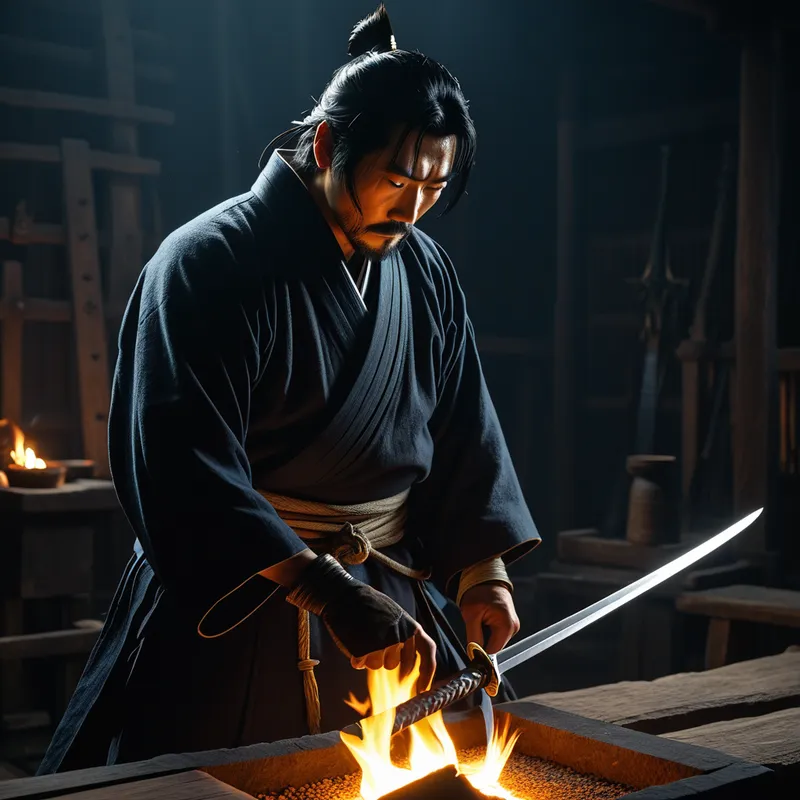
Listen, and hear the whisper of steel folded ten thousand times. In an age when the spirit of the land still spoke through fire and water, there lived a man whose hands were guided by the kami. His name was Gorō Nyūdō Masamune. His forge was not merely a workshop; it was a shrine, a place of purification where the breath of the bellows was a prayer and the strike of the hammer a sacred rhythm.
The air in Sagami Province hung heavy, not just with heat, but with the weight of an unspoken challenge. For there was another smith, Sengo Muramasa. His talent was a blazing, undisciplined star. His blades were born of a fierce, hungry fire—razor-sharp, eager to draw blood, vibrating with a restless energy that some said mirrored his own turbulent spirit. A silent rivalry, cold as unsheathed steel, stretched between their traditions.
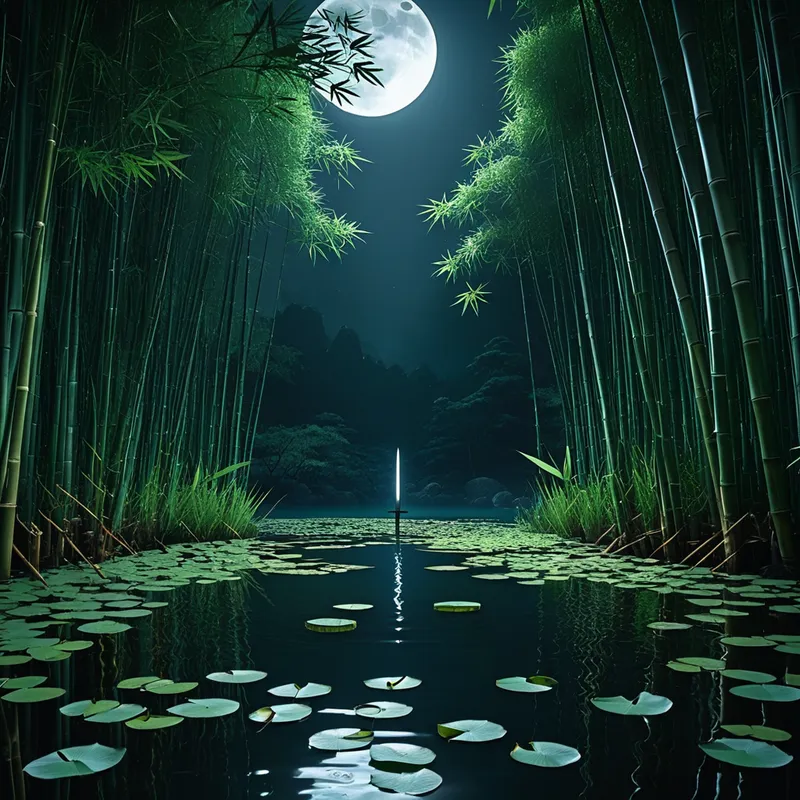
To settle the matter of supreme artistry, a test was devised. The two masterworks—Masamune's serene Yawarakai-Te and Muramasa's fierce Juuchi Yosamu—were suspended in a gentle, crystal-clear stream, their cutting edges facing the current.
Muramasa’s blade sang a song of violence. Leaves, fish, even the very air that touched its edge were severed. It cut the current itself, parting the water with a vicious hiss, a testament to its unparalleled, indiscriminate sharpness. The observers murmured in awe and fear.
Then, they looked to Masamune’s blade. And they saw… nothing. The water flowed around it, undisturbed. Leaves drifted past, caressing its side. A curious fish swam unmolested through its shadow. To the untrained eye, it seemed a failure—a dull, inert bar of metal. Disappointment rippled through the crowd.
But a wise, old monk, his eyes seeing the world of spirit as clearly as the world of form, stepped forward. He smiled. “Observe,” he whispered. He plucked a single lotus leaf and let it fall upon the current upstream of Masamune’s sword. The leaf, carried by the flow, did not avoid the blade. It was drawn to it. And as it touched the steel, it did not slice, but parted cleanly along its natural seam, as if willingly offering itself, before the two halves floated peacefully on.
“Muramasa’s blade cuts all things without discrimination,” the monk declared, his voice resonating in the sudden silence. “It is a weapon of chaos, of unbound appetite. But Masamune’s blade… it possesses saya no uchi no kachi—the victory in the scabbard. It cuts only that which deserves to be cut: evil, injustice, impurity. It spares the innocent, the pure, the living water. This is not mere sharpness. This is discernment. This is a blade that possesses a soul of benevolence.”
In that moment, the truth was unveiled. Masamune’s creation was not inert; it was in perfect harmony. It did not force its will upon the world; it interacted with the essential nature of things. The rival’s blade, for all its terrifying prowess, was revealed as a slave to its own edge, while Masamune’s was a master of spirit.
Cultural Origins & Context
The tales of Masamune and Muramasa are not Kojiki myths of primordial gods, but densetsu born from the medieval samurai ethos. They emerged in the tumultuous Sengoku Jidai, a time when the quality of a sword literally meant the difference between life and death, honor and disgrace. These stories were told by swordsmiths to apprentices, by samurai around campfires, and later, immortalized in Kabuki and ukiyo-e.
Their function was multifaceted. On one level, they were parables of craftsmanship, extolling the virtues of patience, spiritual discipline, and humble service to the art over flashy technical skill. On a deeper societal level, they served as moral instruction for the warrior class. A samurai’s sword was his soul; the myth taught that the soul’s true power lay not in unchecked aggression, but in righteous judgment and controlled force. The Masamune legend thus became a cornerstone of the idealized bushidō spirit, where the ultimate weapon is one that knows when not to strike.
Symbolic Architecture
At its heart, this is not a myth about swords, but a myth about consciousness. The two blades represent two fundamental orientations of the psyche.
Muramasa’s blade symbolizes the untamed, undifferentiated Shadow and the raw, unchecked power of the ego. It is pure id, cutting through reality without consciousness, distinction, or care for consequence. It is talent without wisdom, force without purpose, a brilliant but dangerous fragmentation of the self.
Masamune’s blade represents the integrated Self, where consciousness and the unconscious are folded together like the layers of his steel.
His Yawarakai-Te (Tender Hands) embodies the principle of synthesis. The folding process is the labor of individuation—taking the base, brittle material of the unconscious (the raw tamahagane) and repeatedly heating, hammering, and folding it with the oxygen of awareness. The resulting blade is not a denial of sharpness (power), but its transcendence into discernment. It can cut, but its primary state is one of serene, non-invasive presence. It does not seek conflict; it resolves it by recognizing the inherent nature of what approaches it. The lotus leaf parting along its seam is the ultimate symbol of this: true power works with the natural order, not against it.
The Dreamer's Resonance
When this myth pattern stirs in the modern psyche, it often manifests in dreams of choice, judgment, or confrontation with a "sharp" or dangerous aspect of oneself or another. You may dream of a brilliantly sharp tool that turns on you, or of a serene object that passively deflects chaos. You may find yourself tested, asked to choose between two paths: one flashy and immediately gratifying but fraught with collateral damage, the other quiet, demanding, and profoundly right.
Somatically, this can feel like a tension between a knotted, aggressive energy in the solar plexus (the Muramasa impulse) and a calm, centered strength in the hara (the Masamune center). The psychological process is one of discernment. The dream ego is navigating the challenge of integrating a potent but unruly talent, a fierce ambition, or a reactive anger into a more conscious, purposeful framework. The dream asks: Is this power serving my whole being, or is it cutting me off from life, like the blade that severs the very water that flows past it?

Alchemical Translation
The alchemical journey modeled here is the transmutation of raw skill or power into wise artistry. We all possess our "Muramasa blade"—a innate talent, a sharp intellect, a passionate drive. Left in its raw state, this gift can become a curse, isolating us, creating unintended damage, and ultimately becoming a source of inner turmoil.
The Masamune process is the sacred labor of the Creator archetype. It requires the forge of discipline (the consistent practice), the fire of attention (self-reflection), and the water of humility (the quenching of ego). We must "fold" our raw impulses into our conscious values, again and again, creating a layered, resilient structure.
The goal is not to dull your edge, but to sanctify it. To move from being wielded by your power to wielding it with benevolent intent.
The final test at the stream is the moment of lived integrity. It is when your actions in the world no longer arise from a need to prove your sharpness, but from an attuned responsiveness to the situation itself. You cut only what needs to be cut—outmoded habits, toxic relationships, self-deception—and you spare what is vital and pure. Your very presence becomes a clarifying force, not a destructive one. You achieve saya no uchi no kachi: the greatest victory is the one where the sword, integrated and wise, never needs to leave its scabbard at all. In this state, you are not a weapon, but a work of art—forged in spirit, tempered by experience, and utterly, harmoniously whole.
Associated Symbols
Explore related symbols from the CaleaDream lexicon: