Marzanna Myth Meaning & Symbolism
A myth of the Slavic goddess of winter and death, ritually drowned to ensure the rebirth of spring, embodying the necessary cycle of decay and renewal.
The Tale of Marzanna
Listen, and hear the tale that the old earth tells when the wind bites from the north and the last leaf clings to the oak. In the time when the world was thick with forest and the spirits spoke in the rustle of the rye, there walked a queen not of summer’s bounty, but of silence. Her name was Marzanna.
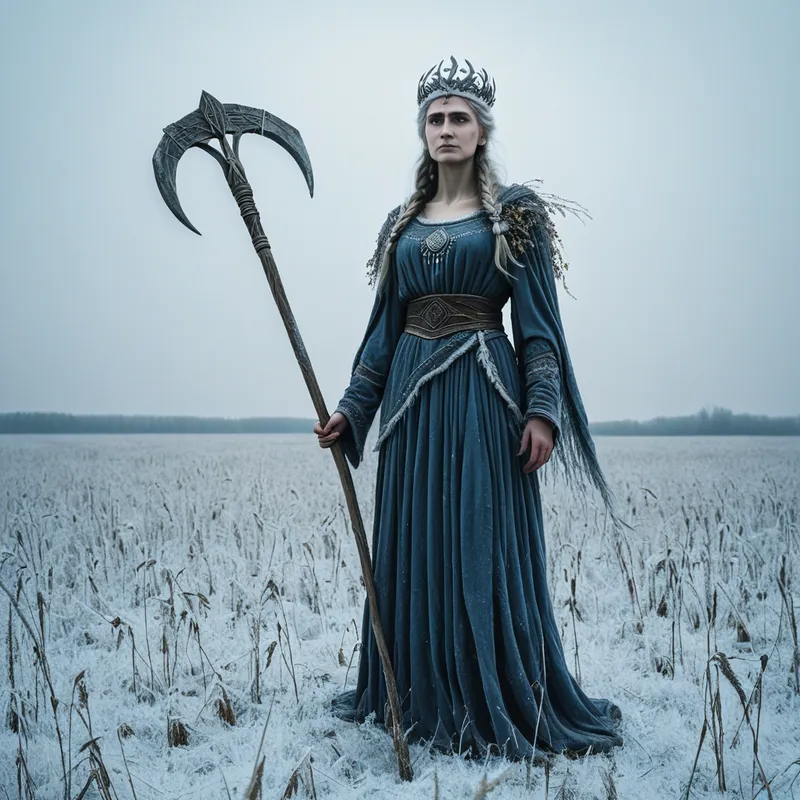
She was not born of sunlight, but of the first frost that kissed the dying stalk. Her hair was the long, pale grass of November fields; her eyes were the deep, still pools locked under ice. Her gown was woven from the shroud of mist that settles over the harvested earth, and in her hand she carried not a scepter, but a sickle, its blade dull and cold. Where Marzanna trod, the laughter of streams ceased, hardening into glass. The vibrant green cloak of the Leshy’s domain fell away, leaving skeletons of birch and ash clawing at a grey sky. She was the great turner, the one who called all things back into the dark, silent womb of the earth.
The people knew her reign was necessary, for without the sleep, there could be no awakening. Yet, as the days grew short and the hearth-fire’s glow seemed a feeble defiance against the endless night, a heaviness would descend. The life-force, the Zhiva in all things, grew thin. Children’s voices grew quiet; the old stared long into the embers. Marzanna’s rule, just in its season, began to overstay. Her cold was no longer a cleanser but a jailer. The promise of Jarilo, the youthful god of spring and vitality, became a memory so distant it felt like a dream.
Then came the day when the sun, though weak, held its gaze a moment longer. A whisper ran through the village, carried on a wind that smelled faintly of wet soil instead of iron frost. It was time. The women gathered the last stalks of straw from the byre—the husks of life already passed. With solemn hands, they fashioned an effigy: a crone of straw, dressed in a stolen shift, adorned with beads that held no light. They gave her the face of the long winter.
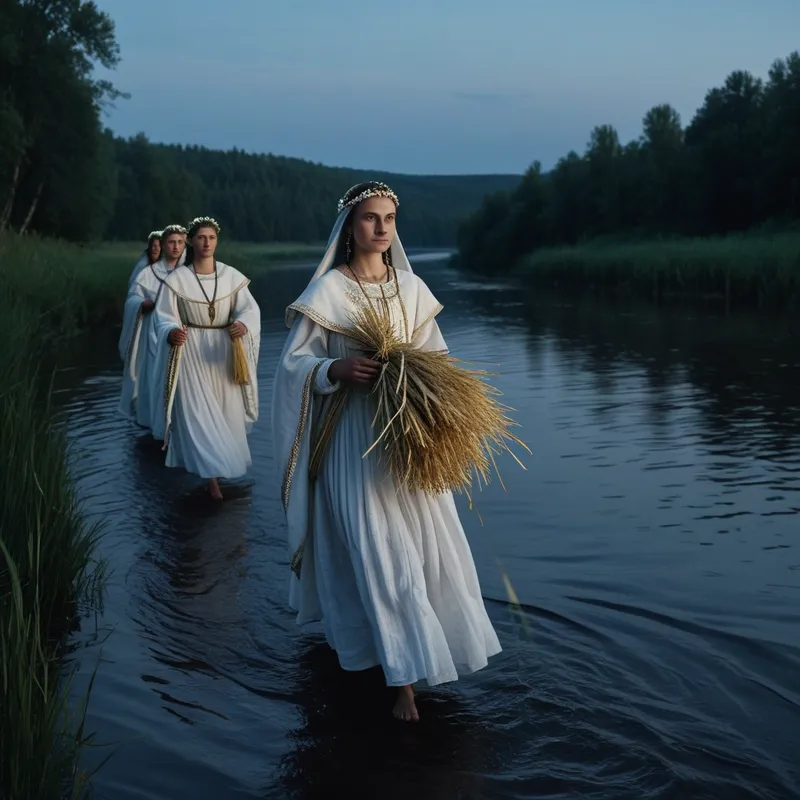
The procession to the river was a funeral march sung for death itself. They carried their creation—this symbol of the frozen queen—through the skeletal woods, past fields sleeping under her rule. They chanted not words of hatred, but of release. At the water’s edge, the current, newly freed from ice, churned dark and hungry. With a collective breath that held grief and hope in equal measure, they cast the straw Marzanna into the embrace of the flowing water. They watched as the current took her, dissolving her form, pulling the straw limbs apart, drowning the symbol of stagnation. As the last fragment vanished downstream, a palpable silence broke. And in that silence, carried on the next breeze, was the undeniable, tender scent of earth awakening. The jailer was gone. The seed could stir.
Cultural Origins & Context
The myth of Marzanna is not a singular, codified scripture, but a practice that was the myth. It lived in the seasonal rituals of the West Slavic peoples (Poles, Slovaks, Czechs) and related groups across the Baltic region. This was a tradition of Rodnovery, the native faith, where deities were not distant abstractions but the very forces of nature personified and engaged with directly.
The ritual drowning or burning of a Marzanna effigy, typically around the spring equinox or on the fourth Sunday of Lent, was a profound act of sympathetic magic and communal psychology. It was performed by entire communities, often led by women and children, underscoring its connection to the cycles of fertility and domestic life. The act was not a murder, but a necessary sacrifice—a deliberate, ritualized participation in the cycle. By physically removing the symbol of decay, the community actively catalyzed the return of life, aligning their human will with the inevitable turn of the cosmos. It was a way to make the intangible, terrifying power of seasonal death tangible, manageable, and ultimately, dismissible.
Symbolic Architecture
Marzanna is the archetypal Dark Mother in her most stark form. She is not the nurturing mother of the harvest, but the mother who receives the dead back into her body. She represents the phase of the cycle that modern consciousness often fears and rejects: dissolution, dormancy, and the necessary decay that fertilizes new growth.
To honor Marzanna is to honor the truth that life is not a line, but a circle. Death is not the opposite of life, but its profound and necessary partner.
Her straw effigy is a masterpiece of symbolic thought. It is crafted from the discarded husks of last year’s grain—the literal physical remains of a life that has already been lived and consumed. By dressing these husks as the goddess and then destroying them, the ritual enacts a profound alchemy: the dead matter is transformed into a symbolic vessel for the principle of death, which is then itself destroyed. This leaves only fertile silence, ready for a new incarnation. The River into which she is thrown is the flowing, unconscious medium of time and change, carrying the old form away to make space for the new.
The Dreamer's Resonance
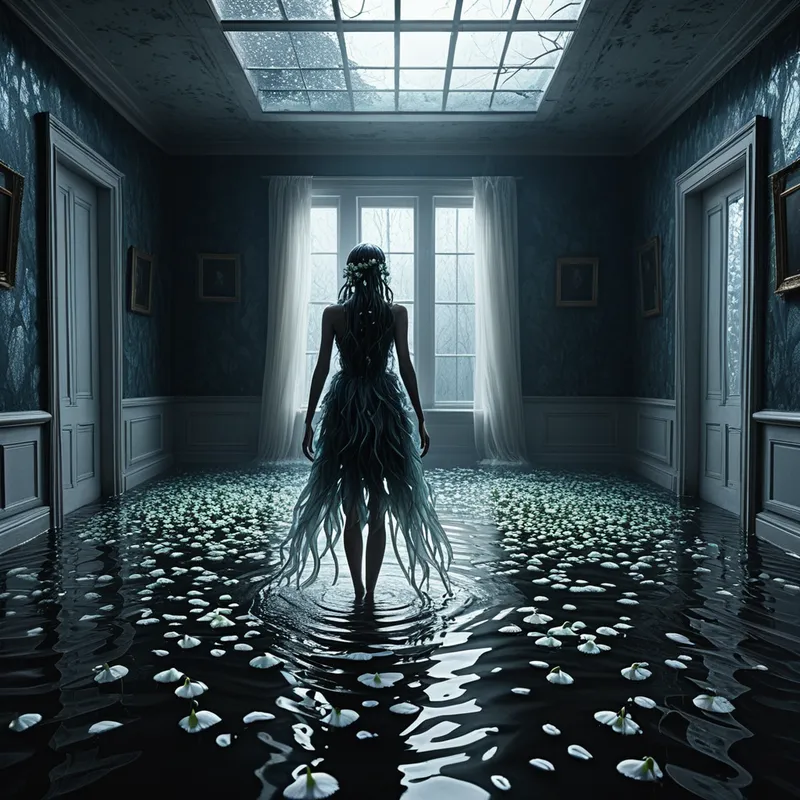
When Marzanna walks in modern dreams, she rarely appears as a straw doll. She is the atmosphere of the dream itself: a feeling of being frozen in place, of creative or emotional sterility, of a relationship or project that has gone cold and lifeless. She is the dream of wandering through an empty, frozen house that was once a home. She is the figure in the mirror who looks back with your face, but eyes that are hollow and cold.
To dream of Marzanna is to somatically experience a psychic state that has overstayed its welcome. It is the depression that has ceased to be a fruitful introspection and become a prison. It is the old identity—the “straw self” constructed from past achievements, outdated roles, or clung-to grief—that is now dead weight, inhibiting new growth. The dream may present a frozen landscape, a blocked path, or a feeling of being buried. This is the psyche signaling that a cycle has ended. The grief, the numbness, the stagnation is Marzanna’s presence. The healing lies in recognizing her, not as a monster, but as a signpost. Her appearance is the dream’s imperative: it is time for a ritual of release.
Alchemical Translation
The individuation process, the journey toward psychic wholeness, requires not just building up the ego but also the disciplined, courageous dissolution of what no longer serves. Marzanna’s myth provides the template for this nigredo.
First, we must name and personify our winter. What in my life has become cold, rigid, lifeless? Is it a habit, a belief, a resentment, a self-image? We must gather the “straw” of this dead material and fashion it into a clear symbol—through journaling, art, or conscious reflection. This is the creation of the effigy: making the inner stagnation visible.
Second, we must perform the ritual of drowning. This is the active, often painful, work of letting go. It is speaking the hard truth, ending the unfulfilling commitment, feeling the buried grief we’ve been avoiding, or simply ceasing a mental pattern. We cast the effigy into the river of our own feeling and time, allowing the current of life to disintegrate it. This is not an act of violence against the self, but a sacred release of a form that has died.
The triumph is not in killing winter, but in completing her. The ritual drowning is the final, respectful act that allows the season to turn.
The space left behind is the fertile void, the chaos before a new creation. It is the psychic condition for Jarilo to emerge. We do not force the spring; we simply, and courageously, clear the ground for it. By consciously engaging in this cycle within ourselves, we move from being victims of our inner seasons to participants in our own ongoing creation.
Associated Symbols
Explore related symbols from the CaleaDream lexicon:
- Death — The central, non-negotiable phase of the cycle that Marzanna embodies, representing not finality but the essential transition that makes rebirth possible.
- Water — The river into which Marzanna is cast, symbolizing the flowing unconscious, purification, dissolution of form, and the medium of transformation between states of being.
- Earth — The dark, silent womb to which Marzanna calls all life, representing both the grave and the source of all future fertility and growth.
- Rebirth — The inevitable consequence of Marzanna's ritual removal; the return of life, vitality, and consciousness that is only possible after a period of complete dissolution.
- Ritual — The structured, communal act of drowning the effigy, which provides a container for safely engaging with and transforming the powerful, terrifying archetype of death.
- Mother — Marzanna as the Dark Mother archetype, the devouring and receiving aspect of the feminine that takes life back into itself to later give it forth anew.
- Tree — The skeletal, dormant form of life in winter, representing the potential for future blossoming that lies hidden within Marzanna's reign of stillness.
- Seed — The hidden, latent life force that survives within the cold earth under Marzanna's domain, containing the entire blueprint for the spring to come.
- Grief — The human emotional response to Marzanna's season, the necessary feeling-toned companion to loss and dissolution that must be fully experienced to allow for release.
- Circle — The fundamental shape of the myth, representing the eternal, cyclical process of life, death, and rebirth in which Marzanna plays her indispensable part.