
Mars Myth Meaning & Symbolism
Mars is the Roman god of war, agriculture, and the state's protector, embodying the sacred duty of conflict and the fertile power of disciplined strength.
The Tale of Mars
Hear now the tale of the one who walks before the legions, whose breath is the wind in the standards and whose heartbeat is the drum of the march. In the time before time was counted by consuls, the sky was a vast, untamed vault. From its fiery heart, with a cry that split the silence, was born a son to Jupiter himself. They named him Mars.
He did not emerge gentle. His first steps shook the earth, and where he gazed, the wild grasses stiffened as if for a charge. He was given a domain not of soft clouds, but of the hard, defining line—the boundary of the field, the wall of the city, the frontier of the empire. His was the spirit of the ager, the tamed land, and the hostis, the enemy beyond it. He was the father of Romulus and Remus, suckled by the she-wolf, and in their veins flowed his fierce love for a place to call their own.
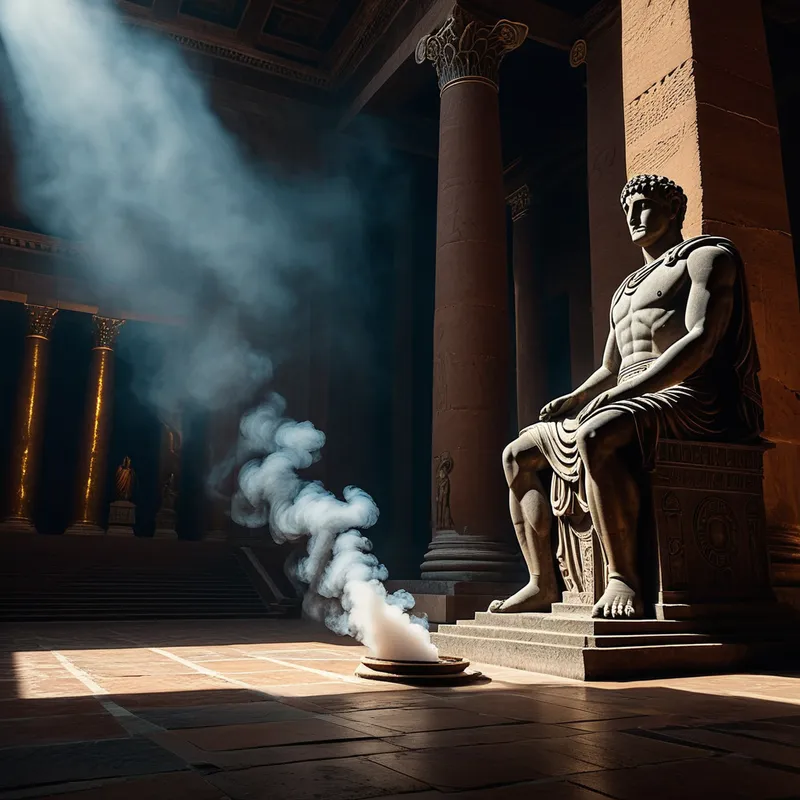
The great conflict was not a single battle, but his eternal condition. Each spring, the priests, the Salii, would lift his sacred shields, the Ancilia, and beat them in a wild, clanging dance through the streets of Rome. This was not mere noise; it was the waking of the god, the ritualized rousing of the city’s defensive soul. Before armies marched, the generals would enter his temple, the air thick with the smell of burnt barley and the blood of sacrificed bulls. They would grasp the spear lodged in the statue’s hand and cry, “Mars Ultor, awake! Our cause is just!” And in that moment, the line between man and god blurred—the general became the vessel, and Mars the will.
His triumph was not merely in conquest, but in the return. When the legions came home, stained with the dust of foreign lands, they processed to his temple on the Capitoline. The spoils were laid at his feet, and the boundary, stretched thin by war, was ritually knitted back together. The god of the March became the god of the October, his weapons purified and stored, his fierce energy redirected to guard the harvest’s peace. The resolution was this cyclical truth: his violence was not for its own sake, but for the sacred circle of the hearth, the city, the sown field. He was the terrifying father who stood at the gate, so that within, life could grow.
Cultural Origins & Context
Mars, or Mavors, predates the grandeur of imperial Rome. His roots dig deep into the soil of ancient Italic tribes—the Sabines and Latins—for whom he was primarily an agricultural deity. He was a god of vegetation, of the wild frontier land that must be cleared, defended, and made fertile. This dual nature is essential: the same power that drives the spear to defend the boundary drives the plow to break the soil. His sacred month, Martius (March), opened both the military campaign season and the agricultural year.
The myth was not contained in a single epic poem like those of Greece. It was lived, performed, and embedded in the very fabric of the Roman state. The stories were passed down through state rituals, temple dedications (like the magnificent Temple of Mars Ultor in Augustus’s forum, built to avenge Caesar’s murder), and the historical annals that framed Rome’s wars as sacred missions under Mars’s auspices. The myth’s societal function was foundational: it sacralized the Roman concept of virtus (manly courage and excellence) and pietas (duty to gods, state, and family). Mars provided the divine sanction for Rome’s destiny to conquer and civilize, transforming raw conflict into a sacred duty of order.
Symbolic Architecture
Psychologically, Mars represents the archetypal principle of directed force, conscious aggression, and the establishment of boundaries. He is not the chaotic, instinctual fury of Ares; he is the disciplined, purposeful application of strength for a defined end.
The spear of Mars does not merely pierce; it draws a line. It defines the self from the other, the interior from the exterior, the sacred from the profane.
His symbols are a lexicon of this principle. The spear is the penetrating will, the focused intention. The shield is the boundary of the self, the ego’s necessary defense. The wolf that nurtured his sons symbolizes the fierce, protective instinct of the pack. Even his agricultural aspect reveals the core symbolism: true strength is not just destructive, but generative. The energy of conflict, when consciously harnessed and ritually concluded, fertilizes the ground for new growth. He embodies the difficult truth that the capacity for aggression is inseparable from the capacity for protection. To deny Mars is to leave one’s boundaries undefended and one’s creative potential untilled.
The Dreamer's Resonance
When Mars strides into the modern dreamscape, he rarely appears in full mythic regalia. His presence is felt somatically and situationally. The dreamer may find themselves in a recurring dream of defending a crumbling wall or a besieged house—a direct image of the boundary principle under threat. They may dream of a forgotten, overgrown garden that requires fierce, almost violent clearing, echoing his agricultural roots.
Psychologically, these dreams often signal a process of confronting one’s own passive aggression or, conversely, reclaiming one’s right to healthy assertion. The somatic experience can be one of tension in the arms and shoulders—the body preparing to wield the spear or raise the shield. A dream of Mars asks the dreamer: Where are your boundaries weak? What within your own psyche are you failing to protect (a creative project, a personal value, your own self-respect)? Or, conversely, what outdated, internal “war” are you still fighting that needs a ritual conclusion, a laying down of arms so new life can grow?

Alchemical Translation
The individuation process modeled by Mars is the alchemy of raw instinct into conscious, life-serving power. The initial prima materia is the undifferentiated, often repressed, aggressive impulse—the anger, the frustration, the will to power that society may deem unacceptable.
The alchemical work of Mars is to take the base metal of rage and forge it into the tempered steel of purpose.
The first stage is calcinatio—the burning away of passivity and victimhood in the fires of conscious anger. This is the recognition of one’s own strength. The second is coagulatio—giving that force form and direction. This is the crafting of the “spear”: defining a goal, a project, a stand. The third is sublimatio—the ritual purification. This is the crucial, often missed step where the energy, after its external application, is brought back inward, integrated, and allowed to fertilize the psyche. The warrior returns to tend his own field.
The triumph is not a state of perpetual war, but the achievement of a dynamic, resilient selfhood. The modern individual completes this translation when they can consciously say “no” to protect their integrity (the shield), actively pursue their goals with disciplined will (the spear), and then, having acted, integrate that experience into a more grounded, fertile sense of self (the harvested field). In this way, the ancient god of boundaries becomes the internal architect of a sovereign psyche.
Associated Symbols
Explore related symbols from the CaleaDream lexicon: