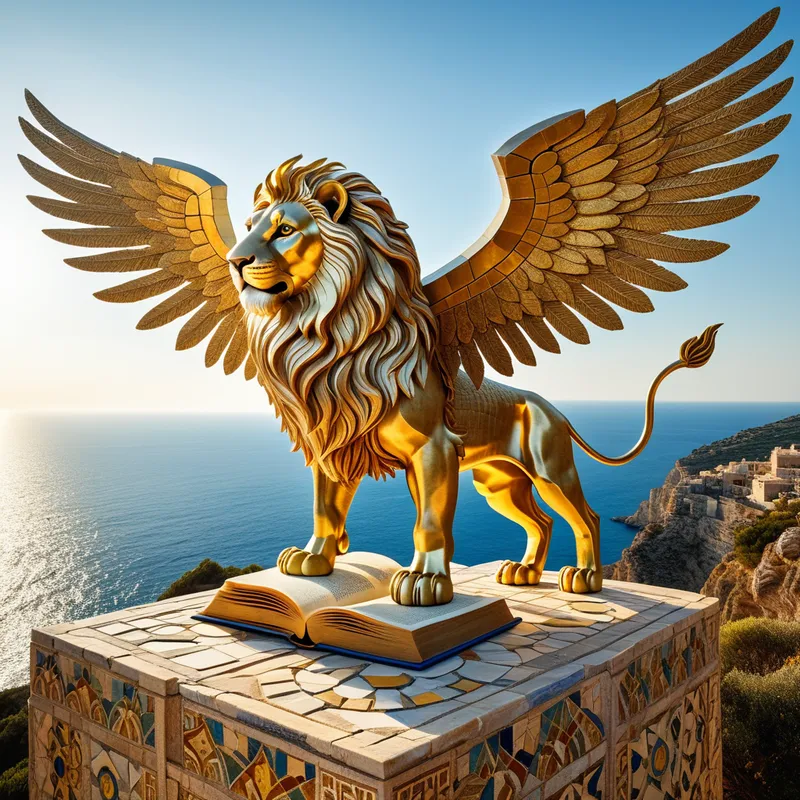
Mark's Evangelist Symbol Myth Meaning & Symbolism
The story of the winged lion, a celestial beast whose roar heralds the dawn of a new truth in the wilderness of the human soul.
The Tale of Mark's Evangelist Symbol
Listen, and hear the tale not of a man, but of his echo in eternity. In the beginning was the Word, a sound so pure it shaped the void. And from this sound, four living creatures were called to be its heralds, its pillars in the corners of perception. This is the story of the second, the creature of the south, whose domain is the scorching noon and the roaring wilderness.
He was not born of earth, but of vision. In the throne-room of heaven, amidst the wheels within wheels and the sea of glass like crystal, the prophet Ezekiel beheld them: four faces gazing as one. And one face was that of a lion. Later, on the isle of Patmos, in exile and revelation, the seer John heard the voice like a trumpet and saw the four living creatures around the throne. The second creature, he said, was like a lion.
But a symbol must find its anchor in the world of flesh and blood. It found him in John Mark, a son of Jerusalem, a companion in shadows and flight. He walked with the hurricane of spirit, Peter, and from that storm, he captured the narrative—not of a serene god, but of a man of action, a divine force moving with urgent purpose through the dust of Galilee. His gospel begins not with genealogy or poetry, but with a voice crying out in the wilderness. A voice that demands preparation. A voice that is, itself, a roar.
And so the spirit of the lion descended. It did not come as a tame pet, but as the king of the arid places. It found Mark not in a palace, but in the intellectual wilderness of Alexandria, a city of competing truths. Here, the scribe toiled, his words a testament. And as he penned the final line, a great heat filled the chamber. The air shimmered, not with desert sun, but with celestial fire. From the space between the letters, from the breath behind the words, the form coalesced: mighty shoulders, a mane like a halo of flame, and eyes that held the ancient knowledge of the sands. Then, from its back, wings erupted—not of feather, but of living light, vast and thunderous.
With a sound that was both a roar and a whisper, the lion-beast lifted the completed scroll in its gentle yet powerful claws. It was a claim and a declaration. This story, it proclaimed, was not merely history. It was a royal decree from a kingdom not of this world. The lion turned its gaze east, towards Rome, where Mark would meet his earthly end, and let out a cry that shook the foundations of mere story. It was the cry of the herald, the voice in the wilderness made flesh and symbol, forever binding the swift, powerful narrative of action to the majestic, courageous heart of the king of beasts. Then it settled, not vanishing, but imprinting itself upon the very essence of the tale, becoming its guardian and its face for all ages.
Cultural Origins & Context
The symbol of the winged lion for Mark the Evangelist did not spring from a single story, but from a profound theological synthesis in the early Christian church. By the 4th century, theologians like St. Jerome and St. Augustine were seeking to harmonize the four distinct Gospel accounts into a unified witness. They turned to the two great apocalyptic visions: Ezekiel’s cherubim (Ezekiel 1:10) and John’s living creatures (Revelation 4:7).
This was not dry scholarship; it was an act of cosmic cartography. Each Gospel was assigned a creature, forming the Tetramorph, a stable, visionary architecture for the faith. Mark was paired with the lion. The reasons were deeply rooted in his text’s character: it begins with John the Baptist’s voice in the wilderness (a lion’s domain), it emphasizes the royal dignity of Christ (the Lion of Judah), and its narrative is swift, powerful, and direct—like a pouncing beast.
The symbol was propagated through the most powerful mediums of the age: illuminated manuscripts, church frescoes, and stone carvings. It served a dual function. For the literate clergy, it was a complex theological shorthand. For the vast illiterate populace, it was an immediate, awe-inspiring icon. To see the winged lion on a gospel cover or a church wall was to instantly know which story was contained within and to feel its particular spiritual power—the power of courageous proclamation.
Symbolic Architecture
At its core, the myth of Mark’s symbol is an alchemical wedding of opposites, forging a new kind of spiritual authority.
The winged lion is the embodied paradox: the grounded roar of truth married to the soaring freedom of spirit. It is power made conscious.
The lion represents raw, earthly power, kingship, courage, and the resonant voice. It is the animal soul, the instinctual strength required to survive and rule in the "wilderness" of the material world. It is the heart, the seat of courage. The wings, universally, symbolize spirit, transcendence, divine message, and the ascent above the mundane. They belong to the realm of angels and vision.
By uniting them, the myth declares that true spiritual power is not ethereal weakness. Nor is earthly power brutish without guidance. The Gospel of Mark, through this symbol, is interpreted as a spiritual narrative that is active, immediate, and kingly. Psychologically, the winged lion represents the integration of the powerful, instinctual self (the shadow, in its potent form) with the aspirational, spiritual self. It is the courage to face one’s inner wilderness, and the voice to proclaim what one finds there.
The Dreamer's Resonance
When the winged lion pads into the modern dreamscape, it rarely arrives with Byzantine serenity. It appears as a perplexing, often intimidating, presence. One may dream of a lion in a city square, its wings clipped or bound, roaring silently. Or of finding a forgotten, stained manuscript in an attic, with a lion’s paw print embossed on its cover. Perhaps the dreamer is lost in a desert canyon, only to hear a roar that echoes not from the rocks, but from inside their own chest.
These dreams signal a critical moment in the psyche’s development. Somatically, one might feel a constriction in the chest or throat—a "choked roar." Psychologically, it indicates a struggle to integrate personal power with one’s authentic voice. The lion represents an untapped reservoir of courage, assertiveness, or rightful anger that the conscious personality has caged or denied (the shadow). The wings represent a spiritual or creative potential that feels unrealized, perhaps because it lacks the grounded strength to launch.
The dream is an unconscious summons to the difficult, heroic work of unification. It asks: Where in your life are you powerful but silent? Or where are you aspiring but without foundation? The winged lion dreams herald the birth pangs of a more authoritative, integrated Self.
Alchemical Translation
The journey from the solitary scribe to the guardian of the winged lion is a perfect map for the process of individuation. It models the psychic transmutation required to find and wield one’s authentic voice in the world.
The first stage is the Nigredo, the blackening. This is Mark in Alexandria, grappling with the raw, often chaotic material—the memories, stories, and conflicts of Peter. It is the chaos of the unconscious, the wilderness. The Albedo, the whitening, is the disciplined work of scribing: ordering the chaos into narrative, giving it form and light. This is the conscious ego doing its work of synthesis.
The crucial transmutation is the Rubedo, the reddening. It is not the completion of the book, but the arrival of the symbol. This is the moment the unconscious answers the work of consciousness with a gift of transformative imagery.
The lion (instinct, power) and the wings (spirit, aspiration), previously separate, fuse in a visionary experience. This is the birth of the Self as a ruling, transcendent function. For the modern individual, this alchemy translates to a profound inner event. After a period of diligent work on oneself (confronting shadows, honing skills, seeking truth), there comes a moment of symbolic recognition. One’s life-narrative is suddenly seen not as a series of events, but as a coherent, powerful testimony. The courage to be (the lion) and the vision to become (the wings) unite. You become the herald of your own gospel, not with arrogance, but with the quiet, majestic authority of a creature that is finally, fully, what it was always meant to be.
Associated Symbols
Explore related symbols from the CaleaDream lexicon: