Spiritual & Myth

Winged Lion Dream Meaning

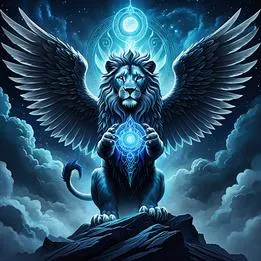
A powerful fusion of earth (lion) and sky (wings), representing divine authority, spiritual guardianship, and the union of strength with higher consciousness.

Common Appearances & Contexts

Context Emotion Interpretation
Flying over city Protective Guiding from above.
Roaring at sky Defiant Challenging higher powers.
Perched on mountain Sovereign Commanding vast domain.
Guarding temple gates Reverent Protecting sacred space.
Wings shedding feathers Vulnerable Spiritual power waning.
Carrying orb Responsible Bearing cosmic knowledge.
Fighting serpent Righteous Cosmic battle ongoing.
Sleeping on throne Peaceful Power at rest.
Teaching cubs Nurturing Passing divine legacy.
Melting into light Transcendent Becoming pure spirit.
Chained to earth Frustrated Spirit grounded unfairly.
Leading procession Proud Divine authority manifesting.

Interpretive Themes

Cultural Lenses

Jungian Perspective

View Context →

Archetype of the Self, integrating solar consciousness (lion) with spiritual aspiration (wings). Represents individuation—the harmonious union of earthly instincts and transcendent spirit in the psyche's maturation.

Freudian Perspective

View Context →

Phallic symbol of paternal authority sublimated into spiritual ideals. Wings represent flight from earthly desires (id), while the lion embodies superego's imposing, disciplined power over base instincts.

Gestalt Perspective

View Context →

Projection of the dreamer's integrated self—the 'lion' part (grounded strength, assertiveness) and 'winged' part (aspiration, freedom). The whole symbol reveals how these aspects interact or conflict currently.

Cognitive Perspective

View Context →

Conceptual blend of 'power' and 'elevation' schemas. The brain constructs this hybrid image to process themes of authority, protection, or transcendence, often during problem-solving or identity formation.

Evolutionary Perspective

View Context →

Supernormal stimulus combining apex predator (survival dominance) with avian mobility (escape threat). Triggers awe responses linked to hierarchical security and expanded territorial awareness for adaptive advantage.

Middle Eastern Perspective

View Context →

Ancient Mesopotamian lamassu and Persian shedu—winged lion guardians of temples and palaces. Represent divine protection, royal authority, and the liminal space between human and divine realms in ritual contexts.

European Perspective

View Context →

Medieval heraldic symbol of St. Mark's Venice, blending Roman imperial power with Christian angelic guardianship. In alchemy, represents fixed (lion) becoming volatile (wings)—spiritual transformation of matter.

South Asian Perspective

View Context →

Narasimha, Vishnu's lion-man avatar, embodying divine fury protecting devotees. In Buddhist art, winged lions flank thrones as protectors of dharma, symbolizing enlightened power overcoming ignorance.

East Asian Perspective

View Context →

Chinese guardian lions (Shishi) with wings appear in temple art as protectors against evil spirits. In modern context, symbolizes corporate strength with innovative vision in business iconography.

African Perspective

View Context →

In some traditions, represents deified ancestors or nature spirits mediating between sky gods and earth. Appears in ritual masks as protector of communities, blending animal power with spiritual authority.

Modern Western Perspective

View Context →

Fantasy genre staple (e.g., gryphons, sphinxes) representing magical guardianship. In psychology, symbolizes integrating personal power with spiritual growth. Corporate logos use it for authoritative, visionary branding.

Global/Universal Perspective

View Context →

Cross-cultural symbol of sovereign power transcending earthly limits. Appears in mythology, heraldry, and sacred architecture worldwide as mediator between terrestrial and celestial realms, guardian of thresholds.

AI-Powered

Interpret Your Full Dream

Beyond this symbol, every dream carries a unique story. Share your dream for a personalized AI-powered interpretation.