Marama the Moon Myth Meaning & Symbolism
A myth of the moon's cyclical death and rebirth, embodying the soul's journey through loss, the underworld, and ultimate return to light.
The Tale of Marama the Moon
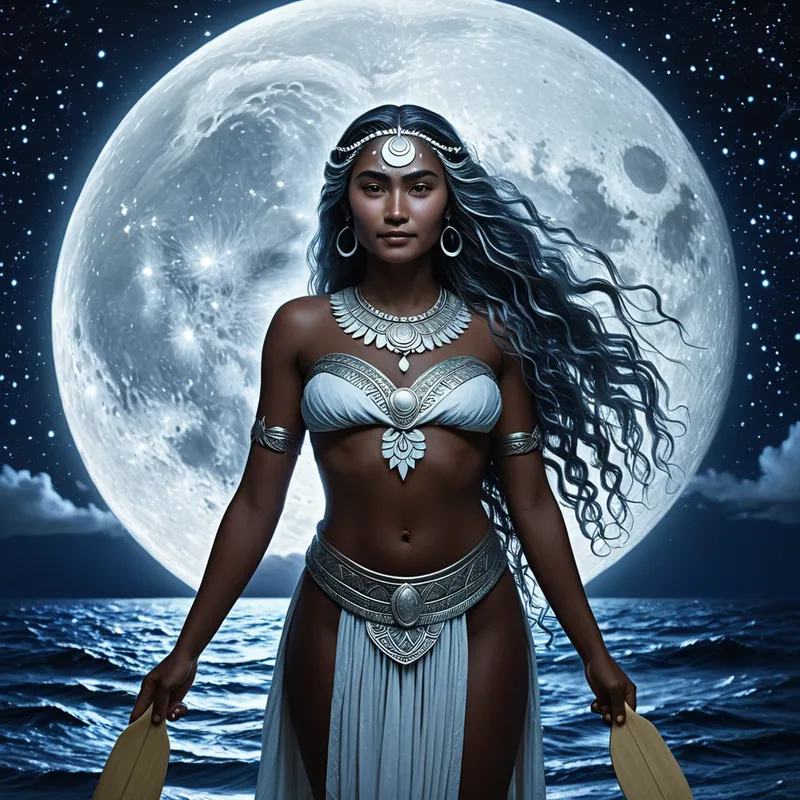
In the time before time, when the sky was a dark cloak and the ocean a silent, dreaming thing, there lived Marama. She was not a distant light, but a radiant woman, her skin the color of polished pounamu touched by starlight, her hair the shimmering path of the Milky Way. She was the beloved of all, a gentle light in the primordial dark, a guide for the first people who walked the earth, Papatūānuku.
But the world was out of balance. Life flourished, yet there was no place for the spirit when the body grew weary. The dead wandered, lost and sorrowful, casting a chill shadow over the living. The great god Io looked upon this suffering and knew a terrible price must be paid for order, for the completion of the great cycle.
He called Marama to him in the highest vault of the sky. “Beloved light,” Io’s voice was the sound of stars forming, “the people need a path. The dead must have a guide to the long night, to Rarohenga. Only a light that knows both life and death can show the way. You must descend.”
Marama felt a coldness seep into her luminous heart. To leave the sky was to forsake her nature. To enter the realm of the dead was to taste oblivion. Yet, in the eyes of Io, she saw the reflection of all grieving hearts below. She did not speak, but her light dimmed in assent, a silent sacrifice that made the very stars weep sparks.
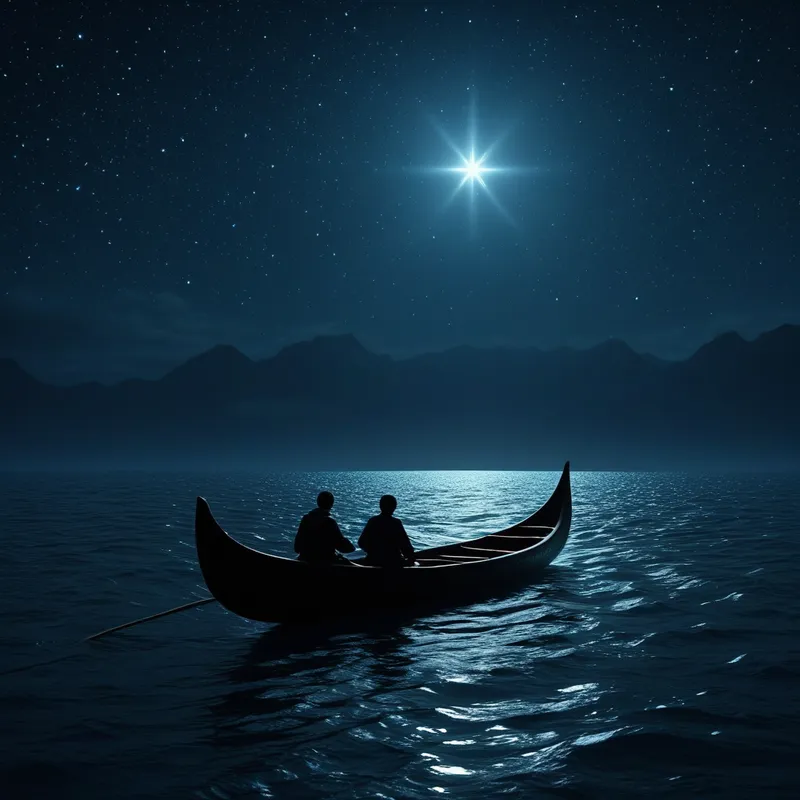
And so, Marama began her descent. She stepped from the sky as a woman steps from a canoe into dark water. The air grew thick and cold. The familiar songs of the land birds faded, replaced by a profound silence that pressed against her ears. She reached the shores of the ocean, where the waters of Tangaroa lay black and still. There, a ghostly waka awaited, carved from the heartwood of a thousand-year-old tree.
She boarded, and the waka moved with no paddle but her will. It carried her across the sea of death, Te Moana-nui-a-Kiwa. As she sailed, the faces of the dead rose to the surface—loved ones, warriors, children—their eyes hollow, their forms etched from memory and shadow. They reached for her light, and she let it wash over them, not as the harsh sun, but as a cool, remembering glow. She gathered them, a silent, shimmering procession in her wake, and steered toward the hidden entrance to Rarohenga, a cavern mouth where the last waves of the world sighed into nothing.
At the threshold, Marama turned. She looked back at the world of light, at the living she would not see again. Then, she entered the darkness. In that place, her light was consumed. She died. She became as the dead, a memory of light in absolute night. For three nights, the world above was black, and the people wailed, believing light lost forever.
But the cycle demanded return. From the depths of her dissolution in the underworld, a spark refused to be extinguished—the memory of her promise, the love for the living. On the fourth night, a sliver of silver pierced the black dome of the sky. A thin, curved blade of light. It was Marama, struggling back from death, paddling her waka of light upward from the abyss. Night by night, she grew fuller, stronger, gathering the fragments of her self until she shone once more, whole and radiant.
But she was changed. Now, her light was wise with the knowledge of the long night. It was a light that remembered darkness, a guide not just for the living, but for the souls of the departed. And so, she established the eternal rhythm: to wax full with life, to wane into death, to journey to the underworld, and to be reborn, forever the luminous bridge between two worlds.
Cultural Origins & Context
The myth of Marama is woven into the very fabric of Māori cosmology, transmitted orally across generations by tohunga and master storytellers. It was not mere entertainment but a foundational narrative, a pūrākau, that explained the fundamental rhythms of existence. Recited during rituals, taught in the wharenui (meeting house), and referenced in waiata and whai kōrero, the story served multiple vital functions.
It provided a cosmological map, explaining the moon’s phases not as mechanical astronomy but as the visible journey of a deity. This anchored time itself; the lunar calendar, maramataka, dictated the rhythms of planting, fishing, and warfare. More profoundly, it offered a complete psychology of death and the soul. In a culture with a deep, spiritual connection to ancestors, mauri, the myth gave tangible, beautiful form to the journey of the wairua after death. It comforted the living, assuring them that their loved ones were not lost to chaos but were guided by a compassionate, divine light on a structured voyage to the ancestral homeland. The myth thus wove together astronomy, spirituality, social order, and existential comfort into a single, resonant narrative.
Symbolic Architecture
At its core, Marama’s story is a masterful symbol of the necessary cycle of disintegration and reintegration. She represents the part of the psyche that must voluntarily descend into its own darkness to retrieve meaning and complete the self.
The moon does not fight the darkness. It submits to it, is consumed by it, and in that very submission, learns the secret of its own return.
Marama is the archetypal Orphan. She is severed from her celestial home (the known, the bright conscious world) and cast into the unknown (the unconscious, the realm of shadow). Her journey on the dark ocean is the soul’s navigation of the unconscious, where the “dead”—repressed memories, unlived lives, ancestral patterns—reside. Her act of illuminating these faces is not an exorcism, but an act of witnessing and integration. Her death in Rarohenga symbolizes the ego’s necessary dissolution; to gain wisdom, the old identity must be surrendered. Her rebirth is not a return to a previous state, but the emergence of a new, more complex consciousness that holds both light and dark within itself. She becomes the psychopomp, the inner guide who can safely mediate between our daily life and the profound, often frightening, depths of our inner world.
The Dreamer's Resonance
When the pattern of Marama’s myth stirs in modern dreams, it signals a profound psychological process underway. To dream of a waning moon, a dark voyage across water, or of guiding lost souls suggests the dreamer is in a phase of necessary withdrawal, a psychic “waning.” This is not depression, but a sacred descent.
Somatically, one might feel a deep fatigue not cured by sleep, a pull toward solitude, or a sense of being “between worlds.” Psychologically, it is a time of reviewing one’s life, confronting grief (both personal and ancestral), and encountering shadow aspects of the self that have been ignored. The dreamer is, like Marama, gathering the “dead”—unfinished emotional business, old identities, inherited traumas—to be witnessed and transformed. Dreams of being in a dark cave, finding a hidden path at night, or seeing a sliver of light in utter blackness are direct echoes of this mythic process. The psyche is orchestrating a ritual of death and renewal, compelling the conscious self to release control and trust the cyclical, healing intelligence of the deeper unconscious.
Alchemical Translation
For the modern individual striving toward individuation, Marama’s myth is a precise alchemical manual. It models the process of nigredo and albedo—the descent into the blackness of the prima materia (the raw, chaotic self) and the subsequent extraction of the silver essence.
The soul’s silver is not mined from the mountain of achievement, but distilled from the dark waters of surrender.
The first, most courageous step is Marama’s assent: the conscious decision to engage with one’s pain, shadow, or grief, rather than perpetually seeking the “sun” of positivity and success. The voyage across the dark sea is the active engagement with therapy, deep reflection, art, or any practice that brings one face-to-face with the repressed. The “death” in the underworld is the often-painful experience of ego dissolution—when old ways of being, coping mechanisms, and self-images fail. This feels like annihilation.
The alchemical miracle is in the return. The sliver of new moon is the first, fragile insight born from the darkness: a new perspective, a genuine forgiveness, a clarified purpose. Each subsequent “waxing” is the gradual rebuilding of the personality, not on the old foundations, but on the newly integrated wisdom of the depths. The individual becomes their own psychopomp. They no longer fear their darkness because they know it contains the map for their renewal. They achieve a state of cyclical wholeness, able to be fully present in the light of day while honoring the necessary, sacred journeys into their own night.
Associated Symbols
Explore related symbols from the CaleaDream lexicon:
- Moon — The central symbol of cyclical death and rebirth, the guiding light in darkness, and the rhythmic, feminine principle of time and the unconscious.
- Water — Represents the unconscious mind, the realm of emotion, memory, and the soul’s journey, across which Marama must voyage.
- Death — Not an end, but a transformative phase in the eternal cycle, a necessary dissolution for rebirth, as embodied by Marama’s descent.
- Rebirth — The core promise of the myth, the emergence of new consciousness from the depths of dissolution, symbolized by the returning crescent moon.
- Journey — The essential narrative structure of the soul’s voyage from the known world, through the underworld, and back again.
- Spirit — The eternal wairua that Marama guides, representing the aspect of self that transcends physical death and undergoes transformation.
- Ocean — The vast, dark Te Moana-nui-a-Kiwa, symbolizing the collective unconscious and the mysterious, ancestral realm of the dead.
- Shadow — The contents of the underworld—the repressed, the forgotten, the ancestral—that Marama illuminates and integrates.
- Ritual — The myth itself provides a cosmic ritual framework for understanding and navigating life’s greatest transitions, especially death.
- Moon Phase — The visible, external manifestation of the internal, psychic cycle of fullness, emptying, death, and renewal.
- Moonlit Path — The guidance offered by the myth and the moon’s light, showing the way through darkness for both the living and the dead.
- Silver — The color and essence of Marama’s light—cool, reflective, intuitive, and connected to lunar wisdom and the soul’s value.