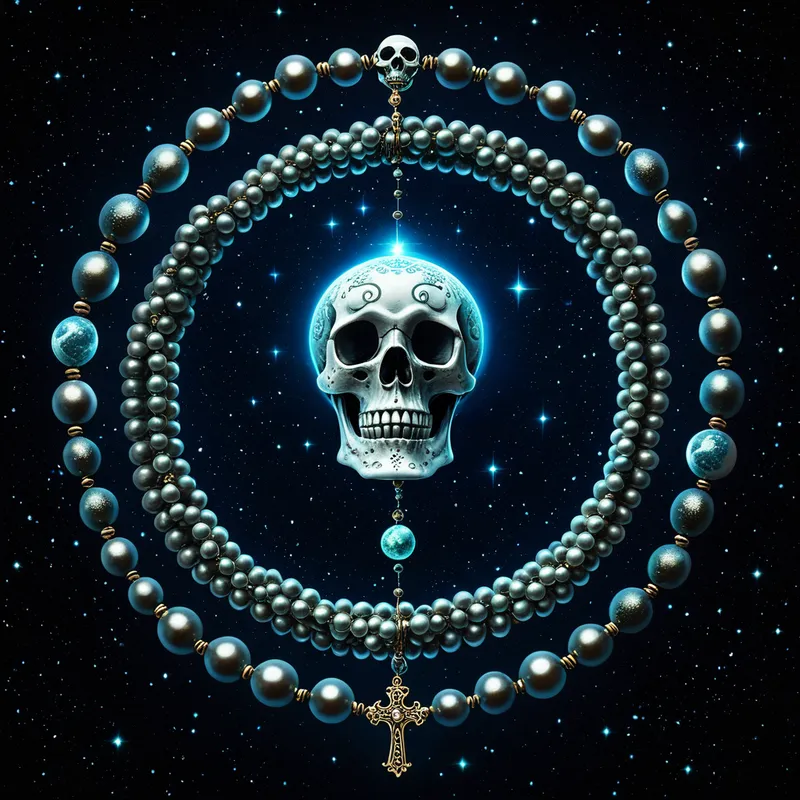
Mantra / Prayer Beads Myth Meaning & Symbolism
A myth of a seeker who, to tame the chaos of mind and cosmos, strings the sacred breath of the divine into a circle of remembrance.
The Tale of Mantra / Prayer Beads
Listen. In the time before time, when the world was a cacophony of becoming, the human heart was a restless bird, beating against the cage of its own fleeting life. It knew the great silence, the vast emptiness from which all things whispered, but could not hear the song within the silence. The mind was a river in flood, carrying thoughts like debris—memories of joy, specters of fear, plans that crumbled like sand. To remember the sacred was to try and hold water in a sieve.
In this age of spiritual amnesia, a seeker—known in some lands as a sadhaka, in others as a contemplative, a wanderer, a heart crying out in the wilderness—climbed the mountain of longing. Their prayer was not for riches or power, but for a simple thing: a way to remember. To remember the name of the divine amidst the market’s din. To remember the breath that connected their mortal lungs to the cosmic wind. To remember their own true nature before it was lost in the dream of the world.
At the summit, where the air was thin and the stars felt close enough to touch, they sat. They sought to count their breaths, to number their invocations, but the wind stole their concentration. They sought to hold a single sacred phrase in their mind, but it slipped away like smoke. Despair, cold and heavy, settled upon them. Their great quest seemed destined to fail on the shores of their own forgetfulness.
Then, a voice, not in the ear but in the very marrow of the bone. It was the voice of the mountain, the whisper of the oldest tree, the hum of the turning stars. “You seek to measure the immeasurable,” it sighed. “You try to contain the ocean in a cup. Do not grasp the water. String together the moments of your attention, as one strings pearls.”
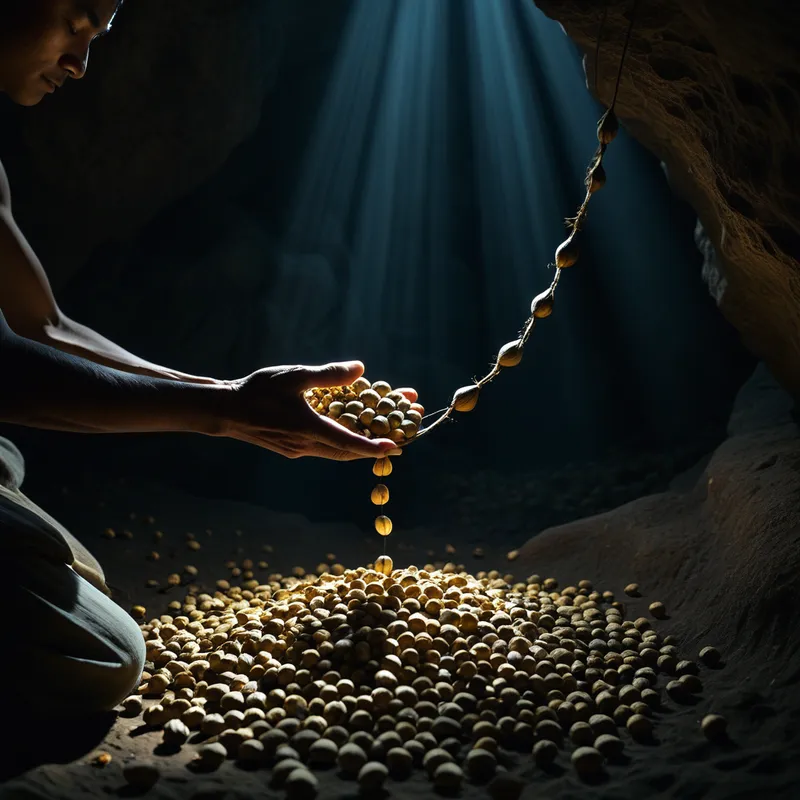
The seeker looked down. At their feet were the humble gifts of the earth: seeds fallen from a Bodhi tree, smooth stones worn by the river, berries dried by the sun. With nothing but their own breath as guide and their intention as needle, they began. With each inhalation, they gathered a seed. With each exhalation, they whispered a fragment of the sacred—a name, a syllable, a breath of gratitude. They pierced each seed, not with metal, but with the sharp point of their focused will. One breath, one seed, one name. The chaotic flood of time began to find banks. The scattered flock of thoughts began to return to the roost of the heart.
They looped the cord. And in that moment of joining end to end, the circle was born—not a line leading to a distant horizon, but a wheel turning in the present, a portable cosmos. The seeker descended the mountain, their fingers walking the path of pearls, each bead a stepping stone back to the summit of their own soul. The myth was born not in a single event, but in the timeless act of return, breath by breath, bead by bead.
Cultural Origins & Context
This is not a myth belonging to one people, but a human response to a universal condition: the fragility of memory and the longing for tangible connection to the intangible. The story manifests in countless forms. In the Vedas, sages used kusha grass knots to track the complex metrics of ritual chant. Buddhist tradition holds that a king, moved by the Buddha’s teaching, created the first mala to help a sick monk maintain his practice. In the Islamic world, the Tasbih or Misbaha emerged as a devotional aid following the Prophet’s example of glorifying God. The Catholic Rosary evolved from the practice of monastic lay brothers counting 150 Psalms on knotted cords.
The myth was passed down not merely through spoken word, but through the somatic ritual itself—from master to disciple, from parent to child, the hands learning the rhythm before the mind fully understood the doctrine. Its societal function was dual: it was a profound tool for personal mysticism, a technology of consciousness for monks and ascetics, and simultaneously a democratizing bridge, bringing the focused, repetitive heart of meditation into the hands of the farmer, the merchant, the homemaker. It ordered inner chaos, making the sacred accessible within the mundane flow of daily life.
Symbolic Architecture
The myth’s power lies in its elegant, multi-layered symbolism. The bead itself is a microcosm: a hard, finite shell containing the potential of the seed, the memory of the fruit, the promise of life. It is the individual soul, distinct yet part of a greater whole. The cord is the invisible thread of consciousness, of breath (prana or ruach), of divine grace that connects all isolated moments of awareness into a coherent being.
The circle of beads is the wheel of samsara transformed into a tool for its own transcendence. One walks the circle not to be bound by it, but to understand its every turn.
The act of moving the beads is a pilgrimage in miniature. The thumb, representing the individual will and ego, touches each bead—each world, each thought, each breath—acknowledges it, and then lets it go to move to the next. This is the rhythm of life: engagement and release, attachment and non-attachment. The guru bead, the sumeru, is the mountain of the myth, the point of return and reorientation, reminding the practitioner that the journey is cyclical, not linear, and always leads back to the source.
The Dreamer’s Resonance
When this myth surfaces in modern dreams, it rarely appears as a literal string of beads. It manifests as the deep psychological process of seeking order and meaning amidst fragmentation. One may dream of desperately trying to gather scattered marbles that roll away, of threading a needle with a trembling hand to mend a torn fabric of reality, or of finding a simple, smooth stone that feels profoundly significant in the palm.
These dreams signal a somatic and psychic need for rhythm and integration. The dreamer is likely experiencing life as a series of disjointed events, emails, and anxieties—a digital-age cacophony mirroring the ancient flood of thoughts. The dream of “stringing beads” is the unconscious proposing a solution: the need to create a personal ritual, a conscious practice of returning to center. It is a call to breathe with intention, to find the single, repeating phrase (a mantra, a value, a core truth) that can act as the cord to bind their disparate experiences into a narrative that makes sense. The anxiety in the dream is the fear of forgetfulness; the resolution is the discovery of the circle, the practice, the breath.

Alchemical Translation
The myth models the entire alchemical process of individuation—the Jungian journey toward psychic wholeness. The initial state is the massa confusa, the chaotic, flooded mind of the seeker at the mountain’s base. The conflict is the confrontation with one’s own capacity for distraction and forgetfulness (the shadow of spiritual laziness). The rising action is the disciplined, often frustrating work of gathering and piercing—the separatio and mortificatio where the ego’s scattered desires are identified, honored, and then strung onto a higher purpose.
The transmutation occurs not in the final bead, but in the space between them—in the moment the fingers release one bead and journey to the next. That is the moment of letting go, the crucible where attachment is burned away.
The looping of the cord is the coniunctio oppositorum, the sacred marriage of the linear and the cyclical, of time and eternity. The completed circle is the lapis philosophorum, the philosopher’s stone—not a magical object, but the integrated Self. For the modern individual, the alchemy is this: we take the raw, often painful, material of our daily lives—our tasks, our worries, our joys, our failures—and, through the consistent practice of mindful attention (the mantra, the breath, the conscious repetition), we string them together. We reframe our life not as a random sequence heading toward an end, but as a sacred circuit, a rosary of experience where every bead, no matter how rough, is essential to the circle’s strength and beauty. We learn that salvation, or wholeness, is not a distant destination, but the quality of attention we bring to each step of the endless, returning path.
Associated Symbols
Explore related symbols from the CaleaDream lexicon: