Mangkukulam Myth Meaning & Symbolism
A myth of the witch-healer, weaving power from shadow, where poison and cure share a single root in the deep forest of the psyche.
The Tale of Mangkukulam
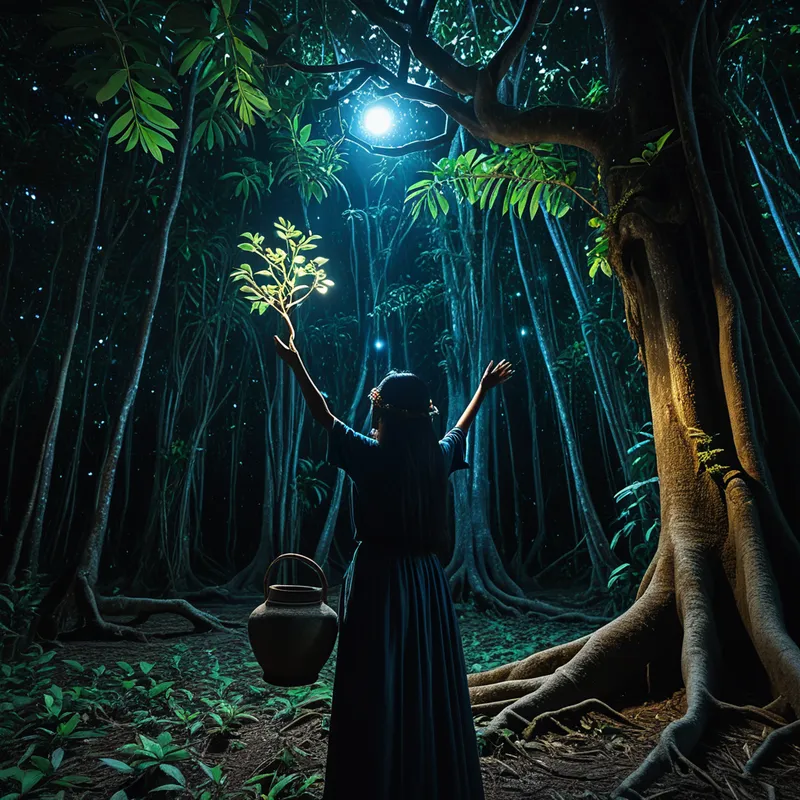
Listen, and let the night wind carry the tale. It does not begin in a kingdom of gold, but in the deep, breathing heart of the balete forest, where roots coil over forgotten stones and the air hums with the secrets of decay and growth. Here, in a village clinging to the forest’s edge, lived a woman named Liwanag. She was not a queen, but a keeper of green things, a listener to the aches of the earth and the whispers of fevered brows.
One season, a silence fell upon the village. It was a sickness that stole the warmth from children’s skin and left a cold, grey ash in the lungs. The prayers to the anitos echoed back, unanswered. The healers’ herbs turned to dust in their hands. Despair, thick as monsoon mud, settled over the homes.
Liwanag watched the light fade from her own grandson’s eyes. In that moment of utter powerlessness, a different kind of prayer was torn from her—not a plea, but a raw, defiant cry into the forest’s gloom. It was a bargain forged in grief: give me the means to fight this shadow, and I will pay its price.
The forest heard. That night, a figure emerged from the gnarled trunk of the oldest balete. It was not a god, but the diwata of the deep wood, her form shifting like dappled light and rot. “You call upon the knowledge that sleeps in poison thorn and cursed ground,” the spirit’s voice rustled. “To wield it is to be marked. You will hold the venom that kills and the essence that cures in the same hand. The village will name you not healer, but Mangkukulam. They will fear the very power that saves them.”
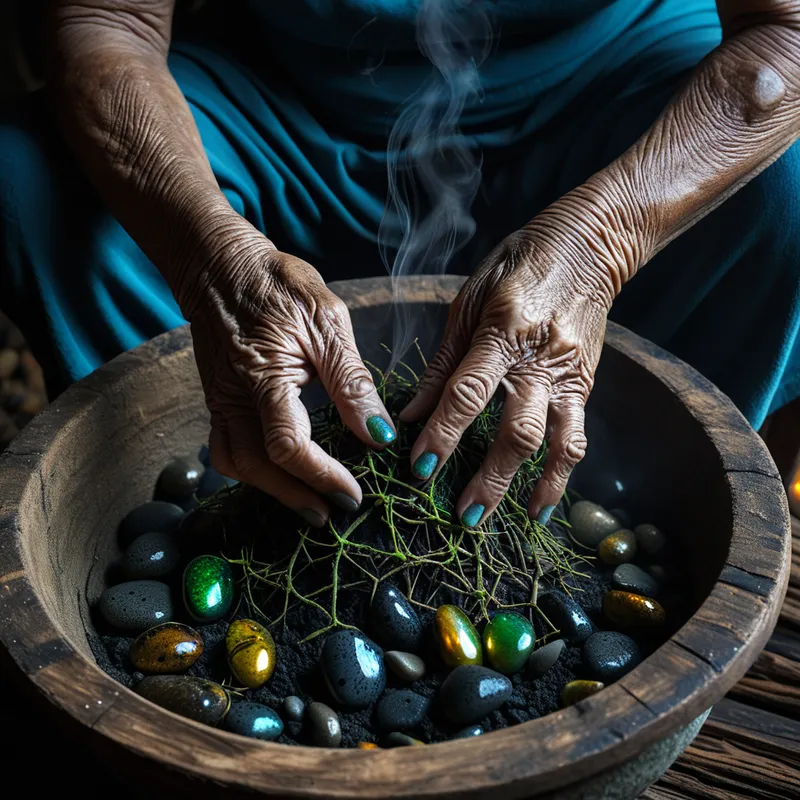
Liwanag did not hesitate. She reached into the hollow the diwata revealed and took not a leaf or a berry, but a handful of the dark, teeming soil itself—soil fed by death, cradling the seed. The knowledge flowed into her like a bitter river: the chant to draw fever into a knotted cord, the ritual to transfer pain to a carved root, the precise wrath of a thorn that could mirror an illness and shatter it.
She returned as the moon bled silver on the thatched roofs. Where she walked, children’s fevers broke in cold sweats. Where she passed her hands over swollen flesh, the inflammation receded like a tide. But they saw her muttering over black candles. They saw her burying pouches at crossroads. They saw the shadow that now clung to her, a twin born of her desperate love. They whispered the name: Mangkukulam.
Her grandson lived, laughing in the sun. But Liwanag lived apart, at the threshold of village and wild, a bridge of terrifying grace. She had mastered the art of turning shadow into medicine, and in doing so, became the shadow the village needed—feared, revered, and utterly alone, the healer who wore the cloak of the witch.
Cultural Origins & Context
The figure of the Mangkukulam is not a singular myth from a forgotten epic, but a living, breathing archetype woven into the pre-colonial animist tapestry of the Philippine archipelago. This concept existed long before the dichotomies of saint and sinner imposed by later colonizers. The Mangkukulam represents the indigenous understanding of kapwa and the delicate balance of the natural and spiritual worlds.
Stories of these practitioners were passed down orally, often by firelight, as cautionary tales, explanations for misfortune, and, covertly, as records of a suppressed spiritual science. They were the community’s paradoxical edge-dwellers: consulted in secret for cures, love potions, or protection, yet publicly shunned and blamed for crop failure or illness. This reflects a deep societal ambivalence toward power that operates outside sanctioned, visible channels—power that is intimate, psychological, and rooted in the ambiguous forces of nature. The Mangkukulam myth served as a container for collective anxieties about illness, envy, and the unseen, while also preserving the knowledge that healing often requires engaging with the very darkness one seeks to dispel.
Symbolic Architecture
At its core, the myth of Mangkukulam is a profound map of the Shadow integration process. Liwanag does not defeat the sickness with pure, divine light; she descends into the metaphorical forest—the unconscious—and bargains with its shadowy denizens. She accepts that the antidote is found within the poison, that true healing power is often hidden in what society deems taboo, dangerous, or unclean.
The true healer is not one who has eradicated darkness, but one who has learned the secret language of the dark and can translate its messages into medicine.
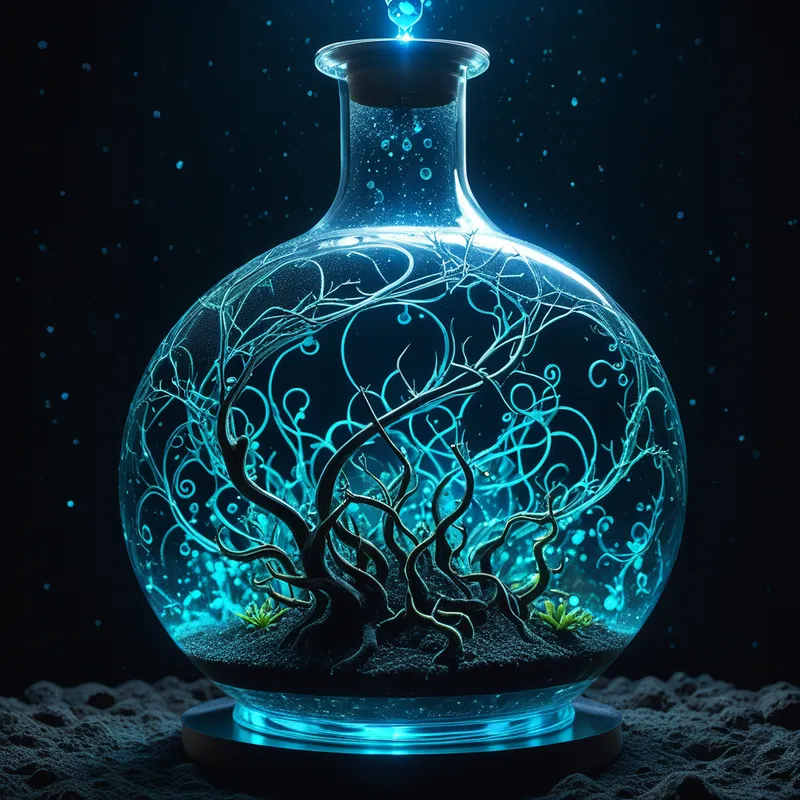
The palayok of glowing herbs and the cursed soil are alchemical vessels where opposites are held in tension. The Mangkukulam becomes the living crucible. Her magic—the whispered spells, the knotted cords—symbolizes the focused intention and ritual necessary to transmute raw, chaotic psychic material (pain, disease, rage) into something that can serve the whole. She embodies the ultimate paradox: the Wounded Healer. Her power is born directly from her vulnerability, her love, and her willingness to be stained by the process.
The Dreamer's Resonance
When the pattern of the Mangkukulam arises in modern dreams, it signals a powerful encounter with the Shadow and the nascent emergence of the healer archetype within the dreamer’s own psyche. You may dream of finding potent, strange objects in neglected parts of a house (the personal unconscious) or a forest (the collective unconscious). You might be performing a ritual you don’t understand but that feels urgently necessary, often involving mixing elements or speaking forbidden words.
Somatically, this can accompany a period of intense introspection, illness, or grief—a “sickness” that demands a new kind of engagement. The dream is not about literal witchcraft, but about the psychological process of gathering your own fragmented, feared, or rejected parts (your jealousies, your angers, your traumas) and beginning the slow, patient work of understanding their purpose. There is often a profound loneliness in these dreams, reflecting the initial isolation that comes with acknowledging one’s own shadow content, separating from collective norms to attend to a deeper, more personal truth.

Alchemical Translation
The journey of Liwanag-to-Mangkukulam is a masterclass in psychic individuation. It begins with the Call—the unbearable tension of a problem that conventional solutions cannot solve (the incurable sickness). This forces the ego to its knees, creating the humility necessary for the Descent. The bargain with the diwata is the pact with the deeper Self; it is the agreement to accept the consequences of wholeness, which includes being misunderstood.
The Transmutation occurs in the daily practice: learning to hold the tension of the opposites (light/dark, poison/cure, love/fear) without collapsing into one side. This is the magician’s work—altering inner reality through will, symbol, and ritual (the practices of the Mangkukulam). The final stage, Return, is not a triumphant homecoming but a lasting repositioning. The integrated individual does not return to the “village” of their old, naive identity. They take up residence at the threshold, becoming a mediating principle. They can interact with the collective, offer healing and insight drawn from their shadow-work, but they can never fully belong to the system that denies the darkness. They become a bridge, a living symbol of the completed process.
Individuation is the craft of becoming your own Mangkukulam: learning to brew the medicine of your soul from the very wounds you once hid.
Associated Symbols
Explore related symbols from the CaleaDream lexicon:
- Forest — The dense, unknown realm of the unconscious psyche, where shadowy knowledge and transformative powers reside, waiting to be confronted and integrated.
- Shadow — The repressed, feared, or rejected aspects of the self that the Mangkukulam must consciously engage with and transmute into a source of power and healing.
- Ritual — The focused, symbolic acts that provide a container for the dangerous process of transformation, turning chaotic inner forces into directed, purposeful energy.
- Healing — The ultimate goal, achieved not through avoidance but through the alchemical engagement with poison, shadow, and wound.
- Wound — The necessary opening, the point of vulnerability and pain, which becomes the very gateway to acquiring profound healing knowledge and power.
- Earth — The raw, dark, fertile material of reality and the body, symbolizing the grounded, often "unclean" source from which all true medicine and magic must be derived.
- Bridge — The Mangkukulam's eternal state of being, connecting the village of conscious life and the forest of the unconscious, mediating between light and dark, community and isolation.
- Cave — The hidden, interior space of initiation and confrontation with the shadow self, where the old identity is dissolved and the new knowledge is received.
- Moon — The cyclical, reflective light that illuminates the shadowy realms, governing intuition, the unseen, and the feminine principle of deep, transformative magic.
- Spirit — The animating force, the diwata or ancestral presence, that provides the hidden knowledge and tests the resolve of the one who seeks transformative power.