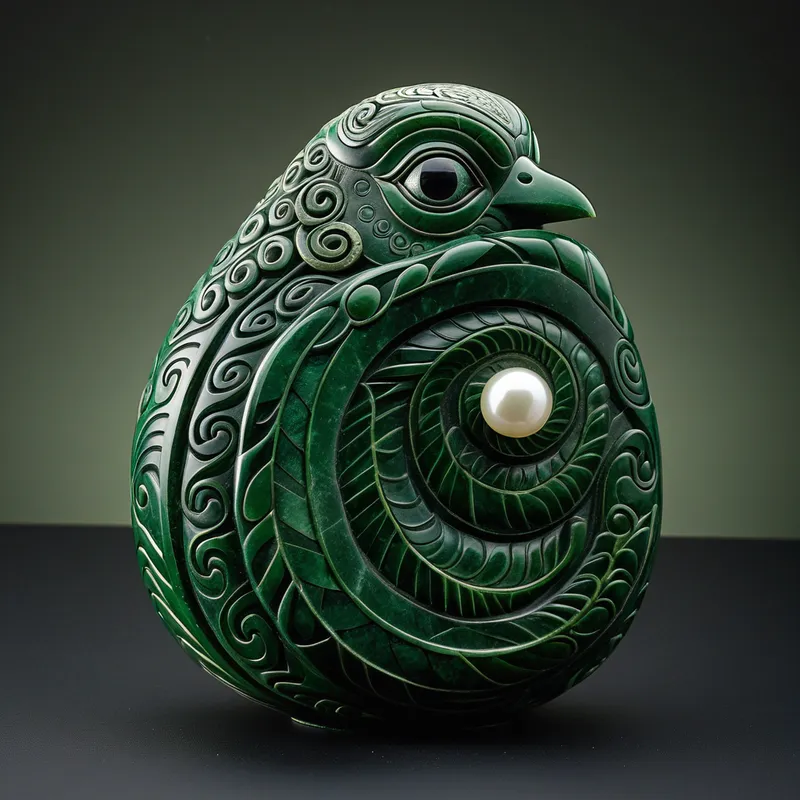
Manaia Guardian Spirit Myth Meaning & Symbolism
A guardian spirit of thresholds, the Manaia watches over the passage between the physical and spiritual realms, embodying protection and cosmic balance.
The Tale of Manaia Guardian Spirit
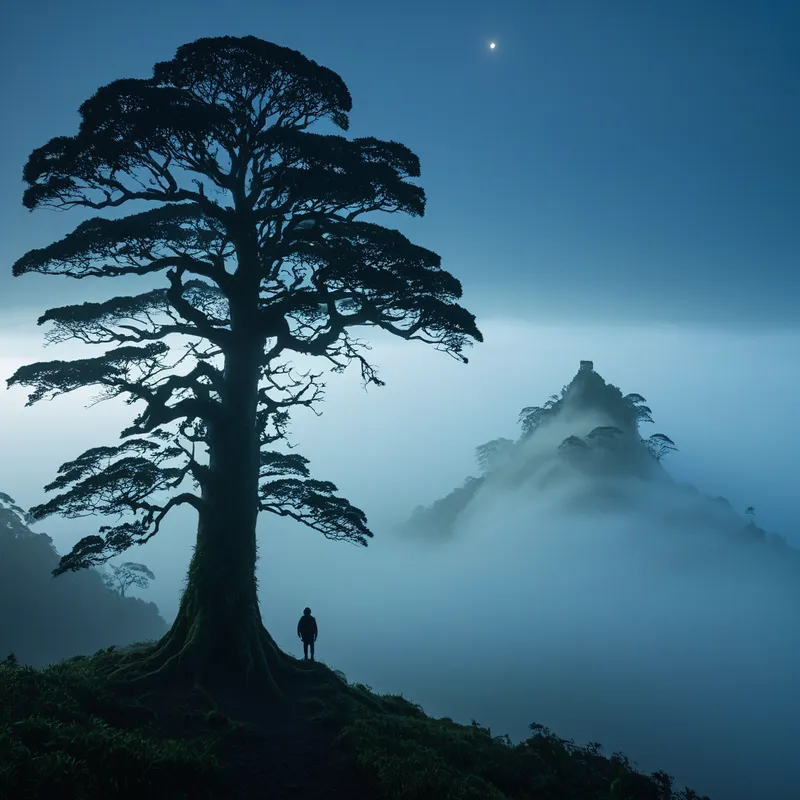
Listen. The world is not as solid as it seems. There are places where the veil between Te Ao Mārama and Te Pō grows thin. At the edge of the whispering forest, on the cliff above the thundering sea, in the deep silence just before dawn—here, the boundaries breathe.
In such a place walked a man, heavy with a grief that clung to his shoulders like a soaked cloak. His name is lost to the wind, but his journey is remembered. He sought passage, not across the sea, but across the great unseen divide. A loved one had stepped into the long night of Te Pō, and his heart, a fractured vessel, could not find peace. He went to the most sacred of cliffs, where the salt spray of the ocean met the breath of the land, a place known to the tohunga as a true threshold.
He began the karakia, his voice a raw thread against the roar of the elements. He called not to the great gods of war or creation, but to the guardians of the between. He offered his tears, his memories, his profound longing as his only sacrifice. For three nights he called, his fire a defiant spark against the vast dark.
On the third night, the air changed. The wind died mid-gust. The crash of the waves fell silent, as if the ocean held its breath. From the convergence of mist, sea spray, and shadow, a form began to coil and unfold. It was not wholly beast, nor bird, nor man, but a magnificent, terrifying synthesis of all three. This was the Manaia.
Its head was that of a bird, sharp-eyed and keen, seeing both this world and the next. Its body carried the strength and spirit of a human, a torso etched with the stories of ancestors. And from its form flowed the powerful, sinuous tail of a taniwha, connecting it to the primal depths of the earth and sea. It did not speak with a mortal tongue, but its presence communicated in waves of meaning: a warning, a question, and an offer of witness.
The man felt his grief laid bare before this silent judge. He did not plead; he simply stood, presenting his broken heart as his truth. The Manaia watched, its gaze piercing the layers of his sorrow. Then, it moved. It did not approach him, but turned its head towards the impenetrable veil of mist hanging over the chasm. With a gesture that was both a pointing and an unlocking, the mist parted—not to reveal the sunny world beyond, but to show a glimpse of a tranquil, silver-lit landscape where familiar shadows moved in peace.
No bridge appeared. No path was laid. The message was clear: the passage was not for him, the living. But the guardian had acknowledged his love and his pain. It had affirmed the connection itself. The Manaia held its vigil at the now-calm threshold, a permanent sentinel ensuring the sanctity of the divide. The man’s grief did not vanish, but it transformed. It was no longer a chain, but a thread—acknowledged, honored, and watched over. He returned to the world of light, carrying the awe of the encounter in his soul, knowing the borders of existence were guarded by a profound, composite consciousness.
Cultural Origins & Context
The Manaia is not a myth contained within a single, linear narrative like the epic voyages of Kupe. It is a pervasive symbolic entity deeply embedded in the visual and spiritual language of Māori culture. Its primary transmission is through the sacred art of whakairo, where it is one of the most recurring and potent motifs, carved into meeting house (wharenui) apexes, weaponry, and personal adornments like pounamu heirlooms.
The storytellers of the Manaia are the master carvers themselves. With each chisel stroke, they are not merely decorating; they are invoking and embedding spiritual protection. The Manaia appears prominently at key thresholds: the gable peak of a wharenui (guarding the community's spiritual heart), on the palisades of a pā (guarding the physical boundary), and around the necks of people as hei tiki or specific hei manaia (guarding the individual's life force, or mana). Its societal function is fundamentally prophylactic and cosmological. It is a reminder that the world is layered, that the spiritual realm (Te Pō) is contiguous with the physical, and that the points of contact between these layers require vigilant, balanced guardianship to maintain the order of the universe.
Symbolic Architecture
The Manaia’s power lies in its triadic, hybrid nature. It is a living symbol of synthesis and boundary.
The bird head represents the realm of the sky, of intellect, prophecy, and the aspirational spirit. It connects to the gods (atua) like Tāne, who separated earth and sky. It signifies foresight and a higher perspective. The human torso anchors the symbol in the world of community, ancestry, and present-tense consciousness. It represents tangata, the people, and their responsibilities, stories, and lineage. The serpentine form connects to the chthonic underworld, the primal forces, the unconscious, and the life-giving waters. It embodies the coiled potential, wisdom, and sometimes dangerous power of the earth, akin to the taniwha.
The guardian does not merely stand against; it stands between, and in doing so, it becomes the embodiment of the connection it regulates.
Psychologically, the Manaia represents the conscious integration of different aspects of the self. The bird is the soaring super-ego and spiritual yearning; the human is the functioning ego and social self; the serpent is the instinctive, vital, and often hidden id. A healthy psyche requires a "Manaia consciousness"—an internal guardian that allows communication between these realms without letting any one dominate or collapse the necessary boundaries. It is the psychic function that manages the threshold between the conscious and the unconscious, ensuring that encounters with deep, archetypal material are protective and transformative, not overwhelming.
The Dreamer's Resonance
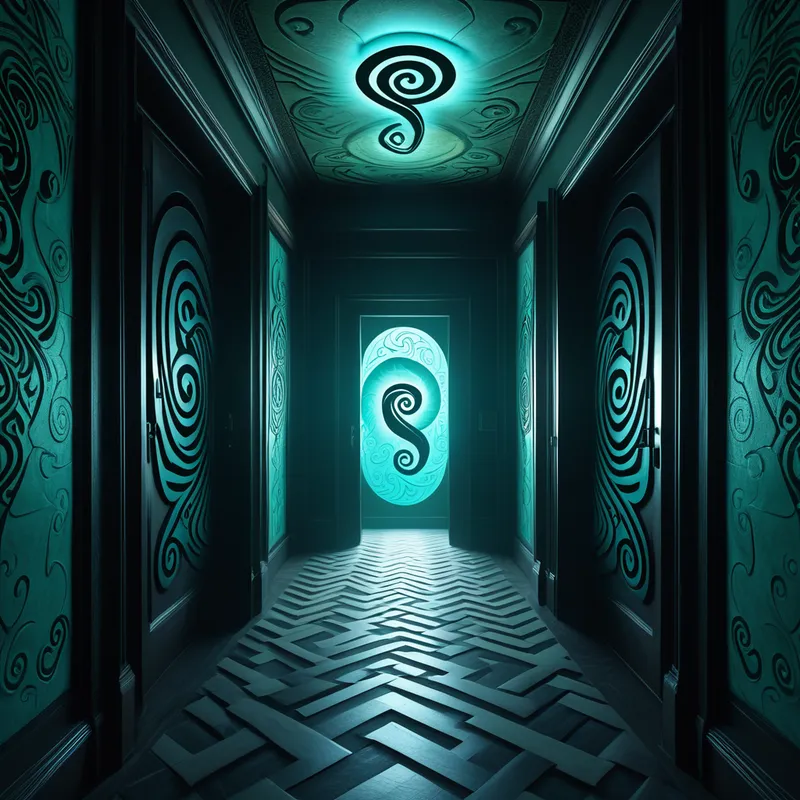
When the motif of the Manaia surfaces in modern dreams, it rarely appears as a literal carved figure. Instead, one might dream of a composite animal with features of different creatures, standing watch at a door, bridge, or forest edge. One might encounter a silent sentinel in a hallway of many doors, or feel the palpable presence of a watchful, non-human intelligence during a dream of profound transition or vulnerability.
Somnologically, this signals a process of internal boundary work. The dreamer is likely at a psychic threshold: perhaps ending a major life chapter, confronting a buried trauma (a passage into the personal Te Pō), or integrating a powerful new aspect of their identity. The Manaia’s appearance suggests the unconscious is activating a protective, synthesizing function. The somatic experience might be one of a charged stillness—a sense of being "seen through" by a powerful, neutral force. The psychological process is the establishment or reinforcement of a necessary psychic boundary, ensuring the ego is not overwhelmed as it navigates between known and unknown territories of the self. It is the psyche’s own architecture rising to guard a sacred inner passage.
Alchemical Translation
The individuation journey, the process of becoming psychologically whole, is an odyssey across internal thresholds. We must leave the familiar shore of our conscious identity to retrieve treasures (and confront shadows) from the unconscious depths. The core struggle in the Manaia myth is not to defeat the guardian, but to earn its acknowledgment by presenting one's authentic truth.
The modern individual’s "grief" offered at the threshold is their unvarnished reality—their wound, their longing, their unintegrated passion. The "Manaia" is the internal archetype of the Guardian that emerges to oversee this perilous work. Its alchemical role is threefold, mirroring its form:
- Bird (Sublimation): It raises the base material of instinct and pain into the realm of conscious understanding and meaning. It provides the "view from above" on one's own life pattern.
- Human (Coniunctio): It holds the tension of opposites within the personal self—light and shadow, strength and vulnerability, past and future—facilitating their marriage in the vessel of the individual.
- Serpent (Prima Materia): It connects the process to the raw, primal life force, ensuring the transformation is not just intellectual but visceral and enlivening.
The goal is not to cross every threshold, but to learn the sacred law of boundaries. True power lies in knowing what to let pass, what to protect, and what must remain separate until the self is strong enough to contain the union.
The triumph is the transformation of the seeker's state. Like the man in the myth, we do not get to illegally cross into repressed realms and remain intact. Instead, we receive the guardian's gift: the assurance that our deepest connections and most profound processes are witnessed and held within a larger, balanced order. We return to our daily life not with the prize of escape, but with the integrated knowledge of the guardian within, able to navigate our own internal thresholds with respect, courage, and protection.
Associated Symbols
Explore related symbols from the CaleaDream lexicon:
- Guardian — The primary archetype embodied by the Manaia, representing the protective force that oversees and regulates passage between different states of being or realms of existence.
- Threshold — The liminal space where the Manaia resides, symbolizing the critical point of transition, decision, or spiritual passage that requires guardianship.
- Bird — Reflecting the Manaia's head, representing higher perspective, spiritual messenger qualities, and connection to the celestial realms and foresight.
- Serpent — Manifest in the Manaia's tail, symbolizing primal earth wisdom, unconscious forces, cyclical energy, and connection to the chthonic underworld.
- Spirit — The essential nature of the Manaia as a non-corporeal entity that operates between worlds, embodying the concept of ancestral and protective spiritual presence.
- Door — The physical manifestation of the threshold the Manaia guards, representing opportunities for passage, hidden realms, and the interface between known and unknown.
- Ancestral Spirit — Connecting the Manaia to the lineage of guardianship and the wisdom of the ancestors who watch over the living from Te Pō.
- Protective Spirit Animal — The Manaia as a composite spirit guide that offers specific guardianship to individuals, communities, and places through its synthesized animal powers.
- Mana — The spiritual authority and prestige that the Manaia embodies and protects, representing the sacred power that flows through proper boundaries and relationships.
- Bridge — Like the threshold, but more active; the Manaia sometimes facilitates safe passage as a living bridge between realms when conditions are properly met.
- Shadow — The aspect of the self that dwells beyond the threshold, which the Manaia both guards against premature confrontation and facilitates conscious integration with.
- Dream — The state in which modern encounters with the Manaia archetype often occur, as dreams themselves are thresholds between conscious and unconscious realms.