Malingee Myth Meaning & Symbolism
A myth of a nocturnal hunter, embodying the sacred boundary between the known world and the deep, untamed wilderness of the night and the self.
The Tale of Malingee
Listen. When the great fireball of the sun sinks below the rim of the world, and the land exhales its heat into a vault of indigo, that is when his time begins. When the last ember of the campfire dims to a pulsating heart of red, and the children are gathered close, that is when you might hear him.
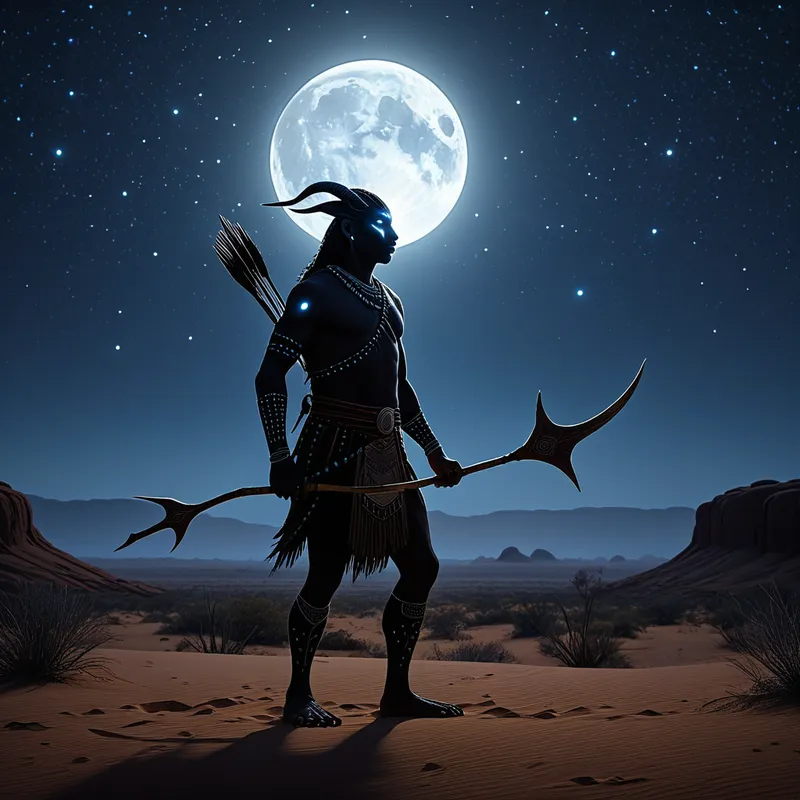
He is Malingee. He does not walk the sun-baked plains of day. He is a creature of the Dreaming that chose the cloak of perpetual night. His skin is the darkness between stars, his eyes are twin coals that see the heat of life where you see only black. He carries a spear, silent and sharp, not for the creatures of the day, but for the truths that only emerge in the absence of light.
In the time of creation, when the ancestral beings were shaping the world, Malingee turned his face from the communal fires. While others sang the rivers into being and danced the mountains forth, he listened to the whispers of the deepening shadows. He learned the language of the rustling spinifex in the cold wind, the secret paths of the nocturnal animals, the geometry of starlight on sand. He became the absolute master of the boundary—the precise, trembling edge where the circle of firelight ends and the unknown begins.
His story is not one of great battles or stolen fire, but of profound, watchful presence. He is the reason a mother pulls her child back from the edge of the camp’s glow. He is the shape your mind conjures in the strange crack of a twig beyond the light. He is the guardian of that line. To cross it unprepared, without respect, is to enter his domain. He does not attack the village; he defines it by what lies beyond. His hunt is eternal, a patrol of the perimeter of the known world. In his silent vigilance, he teaches the first and greatest law: here is safe, because there is sacred, powerful, and not for the careless.

Cultural Origins & Context
The stories of Malingee belong to several Aboriginal language groups across Australia, particularly in the arid central and western regions. He is a foundational narrative figure, a Dreaming ancestor who established a critical aspect of Law: the necessity of boundaries and the profound respect required for the spaces beyond human settlement.
These narratives were not mere campfire tales to frighten children, though they served that practical purpose brilliantly. They were integral to education and survival. Elders would recount the specifics of Malingee’s nature—his association with certain landforms, his behavior—to teach about nocturnal dangers, both animal and environmental. The myth encoded real knowledge: don’t wander at night, keep the fire burning, respect the bush. It was a story that mapped psychological and physical territory simultaneously, passed down through generations to maintain the delicate balance between human community and the vast, untamed Country that sustained it.
Symbolic Architecture
Psychologically, Malingee is a pristine archetype of the Shadow, but not as a mere repository of evil. He represents the necessary shadow—the parts of reality and the self that are wild, untamed, and operate outside the comforting light of conscious awareness and social order.
The boundary is not a wall, but a membrane. It defines the self by acknowledging the not-self, and in that acknowledgment, a sacred relationship is born.
He is the guardian of thresholds. His domain is the liminal space—the dusk, the edge of the clearing, the moment between waking and sleep. He symbolizes all that we exclude to create our identity: our primal instincts, our hidden fears, our untapped potential, and the raw, unfiltered reality of nature that refuses to be domesticated. He is not evil; he is other. He enforces the law that one must be prepared, must be initiated, must carry an inner fire of awareness before venturing into the depths of the unconscious or the wilderness. To meet him unprepared is to be consumed by chaos. To meet him with respect is to gain access to the wisdom of the night.

The Dreamer's Resonance
When the pattern of the Malingee myth stirs in modern dreams, it often manifests as an encounter at a threshold. The dreamer may be standing at a doorway, a forest's edge, or the railing of a bridge, peering into a compelling but frightening darkness. A figure may be glimpsed—a silent watcher, a shape with piercing eyes. There is a somatic tension, a holding of breath, a primal alertness.
This dream signals a psychological process of confronting a personal boundary. The conscious ego (the campfire, the home) has reached its limit. Beyond lies psychic material—a repressed emotion, a forgotten talent, a feared aspect of the personality—that is demanding recognition. The watcher is the psyche’s own guardian, ensuring this material is not approached lightly or with the arrogance of daylight consciousness. The dream is an invitation to acknowledge the shadow territory, to feel its presence and power without yet needing to cross over. It is the beginning of integration, preceded by the essential stage of respectful observation.

Alchemical Translation
The alchemical journey modeled by Malingee is not one of slaying monsters, but of sacred negotiation. The modern individual’s path of individuation requires not conquering the unconscious, but learning its laws and approaching its thresholds with humility.
The first stage is Nigredo, the blackening. This is the recognition of the boundary itself—the realization that one's comfortable identity is a circle of light surrounded by vast unknown. Malingee is this stage. He forces the confrontation with the limit. The next stage is not to charge past him, but to sit at the fire's edge and acknowledge his presence. This is a transmutation of fear into awe.
To integrate the shadow is not to bring the night into the day, but to become at home in the dusk, to learn to see by its different light.
The eventual crossing, when one is prepared, is an act of profound rebellion against the tyranny of a too-small self (hence the archetype of the Rebel). It is a conscious decision to leave the safety of known patterns and enter the wilderness of potential. In doing so, one does not defeat Malingee; one learns his ways. The spear he carries becomes a symbol of the focused insight needed to navigate the inner darkness. The individual who successfully translates this myth internally gains a terrible and beautiful freedom: the ability to move between worlds, to draw wisdom from the shadow, and to understand that the true center of the self exists not in the bright, crowded fire, but in the dynamic, sacred tension between the light one carries and the vast, star-filled night that surrounds it.
Associated Symbols
Explore related symbols from the CaleaDream lexicon: