Mahakala Myth Meaning & Symbolism
A wrathful protector deity embodying the fierce compassion that annihilates spiritual obstacles, transforming inner demons into the fuel for awakening.
The Tale of Mahakala
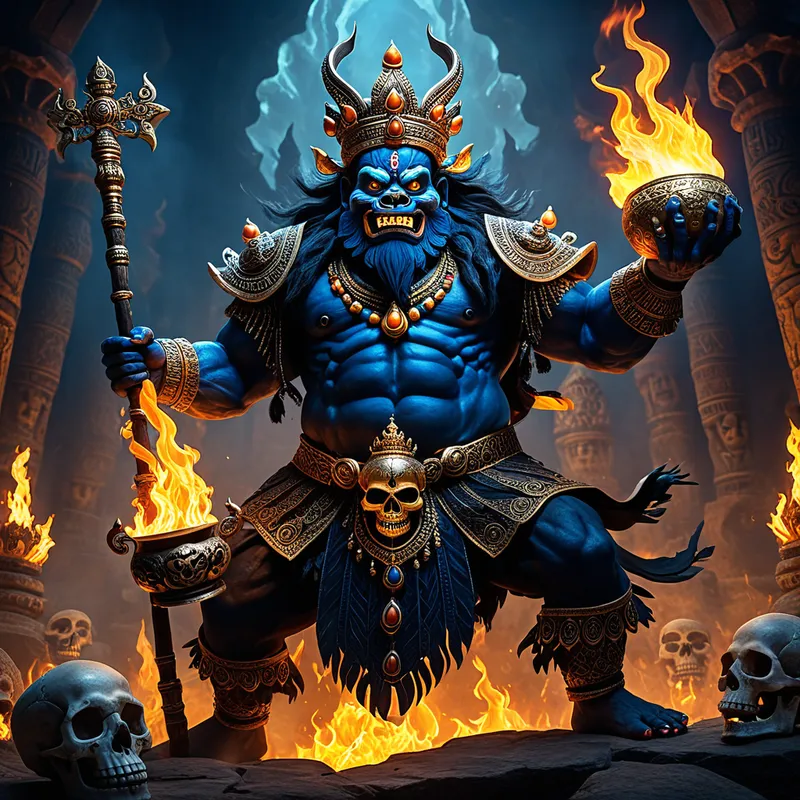
Listen. In the time before time, when the world was a tapestry of raw potential and the mountains were young gods sleeping, there existed a realm of pure, undifferentiated terror. It was not a place of evil, but of absolute, consuming power—the chaotic roar of existence before the mind names it. From this primordial roar, from the very heart of the Samsara he was born to destroy, arose a being of such fierce majesty that the stars themselves hid behind clouds of incense smoke.
His name was Mahakala. His body was the color of a midnight sky emptied of stars, a blue-black so deep it drank the light. Three eyes blazed with the fire of past, present, and future, seeing through all deception. His mouth was a roaring crescent, fangs bared not in malice, but in a timeless, ecstatic roar that shattered ignorance. In his many hands, he held the instruments of liberation: the flaming chopper to sever the roots of attachment, the skull-cup brimming with the nectar of wisdom, the trident that pins down the poisons of the mind. A garland of freshly severed heads, each representing a conquered ego, swung from his neck. His crown was five skulls, the mark of the victory of wisdom over the five afflictions. And beneath his dancing feet lay a prostrate figure, the personification of obstructive forces, not slain but utterly subdued, made into the very ground of his dance.
He did not arrive with gentle words. He erupted. His dance was the universe convulsing in the labor of enlightenment. The sound was the cracking of cosmic eggs, the grinding of continents, the silent scream of the self as it is unmade. He was the storm that clears the air, the surgeon’s blade that cuts the tumor, the all-consuming fire that reduces the forest of illusion to fertile ash. He was not sent; he was the response. Wherever the luminous, compassionate mind of the Bodhisattva met the thick, frozen walls of selfishness, hatred, and delusion, Mahakala manifested. He was the wrathful face of boundless compassion, the terrifying proof that love, in its ultimate form, will destroy everything that stands in the way of your freedom.
Cultural Origins & Context
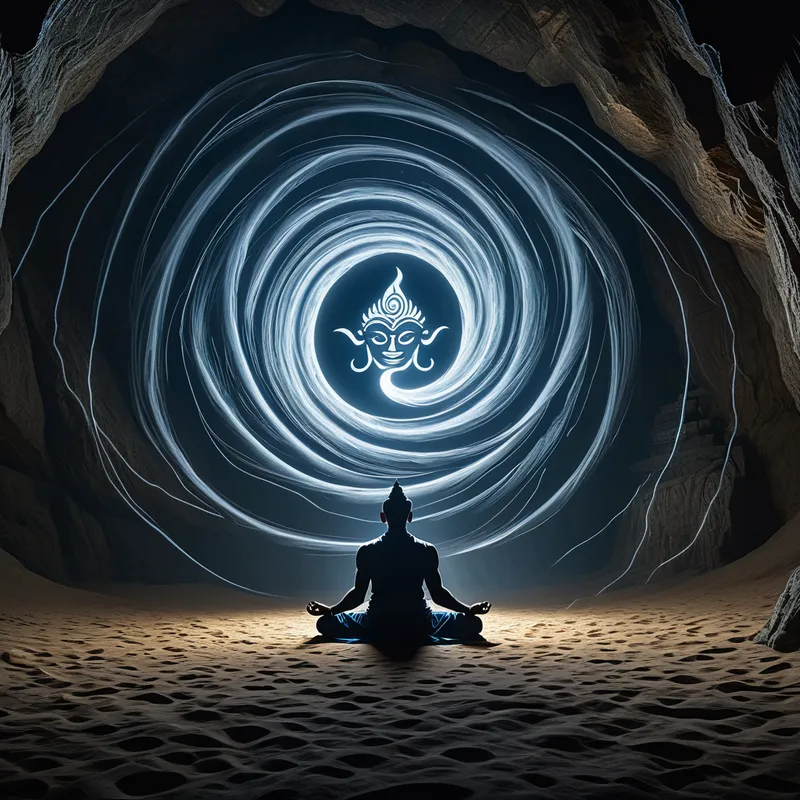
Mahakala’s origins are a palimpsest written across the spiritual history of Asia. His roots reach into the fierce protector deities of pre-Buddhist Bon and the Hindu god Shiva in his aspect as the destroyer of ignorance. With the flowering of Vajrayana Buddhism in Tibet, these powerful, untamed energies were not rejected but skillfully subsumed. They were ritually converted, their power harnessed and redirected through profound tantric practices to defend the Dharma and its practitioners.
This myth was not merely told; it was enacted. It lives in the whispered transmissions from lama to disciple, in the intricate iconography of thangka scrolls, and in the resonant, bone-deep chanting of monastic rituals. In temples, his form is a constant, fierce presence guarding the entrances and inner sanctums. For the yogi in solitary retreat, the visualization and invocation of Mahakala is a core practice—a direct engagement with the shadowy forces of one’s own psyche, transforming them into allies on the path. Societally, he functions as the ultimate protector, a psychological and spiritual guardian for the community and the teachings, embodying the principle that true safety arises not from avoiding darkness, but from mastering it.
Symbolic Architecture
Mahakala is the ultimate symbol of the shadow made sacred. He represents the necessary, terrifying force of psychic demolition that precedes construction. He is not a metaphor for evil, but for the fierce, uncompromising aspect of consciousness required to dismantle the complex, self-constructed prisons of the ego.
The most profound compassion is sometimes a wrathful roar that shatters the shell of the familiar self.
His blackness symbolizes the all-encompassing, fertile void from which all phenomena arise and into which they return—the shunyata that is pregnant with potential. His ornaments of bone and skull are not morbid trophies but emblems of victory over mortality and impermanence. The skull-cup (kapala) holds the elixir of transformed experience; the chopper (kartrika) severs the threads of discursive thought. Psychologically, he is the process of facing one’s deepest fears, rages, and attachments without flinching, and in that full-faced confrontation, discovering they are not enemies, but raw, untamed energy waiting to be liberated and put in service of the whole being.
The Dreamer's Resonance
When Mahakala strides into the modern dreamscape, he rarely appears in traditional regalia. The dreaming psyche translates him into contemporary symbols of overwhelming, transformative force. One may dream of a terrifying black vortex in the basement of a childhood home, a silent, dark figure dismantling a complex machine of worry in one’s office, or a sudden, cataclysmic storm that destroys a fragile, carefully maintained facade.
Somatically, these dreams may be accompanied by a feeling of thrilling terror, a profound shaking or vibration, or a paradoxical sense of relief amidst the chaos. Psychologically, this signals a critical phase of shadow-work. The ego’s defenses are being forcibly, compassionately breached. The dreamer is undergoing a process where long-repressed energies—primal rage, existential fear, “unspiritual” desires—are erupting into awareness. The Mahakala dream pattern insists that one cannot gently reason with these forces; they must be fully acknowledged, faced, and their elemental power consciously integrated. It is the psyche’s own tantric ritual, initiating the dreamer into a more authentic, powerful, and complete state of being.
Alchemical Translation
The individuation process, the journey toward psychic wholeness, requires an alchemical furnace. Mahakala is that furnace. His myth models the stage of the nigredo, the blackening, where all that is false, compensatory, and inauthentic must be ruthlessly incinerated. For the modern individual, this translates to the courageous deconstruction of the persona—the mask worn for the world—and the conscious engagement with the personal and collective shadow.
The path to the golden dawn of the integrated self leads directly through the midnight of the disintegrated one.
This is not self-improvement; it is psychic alchemy. The “demons” he subdues are our own inner obstacles: chronic self-doubt masquerading as humility, passive aggression disguised as kindness, spiritual bypassing pretending to be peace. Mahakala’s practice teaches that we do not fight these forces with their opposite (fighting anger with forced calm), but we meet them with a consciousness more vast and fierce than they are. We “invite the demon for tea,” as the saying goes, but with the unwavering authority of Mahakala. In doing so, the energy bound up in neurosis, fear, and hatred is liberated and transmuted. The very substance of our obstacles becomes the fuel for our awakening. The prostrate figure under his feet becomes the stable ground of our newfound, unshakeable presence. We learn that our greatest protector is not a force outside us, but the fearless, compassionate awareness that can hold and transform even our own darkness.
Associated Symbols
Explore related symbols from the CaleaDream lexicon:
- Shadow — The unintegrated, often feared aspects of the self that Mahakala does not destroy, but masterfully confronts and transforms into sources of power.
- Skull — The kapala or crown of skulls, representing the triumph over ego, impermanence, and the alchemical vessel that holds the nectar of transformed consciousness.
- Fire — The blazing wisdom flames surrounding Mahakala, symbolizing the purifying, transformative power that burns away ignorance and emotional obscurations.
- Dance — Mahakala's dynamic, wrathful posture is a cosmic dance, representing the relentless, rhythmic process of destruction and creation within the psyche and the universe.
- Mountain — The immutable, unwavering ground of being upon which the fierce dance of transformation takes place, symbolizing stability amidst chaos.
- Chaos — The primordial, raw energy from which Mahakala arises and which he ultimately orders and harnesses in service of enlightenment.
- Ritual — The precise tantric practices used to invoke and unite with Mahakala's energy, modeling the conscious, formalized process of engaging with deep psychic forces.
- Death — The constant theme of ego-death and the ending of karmic patterns, which Mahakala embodies as the necessary gateway to rebirth and liberation.
- Fear — The primary obstacle Mahakala confronts, not to eradicate the feeling, but to transmute its paralyzing energy into awakened vigilance and power.
- Protection — The ultimate function of the deity, representing the psychic safety that comes from internal strength and the integration of shadow, not from external barriers.
- Buddhist Stupa — A symbol of the enlightened mind, which Mahakala protects; his fierce energy guards the sacred, structured space of awakening from inner and outer corruption.
- Thunder — The terrifying, awe-inspiring sound of Mahakala's manifestation, representing the shocking, disruptive force of truth that breaks through complacency and illusion.