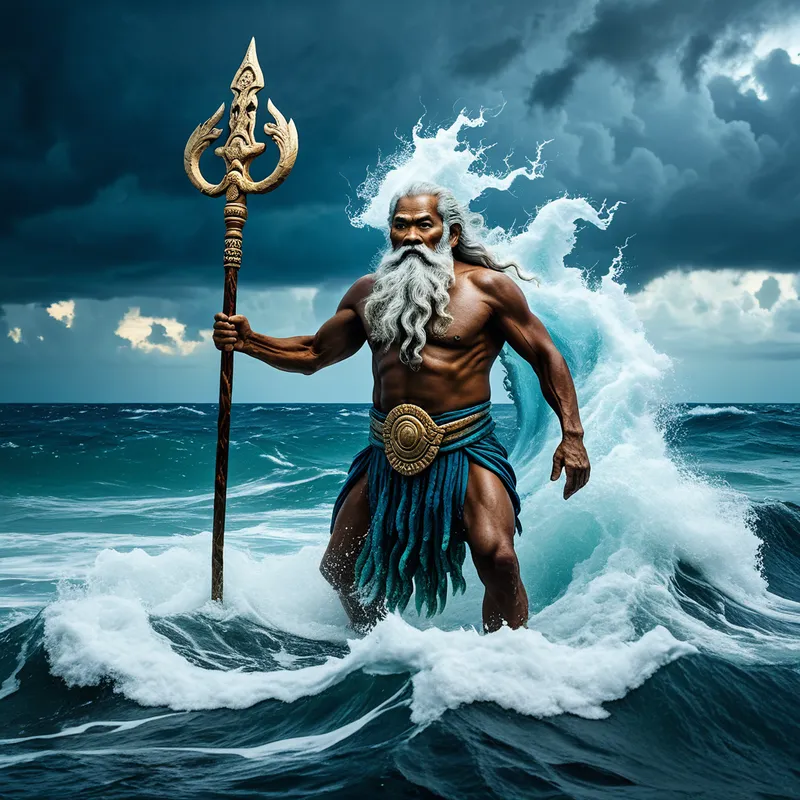
Maguayan Myth Meaning & Symbolism
The myth of the primordial sea god Maguayan and his cosmic battle with the sky god Kaptan, from which the world and humanity are born.
The Tale of Maguayan
In the time before time, there was no land, no sun, no moon. There was only the endless, sighing Maguayan, the sea, and the vast, brooding Kaptan, the sky. They were not enemies, but brothers in the great, silent void, each ruling their own domain. The sea was deep and dark, a realm of shifting currents and unseen depths. The sky was a high, empty vault, a realm of wind and silence. And between them stretched a gulf of nothingness, a loneliness so profound it ached in the very fabric of being.
This loneliness festered, turning to a cold resentment. Kaptan looked down and saw only the restless, grasping waves of Maguayan, who seemed to ever reach for his domain. Maguayan looked up and felt the oppressive weight of Kaptan’s boundless sky, which seemed to press down upon his waters. A word was spoken, sharp as a shell’s edge. An accusation, thrown like a thunderbolt. The great peace shattered.
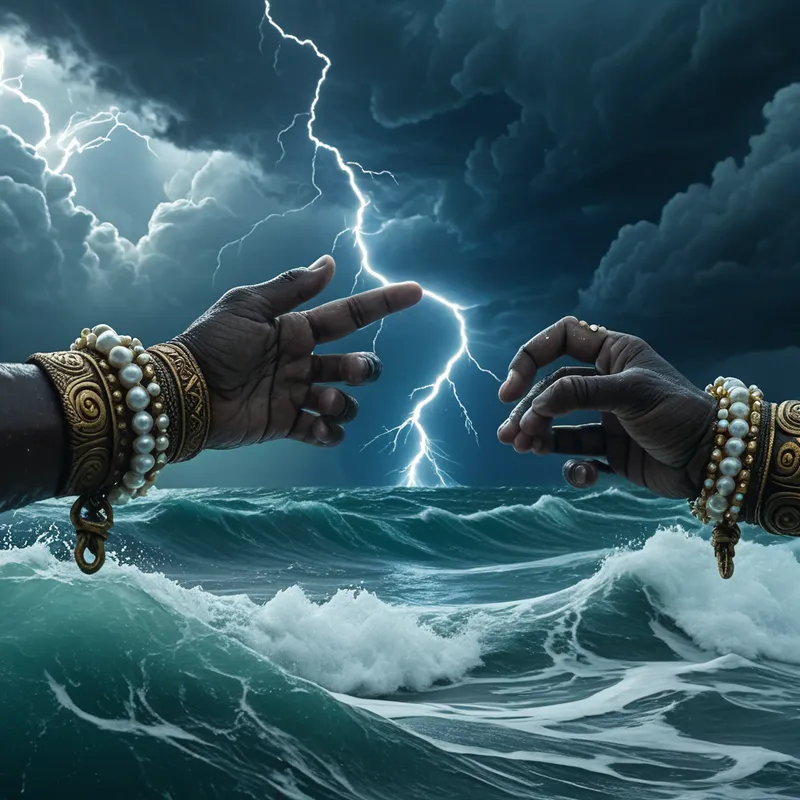
Kaptan, in his fury, hurled down jagged bolts of lightning, tearing the face of the sea. Maguayan, in his wrath, reared up in mountainous waves and colossal whirlpools, his salt spray lashing the lower heavens. The war was cataclysmic. The sea boiled. The sky screamed. For an age, they clashed, their struggle the only event in the universe, a symphony of pure, destructive chaos. The world was their battlefield, and it was formless.
But in the heart of this fury, something unexpected was forged. The very violence of their conflict began to create. Where Kaptan’s lightning struck the sea, islands of steam and rock solidified. Where Maguayan’s waves crashed against the bolts of sky, they threw up great masses of earth and sand. The chaos was giving birth to form.
Yet the war raged on, until from the wounded sea and the scarred sky, their children intervened. A son of Maguayan, Lihangin, the wind, and a daughter of Kaptan, Lidagat, the sea-current, had fallen in love. Their union was a bridge between the warring realms. They pleaded for peace, their voices the first gentle things in that howling void.
Moved, or perhaps exhausted by their own boundless rage, the primordial fathers listened. A truce was struck, not from forgiveness, but from a recognition of the new world their anger had inadvertently sculpted. As a final act of this strained peace, Maguayan and Kaptan turned to the first fruits of their union—the children of Lihangin and Lidagat. From these grandchildren, the first humans were fashioned. Some say they were carved from bamboo that sprouted where sky and sea met; others, that they were molded from the very earth and water of the new-made world. Thus, from a war of absolute separation, the bonded world, and humanity itself, was born.
Cultural Origins & Context
This creation narrative is central to the pre-colonial Visayan peoples of the central Philippines. It was not a single, canonical text, but a living oral tradition, passed down through generations by the babaylan and epic chanters. These storytellers were the keepers of memory, reciting the myths during rituals, community gatherings, and as part of the foundational education of the young. The myth served multiple societal functions: it was a cosmological map, explaining the origin of the islands, the sea, and the sky; a social charter, establishing the interconnectedness of all life and the divine origins of humanity; and a moral lesson about the destructive power of unchecked conflict and the creative potential that can emerge from reconciliation, however tense. It grounded a people surrounded by ocean and sky in a story where those very elements were their ancestral parents.
Symbolic Architecture
The myth presents a profound blueprint of creation emerging not from a single, ordered act, but from a dynamic, often violent, tension between opposites. Maguayan represents the unconscious, the feminine principle, the chaotic, fertile, and nurturing depths from which all life ultimately springs. Kaptan is consciousness, the masculine principle, the ordering, structuring, and differentiating force that gives shape and name.
Creation is not an act of will alone, but the often-painful child born of the confrontation between chaos and order.
Their war is the necessary, primal conflict that precedes all formation. The resulting world—the islands—symbolizes the nascent psyche, the first stable ground of individual identity emerging from the formless soup of potential. The children, Lihangin and Lidagat, represent the reconciling functions—the breath (wind) and the flow (current)—that can mediate between deep feeling and lofty thought. Humanity, born from their offspring, is thus inherently a hybrid creature, carrying within both the dark, salty depths of Maguayan and the luminous, airy expanse of Kaptan.

The Dreamer's Resonance
When this myth stirs in the modern soul, it often manifests in dreams of titanic, elemental conflict. You may dream of being caught between a terrifying storm and a raging flood, or of two colossal, impersonal forces clashing above you. This is the somatic signature of a profound internal schism. Perhaps your structured, rational life (Kaptan) is at war with your deep, emotional, or instinctual needs (Maguayan). The dreamer experiencing this is in the throes of a necessary, if frightening, psychic reorganization. The body feels the tension as anxiety, a feeling of being torn apart. The dream is not a prophecy of doom, but a depiction of the creative process of the unconscious, working to forge a new, more integrated state of being from the conflict of opposing inner forces.
Alchemical Translation
The individuation journey mirrors this myth precisely. We begin in a state of undifferentiated wholeness that is also a kind of void—a life not yet truly lived, where potentials are latent but unformed. The conscious ego (Kaptan) develops, creating order, plans, and a persona. But it inevitably comes into conflict with the powerful, often chaotic, forces of the unconscious (Maguayan)—repressed memories, instincts, passions, and shadow aspects. This inner war can feel like a crisis: depression, explosive anger, or a sense of meaninglessness.
The goal is not the victory of one side over the other, but the creation of a world that can hold them both.
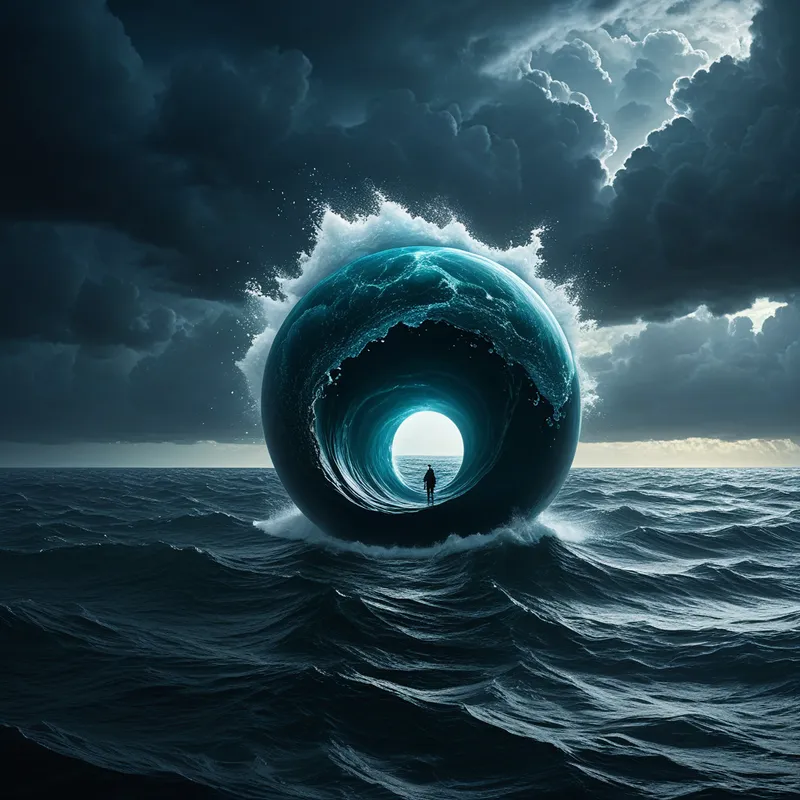
The alchemical work is to endure this coniunctio oppositorum (the conjunction of opposites) without being destroyed by it. We must allow the lightning of insight to strike the sea of emotion, and allow the waves of feeling to challenge the rigid structures of our sky. From this sustained tension, something new—islands of genuine personality, a stable inner ground—begins to form. The mediating functions (the loving children in the myth) are our own capacity for self-reflection, active imagination, and humility that allows dialogue between these warring parts. The final creation, the human born of this struggle, is the Self—the individual who has consciously integrated both the depth of Maguayan and the height of Kaptan, becoming whole.
Associated Symbols
Explore related symbols from the CaleaDream lexicon:
- Ocean — Represents the primordial, unconscious realm of Maguayan, the source of all potential life and the deep, emotional chaos that precedes creation.
- Sky — Symbolizes the conscious, ordering principle of Kaptan, the realm of intellect, spirit, and the structures we impose on reality.
- Chaos — The essential, fertile state of the universe before the conflict, and the necessary ingredient that, when engaged with order, gives birth to form.
- Order — The structuring impulse that emerges from the sky, providing the boundaries and differentiation needed to create a distinct world from the formless sea.
- Lightning — The piercing, transformative insight or violent action from the conscious realm (Kaptan) that strikes and catalyzes change in the unconscious depths.
- Storm — The somatic and psychological experience of the cosmic conflict between inner opposites, a turbulent but creative period of upheaval.
- Bridge — Embodied by the union of Lihangin and Lidagat, representing the mediating functions of psyche that can connect and reconcile warring opposites.
- Earth — The islands born from the conflict, symbolizing the nascent Self, the stable ground of identity that emerges from the integration of chaos and order.
- Creation — The core theme and outcome of the myth, where something new and tangible is born not from peace, but from the dynamic tension between opposing forces.
- Sacrifice — The relinquishing of absolute dominion by both Maguayan and Kaptan, a necessary surrender for the new world and humanity to come into being.