Macondo Myth Meaning & Symbolism
A magical town rises from the jungle, lives through a century of wonders and sorrows, and is erased by a wind of forgetting, holding a nation's soul.
The Tale of Macondo
In the beginning, before maps held their shape, there was a place the world had forgotten to invent. It was not discovered, but dreamed. A man named José Arcadio Buendía led his people through mountains that wept stone, guided by the ghost of a friend he had killed in a duel of honor, until they came to a riverbed of polished stones that were “prehistoric eggs.” And there, under the colossal, indifferent sun, he dreamed so fiercely of a city with walls of mirror that the dream took root. Macondo was born—a village of twenty houses of mud and cane built on the bank of a river of clear water that rushed over a bed of polished stones, white and enormous, like prehistoric eggs.
For years, it was a place of perfect innocence. The world was so new that many things lacked names, and to mention them you had to point. It was visited by a tribe of gypsies, led by the magnetic Melquíades, who brought magnets, magnifying glasses, flying carpets, and blocks of ice that steamed with cold fire in the tropical heat. José Arcadio Buendía traded his mules and a pair of fighting cocks for these marvels, his soul ablaze with an alchemist’s hunger. But innocence cannot hold. His sons grew, a church was built, a magistrate arrived, and the slow stain of politics, war, and commerce began to color the white walls.
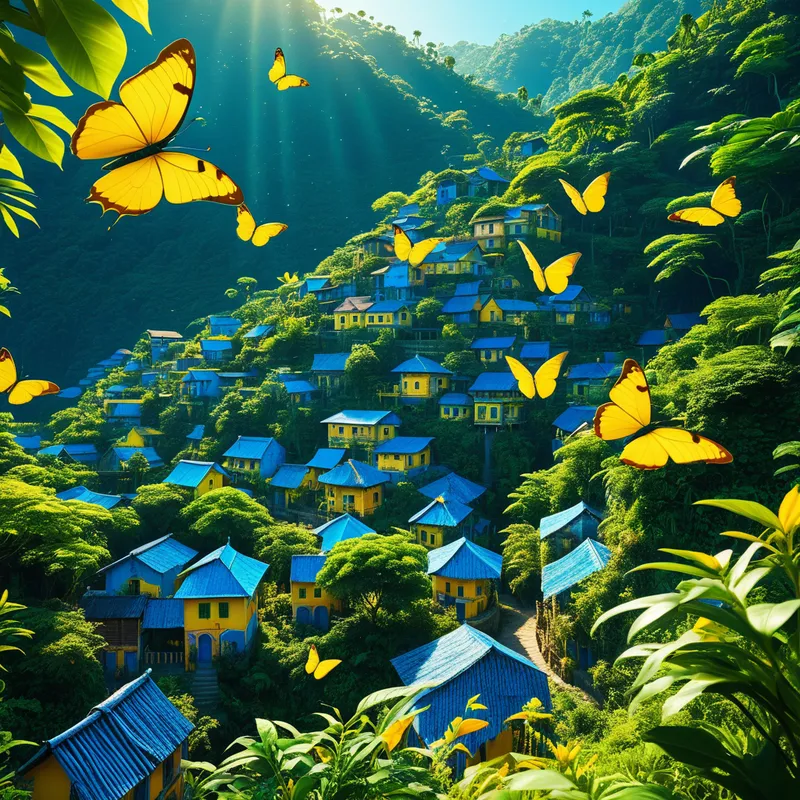
The town swelled with life and ghosts. A woman ascended to heaven while folding sheets. A trail of blood from a dead man wound its way through the streets, up staircases, and into his mother’s kitchen. A beautiful girl so pure she was ethereal ate only white chalk and earth, and was followed by a cloud of yellow butterflies wherever she went. For a century, the Buendía family lived, loved, fought, and dreamed within its confines, their personal madnesses and passions mirroring the town’s own fever. They fought civil wars that nobody remembered the cause of, built a railroad that brought a plague of forgetfulness, and witnessed a massacre by banana company soldiers whose bodies were loaded onto trains and thrown into the sea—an event so traumatic the official rain that followed washed all memory of it away.
And through it all, in a room sealed with the cipher of time, the last Aureliano pored over the parchment manuscripts of Melquíades, translating the prophetic history of his family, written in Sanskrit, Lacedaemonian military code, and the private poetry of the gypsy’s soul. He read, rushing, as he felt the wind beginning to rise. He did not need to leave the room to know it was the wind of finality, the wind foretold. For as he deciphered the last line, which coincided with his own moment of epiphany, he understood that Macondo was a city of mirrors (or mirages) that would be wiped out by the wind and exiled from the memory of men at the precise moment Aureliano Babilonia finished deciphering the parchments. And so it was. The town, and all its luminous and tragic history, was erased from the great book of the world, not with a bang, but with the soft, inexorable sigh of forgetting.
Cultural Origins & Context
This is not an ancient myth passed down through oral tradition, but a modern literary one, born from the typewriter of the Colombian novelist Gabriel García Márquez. Published in 1967, One Hundred Years of Solitude synthesized the collective soul, history, and magical consciousness of Latin America, particularly the Caribbean coast of Colombia. Márquez drew from the stories told by his grandparents, from the superstitions and hyperbole of local gossip, and from the region’s history of violence, solitude, and surreal political realities.
The myth of Macondo functions as a foundational narrative for a continent that often sees its own history as a magical-realist saga—a place where the extraordinary is mundane and the tragic is often met with a shrug of cosmic fate. It is a myth of origin, apocalypse, and cyclical return, told not by a village elder but by a novelist who became a continent’s bard. Its societal function is one of profound mirroring: it allows Latin Americans to see their own isolation, their political absurdities, their familial passions, and their struggle against historical amnesia reflected in a grand, tragicomic epic. It is a myth about the necessity and impossibility of remembering.
Symbolic Architecture
Macondo is not merely a town; it is the psyche itself—the isolated, burgeoning consciousness that must engage with the world. Its founding represents the heroic, naive act of creation and differentiation: “This is my Self, separate from the chaos.”
The founding solitude of Macondo is the necessary precondition for consciousness, but it is also the seed of its eventual madness.
The cyclical repetition of names and fates within the Buendía line symbolizes the neurotic patterns of the personal and collective unconscious, the family complexes we are doomed to re-enact until they are made conscious. The parchments of Melquíades represent the Self’s own encoded blueprint, the transcendent function that contains the meaning of the entire chaotic journey, but which can only be read at the end, in the moment of dissolution. The final wind is the archetypal force of entropy, of the unconscious reclaiming what was once differentiated. It symbolizes the terrifying truth that what is not truly remembered, what is not integrated into lasting meaning, is subject to annihilation.
The Dreamer's Resonance
To dream of Macondo is to dream of one’s own inner world in its entirety—a self-contained psychic ecosystem. You may dream of a familiar yet impossible hometown, vibrant yet decaying, filled with relatives who are both known and strange. This is the dream of confronting the Self as a historical entity.
The somatic feeling is often one of profound, enveloping solitude, even amidst a crowd of dream figures. You may feel the “wind” approaching—a rising anxiety that everything you have built internally is ephemeral. Dreaming of deciphering a text in a forgotten language points to a nearing breakthrough in understanding a deep, lifelong pattern, a moment of synthesis that may feel simultaneously like triumph and annihilation. The dream is a signal that the psyche is conducting a full audit of its legacy, preparing for a fundamental transformation that requires the old structures of identity to be seen in their totality before they can be released.

Alchemical Translation
The alchemical process modeled by Macondo is the opus contra naturum—the work against nature, which here is the work against forgetting. The base material is the prima materia of raw, undifferentiated experience (the founding jungle). Through the stages of calcinatio (the wars, the passions), solutio (the floods of rain and tears), and coagulatio (the building of the town, the family line), the psyche strives to create a lasting lapis, a permanent structure of consciousness.
The ultimate transmutation is not the preservation of the town, but the full comprehension of its story. The gold is not in the survival of the ego, but in the achievement of its meaning.
The final stage, mortificatio, is represented by the erasing wind. This is not failure, but the necessary dissolution of the identified ego-complex (“my story,” “my family drama,” “my trauma”) into the wider ocean of the Self. Aureliano’s deciphering at the moment of destruction is the critical act. It is the ego, in its final moment, fully comprehending the pattern of the Self. This is individuation: not building an eternal monument, but understanding the full arc of one’s psychic life so completely that its dissolution is no longer a tragedy, but the fulfillment of its prophecy. The individual is freed from the cyclical solitude of the Buendías by finally reading the manuscript of their own soul. The city of mirrors shatters, and in that shattering, for a fleeting instant, it reflects the whole of the cosmos.
Associated Symbols
Explore related symbols from the CaleaDream lexicon: