Lupa Myth Meaning & Symbolism
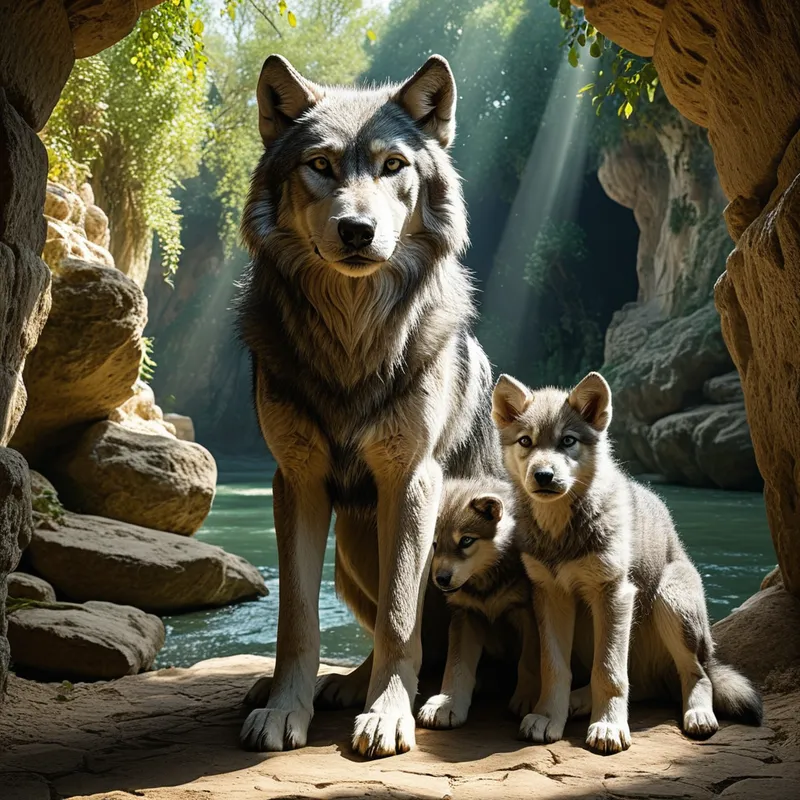
The she-wolf Lupa rescues and suckles the abandoned twins Romulus and Remus, an act of feral grace that founds the destiny of Rome.
The Tale of Lupa
Hear now the tale of the river’s whisper, the cry that changed the world. It begins not in a palace, but in the mud.
The king was afraid. A usurper himself, he saw his doom in the eyes of his newborn grand-nephews, twins born of the war god Mars and the priestess Rhea Silvia. Their bloodline was a threat, a spark that could ignite his downfall. So, he gave the order: take them to the swollen Tiber. Let the current be their cradle and their tomb.
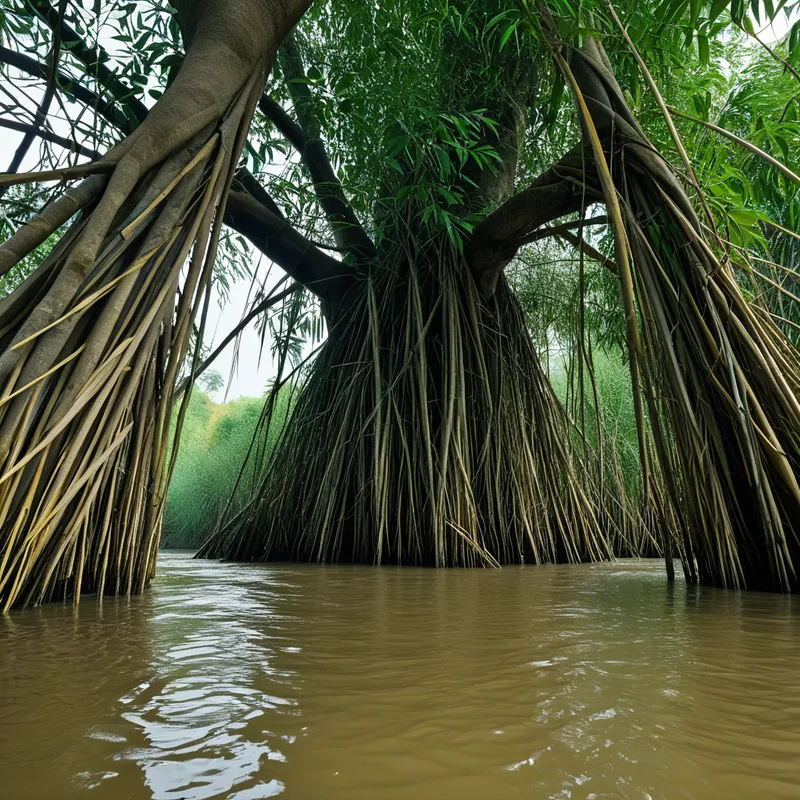
The servant’s heart faltered. He placed the squalling infants in a basket of woven reeds and set it upon the waters, not at the torrent’s heart, but where the river, swollen with spring rains, had spilled over its banks. The basket caught, not in the deadly flow, but in the gentle grasp of the flooded marsh, beneath the sacred Ficus Ruminalis. There, in the muck and the roots, the twins wailed their protest to the uncaring sky.
But the wild heard them.
She came from the deep green shadows, a shape of silent grace and lethal power. Lupa. Her nose twitched at the strange scent—human milk-sour, but underpinned by something divine. She found them, these mewling, hairless things. The predator’s instinct should have been clear. Yet, a different impulse stirred. Perhaps it was the will of Mercury, or the lingering trace of their father Mars in their blood. Or perhaps it was a mystery belonging to the wolf alone.
She did not devour. She nudged the basket to drier ground. She lay down, her warm flank a bulwark against the damp. And when their cries sharpened with hunger, she offered not fangs, but life. She suckled them. The river babbled its astonishment. The woodpecker, sacred to Mars, brought them scraps of food. The wild itself became their wet nurse, a kingdom of fur and feather ruling over two future kings.
They thrived, these children of the she-wolf, until a shepherd, Faustulus, stumbled upon the impossible scene: a wolf, tender with human young. He and his wife took them in, naming them Romulus and Remus. They grew strong on the hills, leaders of shepherd bands, their spirits forever marked by the beast that gave them their first strength. The feral milk of Lupa flowed in their veins, a primal legacy that would one day be poured into the foundations of the world’s greatest city.
Cultural Origins & Context
The myth of Lupa is not a fringe folktale; it is the foundational pre-history of Rome itself. It was a central pillar of Roman identity, recounted by historians like Livy and poets like Vergil. It was performed in rituals, depicted in statues (the famous Capitoline Wolf), and stamped on coins.
Its function was multifaceted. Primarily, it was an aition—a story explaining origins. It answered the profound question: How did a city of such ruthless order and military discipline arise? The answer lay in a paradox: Rome was born from an act of chaotic, wild mercy. The myth provided a divine and heroic pedigree, connecting the Roman people directly to Mars, thus legitimizing their militaristic culture as a birthright. Furthermore, it established a core Roman value: pietas, a complex sense of duty. The twins owed their lives not to human society, which had rejected them, but to the divine wild and humble shepherds. Their eventual founding of Rome was, in a sense, the ultimate act of repayment for that debt of salvation.
Symbolic Architecture
At its heart, the myth of Lupa is a profound symbol of the Wild Nurturer. It shatters the simplistic dichotomy between nature (savage, red in tooth and claw) and culture (ordered, civilized). Here, the ultimate symbol of feral nature becomes the source of survival and foundational strength.
The first law is not the law of the city, but the law of the den. Nurturance emerges from the most unexpected, untamed quarters.
Lupa represents the instinctual, unconscious foundation of the psyche. She is the raw, animal vitality that sustains life before reason, language, or social structure exist. The twins symbolize a nascent consciousness, a potential identity, abandoned by the conscious "king" (the ruling ego or old order) and left to die. Their salvation comes not from above, but from below—from the instinctual, shadowy realm of the psyche often feared and repressed.
The river Tiber is the threshold, the amniotic fluid of transformation. The Ficus Ruminalis is the axis mundi, the world tree at the center of this new world's birth. The shepherd Faustulus represents the bridge—the human capacity to recognize, translate, and integrate this wild gift into a human context.
The Dreamer's Resonance
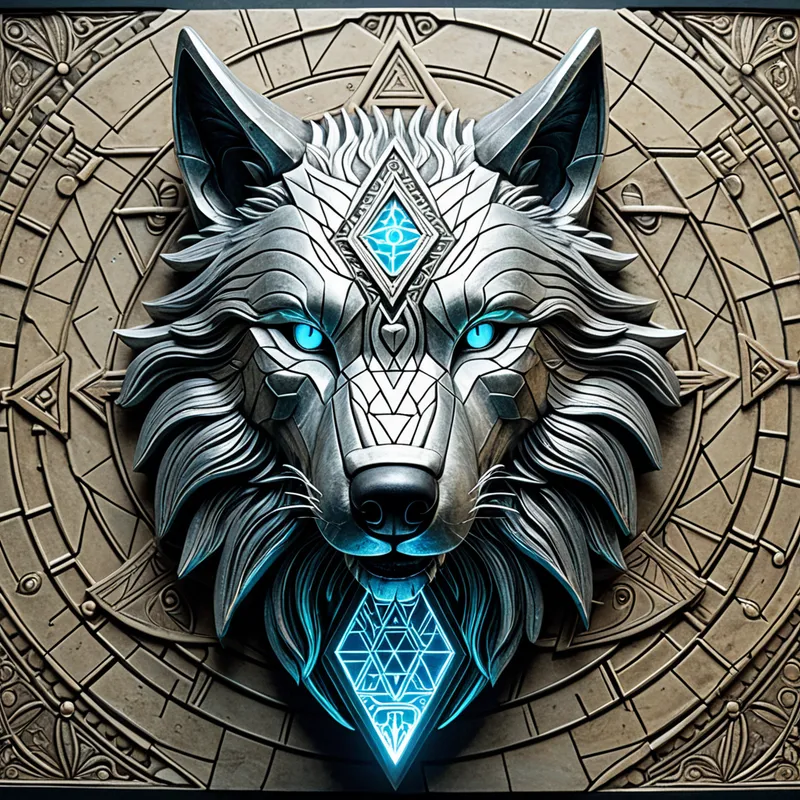
To dream of Lupa is to encounter a moment of profound psychic re-orientation. It often appears when the dreamer feels abandoned by their known world—by family, career, or a crumbling sense of self. The ego feels cast adrift, left to perish.
The she-wolf in the dream is not merely a wolf. She is the embodiment of an instinctual intelligence rising from the depths to offer sustenance. This might manifest somatically as a sudden, fierce urge to protect oneself, a surge of physical energy during illness, or an inexplicable knowing about a life path. Psychologically, it is the discovery of a resource within that you did not know you possessed—a resilience, a creativity, or a protective fury that feels both alien and deeply, authentically you.
The dream may evoke fear (the predator) and awe (the nurturer) simultaneously. This is the correct response. The dreamer is being asked to accept nourishment from a part of their own soul they have perhaps considered too wild, too dangerous, or too "uncivilized" to trust.
Alchemical Translation
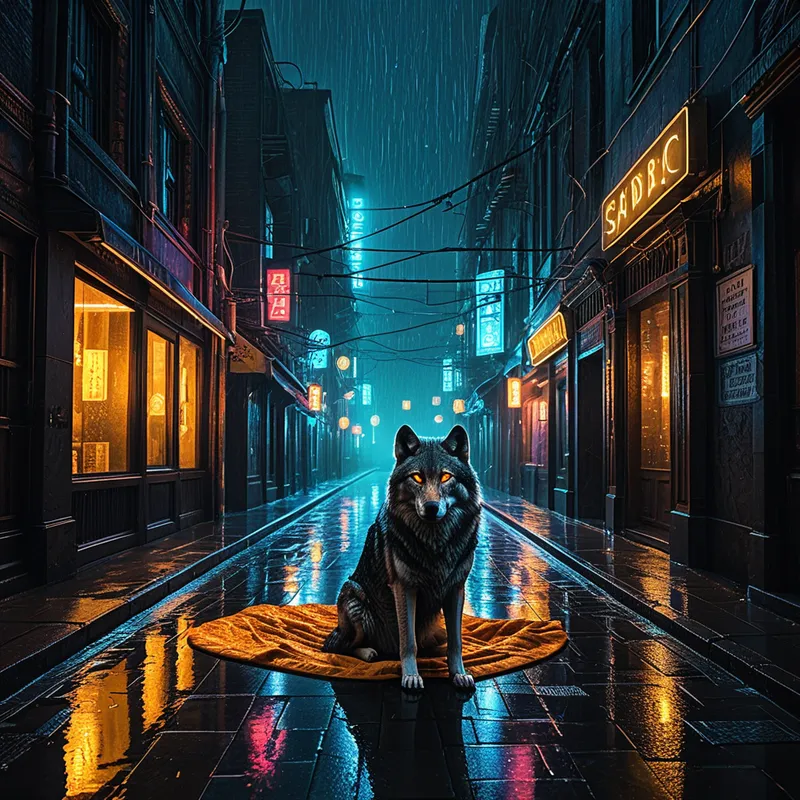
The alchemical process modeled here is the prima materia—the chaotic, base matter—being transformed not by force, but by a mysterious, innate grace. The abandoned twins are the lead, the worthless substance. Lupa is the prima prima, the first agent of change, whose milk is the alchemical aqua vitae (water of life).
For the modern individual, the myth maps the early, crucial stage of individuation: the nurturing of the nascent Self by the instincts. We are all, in some way, Romulus and Remus. We carry potentials, talents, or true identities that our conscious minds or societal expectations have "ordered to be drowned."
Individuation begins not with a grand plan, but with the acceptance of a wild, unexpected kindness from the depths of one's own being.
The process requires:
- Abandonment: The painful but necessary separation from an old, suffocating order.
- The River Threshold: A period of liminality, uncertainty, and emotional flooding.
- The Wild Nurture: The crucial, passive step of receiving sustenance from the instinctual unconscious (through dreams, body wisdom, creative impulses, or synchronicities).
- The Integration: The "shepherd" phase, where the conscious mind (Faustulus) recognizes the value of this wild gift and begins to raise it, to give it a name and a place in the daylight world.
The ultimate "city" we found—our integrated personality—is built upon this paradox. Its walls are disciplined and strong because its cornerstone was laid by a she-wolf's compassion. Our greatest strengths are not born in the light of approval, but are often suckled in the dark den of rejection, fed by the very wildness we must later learn to govern. To know the Lupa within is to know the fierce, foundational love that makes building anything of lasting value possible.
Associated Symbols
Explore related symbols from the CaleaDream lexicon: