
Lugh's Spear Myth Meaning & Symbolism
The story of the god Lugh, who wields a fiery spear that must be quenched in a cauldron of blood, symbolizing the union of power and responsibility.
The Tale of Lugh's Spear
Listen, and let the fire of the tale warm you. In the time before time, when the world was younger and the veil between the worlds was thin as mist, the Tuatha Dé Danann held the green isle of Ireland. But a shadow fell upon the land. The monstrous, one-eyed Fomorians, led by the tyrant Balor of the Poisonous Eye, demanded cruel tribute and bled the land with their oppression. The Tuatha Dé Danann were mighty, but they were divided, their king, Nuada, maimed, their hope a fading ember.
Then, from across the sea, a stranger came to the gates of Tara. He was Lugh Lámhfhada—Lugh of the Long Arm. The gatekeeper, skeptical, listed the skills required to enter: blacksmith, champion, harper, poet, historian, sorcerer, physician, cupbearer. To each, Lugh replied, "I am that." But he was more. He was master of all arts, a sun-bright synthesis of every skill. Admitted, he stood before the council, his presence a quiet challenge. He played the harp until the court wept, then laughed, then slept. He moved the Stone of Fál with his strength. He was the shining one, the Samildánach.
Yet, for the coming cataclysm, the Second Battle of Mag Tuired, he needed a weapon worthy of a god-king. Not just any spear. He sought the Spear of Gorias, one of the Four Great Treasures. This was no mere shaft of wood and iron. It was a fragment of sovereignty itself, forged in a city of the Otherworld. It was named Areadbhair, and it thirsted. It was a spear of living flame, so fierce and battle-mad that once drawn, it could not be sheathed until it tasted blood. It roared with a will of its own, a torrent of destructive potential.
On the fateful day at Mag Tuired, the armies clashed. The sky wept, and the earth groaned. Balor, the Fomorian king, unveiled his terrible eye, whose gaze could wither a hundred warriors where they stood. As that lid began to rise, a deathly chill swept the field. Then, Lugh acted. He did not merely throw the spear. He became its aim. Channeling the focused fury of his people, the brilliance of his many arts, he let fly Areadbhair. It flew not as wood and fire, but as a bolt of concentrated purpose. It pierced Balor's eye, driving the poison back into the giant's own skull, felling him like a mountain.
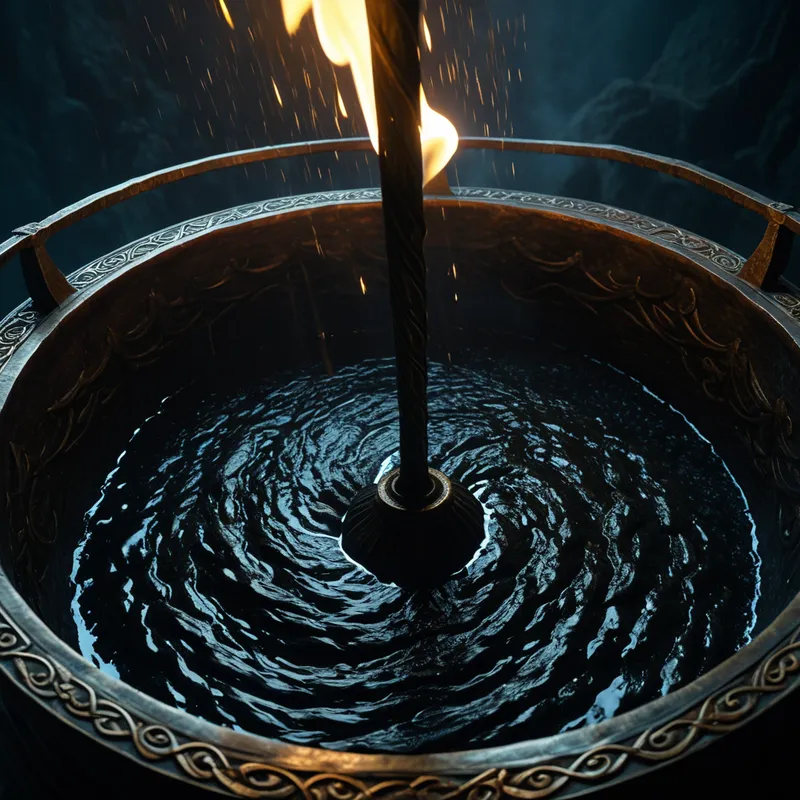
But the spear's work was not done. Thrumming with unleashed power, hot and screaming for more, it threatened to burn the very victory it had won. So, Lugh, the sovereign king, performed the necessary rite. He ordered the spear to be quenched. Not in water, but in a cauldron filled with the blood of slain Fomorian champions and witches. The hiss was not of steam, but of a terrible thirst being slaked, a primal force being cooled and contained by the substance of its own conquest. Only then did the flames die, and the spear grew still. The land was free, and the fiery spear of sovereignty was tempered by the cauldron of sacrifice.
Cultural Origins & Context
This myth survives primarily in the medieval Irish text Cath Maige Tuired, a saga compiled by Christian monks from much older oral traditions. It is a cornerstone of the Mythological Cycle, which chronicles the deeds of the Tuatha Dé Danann. The storytellers were the filid, keepers of lore, who would have recited this tale to affirm the cosmic order and the qualities of rightful kingship.
The myth functioned as a sacred charter. It explained the sovereignty of the land (Ireland) as being won and maintained not by brute force alone, but by a specific, sacred formula. Lugh, the ideal king, embodies the geis or sacred duty: the union of unparalleled skill (Samildánach) with the responsibility to channel and temper destructive power. The spear's quenching was not an afterthought; it was the essential, concluding ritual that transformed victory from a chaotic eruption into a stable reign. It taught that true power must be integrated, its fires cooled by the sobering waters—or blood—of consequence, lest it consume the ruler and the realm.
Symbolic Architecture
At its heart, Lugh's Spear represents the formidable, focused power of consciousness—the penetrating light of the intellect, will, and skill. It is the "Long Arm" of Lugh, the ability to reach out, to grasp, to strike with precision. It is the fiery drive of the ego, of ambition, and of singular purpose.
The spear is the weapon of differentiation, piercing the monolithic, oppressive "eye" of undifferentiated chaos and tyranny.
Balor's Eye is its perfect counterpart: a symbol of the devouring, petrifying gaze of the unconscious, of fate, of a monstrous, paralyzing complex. It is the tyrannical force that demands total submission, the unprocessed shadow that threatens to annihilate the developing self. Lugh's victory is the triumph of differentiated consciousness over engulfing unconsciousness.
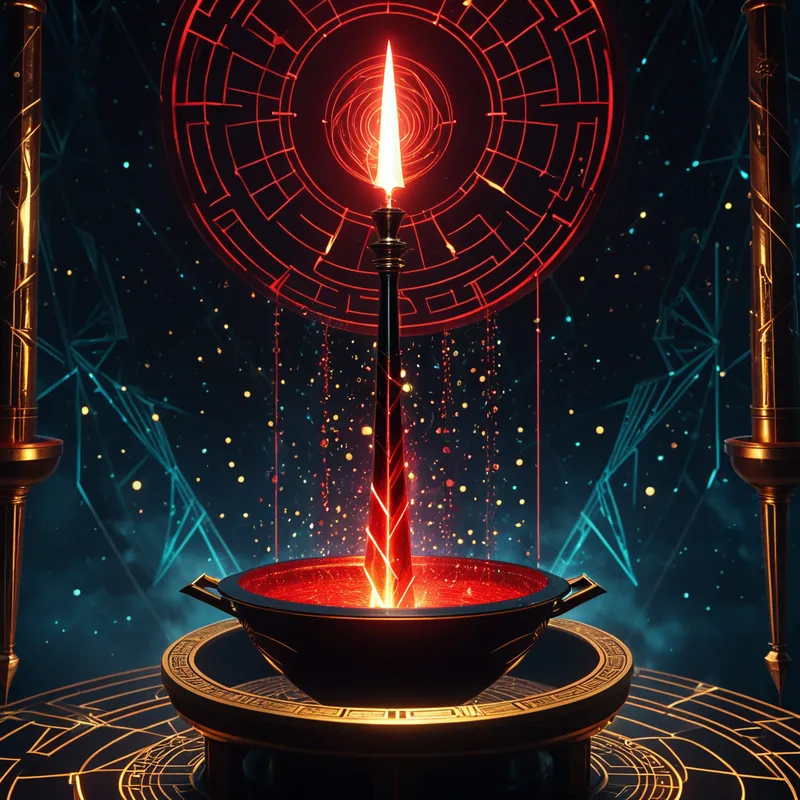
The cauldron of blood is the critical third symbol. It represents the vessel of transformation, the containing womb of the deep psyche. Blood is life, lineage, and the substance of instinct. To quench the fiery spear in it is the alchemical solutio—the dissolution of the rigid, burning ego in the waters of the unconscious, of feeling, and of connection to the ancestral and instinctual realm. The act signifies that raw power, to be sovereign, must be tempered by sacrifice, by acknowledging the cost, and by integrating the lifeblood of what is conquered or overcome.
The Dreamer's Resonance
When this myth stirs in the modern dreamer, it often signals a critical moment of confrontation with a "Balorian" force in their psyche. This could manifest as a domineering internal critic, a suffocating life situation, or a monstrous fear that paralyzes growth. The dreamer may find themselves holding a weapon of light or truth, feeling a surge of potent, righteous anger, or a clear, piercing insight.
The somatic experience is key: a heat in the chest or hands, a sense of tensile strength in the arm, a feeling of being "armed" with a newfound skill or truth. This is the spear awakening. The subsequent dream imagery—perhaps searching for a container, witnessing a spill, or feeling the weapon grow dangerously hot—points to the unresolved second half of the myth. The psyche is announcing, "You have drawn the spear of your will. Now, you must find the cauldron to quench it, or it will burn you." The dream process is the unconscious guiding the individual toward the necessary, often painful, integration of their power with compassion and consequence.
Alchemical Translation
The journey of Lugh models the individuation process for the modern soul. We all possess a "spear": our unique talents, our assertive will, our conscious aims. The first heroic task is to forge and claim this spear—to develop our skills and define our purpose against the inner and outer "Fomorians" of doubt, convention, and oppression.
Individuation is not the unleashing of the spear, but the sacred ritual of its quenching. The king is not crowned in the throw, but in the tempering.
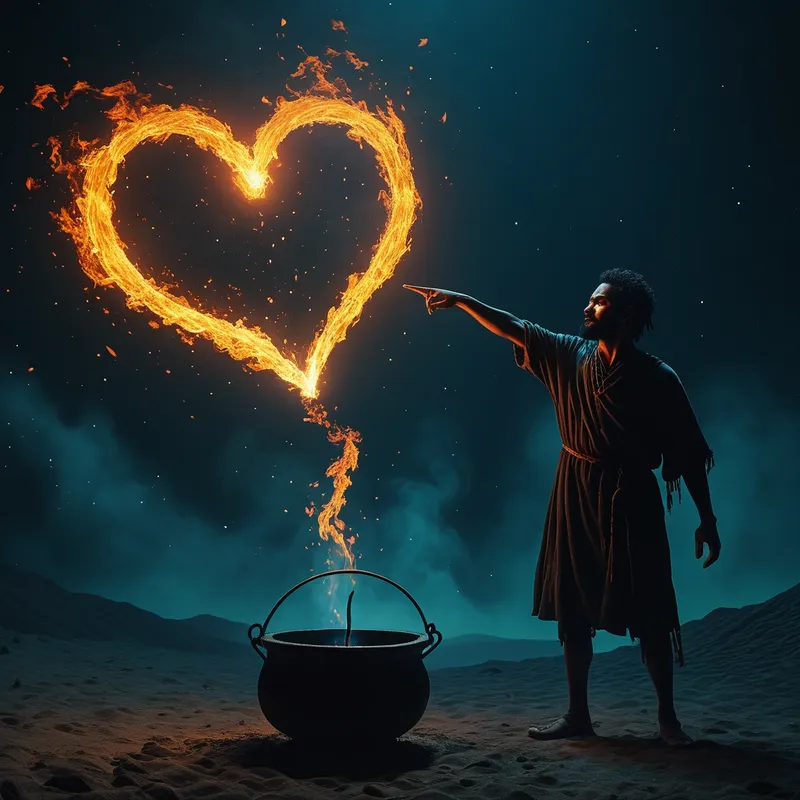
The pivotal alchemical stage is the mortificatio and solutio represented by the cauldron. Throwing the spear (confronting the shadow, achieving the goal) is an act of separatio—differentiation. But victory alone leads to inflation, to a psyche ruled by a burning, insatiable ego. The true transformation occurs when we consciously plunge our hard-won power, our pride, our fiery identity, back into the cauldron of our shared humanity, our grief, our blood-knowledge. We sacrifice the pure, isolated brilliance of the achievement to the messy, living totality of who we are.
This is the move from hero to sovereign. The hero wins the battle. The sovereign, having quenched his spear, rules the peace. For us, it means allowing our achievements, our traumas, our power to be dissolved and reconstituted in the vessel of a deeper, more compassionate self. The spear remains, but it is no longer a raging fire. It is a tempered instrument of sovereignty—a focused will that remembers the cost of its edge, a consciousness that is powerful precisely because it is integrated with the dark, nourishing blood of the unconscious from which it sprang.
Associated Symbols
Explore related symbols from the CaleaDream lexicon: