Love as the Axis of Creation
A Sufi mystical perspective that positions divine love as the fundamental axis and driving force behind all of creation.
The Tale of Love as the Axis of Creation
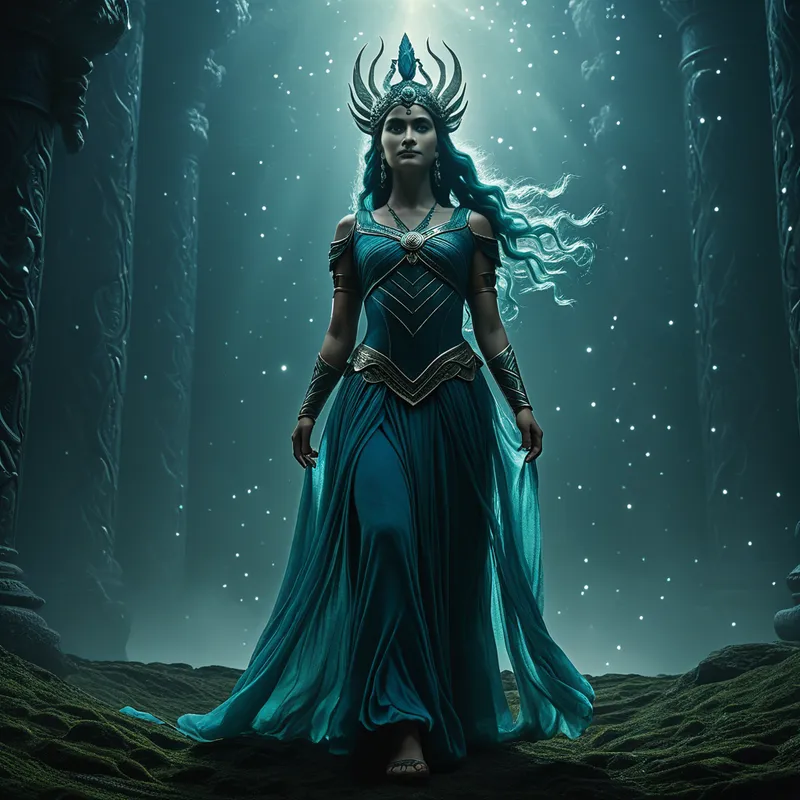
In the beginning, before the beginning, there was only the Beloved, the One, the Absolute Reality, known as al-Haqq. In that state of pure, undifferentiated unity, there was no other, no world, no creation. There was only the solitude of divine majesty, a solitude so profound it was a secret longing to be known. For what is love without a beloved? What is beauty without an eye to witness it?
From this secret longing—this divine nostalgia for companionship—arose a sigh. Not a sigh of weariness, but a sigh of infinite, compassionate yearning. This sigh, in the language of the mystics, was the breath of the Merciful (nafas ar-Rahman). It was not air, but the very substance of love itself, exhaled from the depths of the divine essence. As this breath of love expanded, it spun. It did not push matter into being; it drew possibility into form through the magnetic pull of its desire. All of existence—the swirling galaxies, the rooted trees, the beating hearts of creatures—came into being as expressions flung from this central, spinning axis of divine affection.
The cosmos, therefore, is not a manufactured artifact but a revealed love letter. Every atom hums with the vibration of that original sigh. The great Sufi poet and sage Jalaluddin Rumi speaks of this in his Mathnawi, describing the entire universe as being in a state of perpetual motion, not from mechanical force, but from love: “The lovers of God have no religion but God alone…” They are drawn by the pull of the axis. The story tells of the primordial covenant (alastu bi rabbikum — “Am I not your Lord?”), where all human souls, before time, testified to God’s lordship. This moment was not a juridical contract but the first intimate encounter, the moment the Beloved’s gaze met the potential beloved, and love sealed the bond of all future creation.
Thus, creation is an act of divine unveiling. The One, out of the abundance of its own beautiful nature, desired to see that beauty reflected. It created the cosmos as a mirror. Humanity, possessing the faculty of consciousness (‘aql) and the heart (qalb), is the polish on that mirror, the place where the universe becomes aware of itself and can consciously return the gaze of the Beloved. The axis of love spins us into being, and our purpose is to spin back toward the source, in a dance of recognition and return.
Cultural Origins & Context
This cosmology of love as the foundational principle emerges from the inner, esoteric dimension of Islam known as Sufism (Tasawwuf). While mainstream Islamic theology emphasizes God’s transcendent power (jalal) and will in creation, Sufism balances this with an overwhelming focus on God’s immanent beauty (jamal) and loving desire. This perspective is not a departure but a deep immersion into the Qur’anic verse, “I created the jinn and humankind only that they might worship Me” (51:56), which Sufis interpret not as a demand for servitude but as an expression of divine longing for relationship.
The concept is most eloquently articulated in the school of wahdat al-wujud (the Oneness of Being), associated with Ibn ‘Arabi (1165–1240), and in the poetic metaphysics of Rumi (1207–1273). For Ibn ‘Arabi, love is the very raison d'être of creation. In his Bezels of Wisdom, he states, “He loved to be known, so He created the creatures.” Here, love is the efficient, formal, and final cause all at once. Rumi’s entire poetic corpus is an extended ode to this truth, framing separation from the divine source as the root of all pain and the soul’s journey as a love-drunk return.
This mystical framework provided a profound psychological and cosmological alternative to purely legalistic or philosophical interpretations of existence. It placed the human heart, with its capacity for passionate love (‘ishq), at the center of the cosmic drama, offering a path to the divine not solely through ritual obedience but through the transformative fire of longing and devotion.
Symbolic Architecture
The myth constructs a universe where love is not peripheral but central, architectonic. The primary symbol is the Axis itself—an invisible, vertical line around which all reality turns. This is the qutb, the spiritual pole of the age in Sufi hierarchy, but on a cosmic scale. It represents the unwavering, attracting presence of the Divine around which the soul’s orbit is fixed.
The world is a wedding feast, and every creature is a guest brought into being by the invitation of Love. Our restlessness is not a flaw, but the vibration of the feast’s music, drawing us toward the host.
The Breath of the Merciful is another core symbol. It signifies creation as an act of intimate, life-giving expiration, not a violent command. The universe is breathed into existence, sustained by each divine in-breath and out-breath, making all of life a continuous, loving respiration between Creator and creation.
The Mirror is crucial. Creation is God’s mirror. The human heart, when polished free of the rust of ego and neglect, becomes the clear spot that can reflect the divine attributes back to their source. The pain of life is the polishing process. The Covenant (‘ahd) symbolizes the soul’s eternal, pre-temporal bond with God, the original moment of love that destiny seeks to fulfill.
The Dreamer's Resonance
For the modern psyche, this myth offers a radical re-enchantment of existence. In a world often experienced as mechanistic, random, or hostile, the Sufi axis proposes that the fundamental fabric of reality is affectionate intelligence. The feeling of existential longing—the “divine discontent” that permeates so much of human experience—is reframed. It is not a symptom of maladjustment, but the soul’s memory of its origin, its homing signal activated. Our deepest yearning is the axis of love, felt within.
Psychologically, this translates the concept of the Self (in a Jungian sense) as the central, ordering principle of the psyche. The ego’s suffering arises from orbiting around its own minor axis of fear and desire. Individuation becomes the process of realigning one’s life with the true axis—the pull of the Beloved, which manifests as the call to authenticity, compassion, and wholeness. The heartache of loss, the joy of connection, the creative impulse—all are currents in this greater magnetic field.
Alchemical Translation
The alchemical process here is one of magnetization and liquefaction. The soul, like iron filings, is scattered and asleep. The presence of the divine axis, felt as love or intense longing, begins to polarize the soul’s fragments, drawing them into a coherent pattern oriented toward the source. This is the stage of nigredo, the dark night of the soul where one feels the painful pull away from worldly attachments.
The fire of longing does not burn to destroy, but to melt. It liquefies the hardened structures of the ego—the rigid identities, the calcified wounds—so that the soul, now fluid, can flow in the currents of its true purpose.
This liquefaction is followed by albedo, the whitening, where the heart-mirror is polished by remembrance (dhikr) and surrender. Finally, rubedo is achieved not as a possession, but as a state of perpetual turning—the vibrant, red-gold state of the lover who has become a pure conduit for the love that spins the worlds. The “stone” of the ego is transmuted into the elixir of conscious participation in the divine breath.
Associated Symbols
Explore related symbols from the CaleaDream lexicon:
- Axis — The central, unmoving point around which all of creation turns, representing the divine presence as the ultimate source of attraction and order.
- Beloved — The ultimate object of longing, the divine reality that calls to the soul and is the true focus of all love in the universe.
- Breath — The creative exhalation of spirit into form, symbolizing life as a continuous, intimate gift from the divine source.
- Mirror — The cosmos and the purified human heart as reflectors of divine beauty and attributes, revealing the hidden face of the creator.
- Heart — The polished center of human consciousness where the divine axis is felt, the seat of true knowing and mystical union.
- Fire — The transformative power of divine love, which burns away illusion and ego to reveal the soul's essential gold.
- Dance — The whirling motion of all creation and the Sufi's spiritual practice, embodying ecstatic surrender to the pull of the cosmic axis.
- Covenant — The primordial bond of love and recognition between the soul and the divine, the forgotten promise that guides the journey home.
- Longing — The sacred ache of the soul separated from its source, the very engine of spiritual search and the proof of love's prior existence.
- Sigh — The creative impulse of the divine, the expression of compassionate yearning that brings the world into being from a place of fullness.