Lono God of Agriculture Myth Meaning & Symbolism
The myth of Lono, the Hawaiian god of agriculture, tells of his seasonal descent to bring fertility, his sacred marriage to the earth, and his ritual departure.
The Tale of Lono God of Agriculture
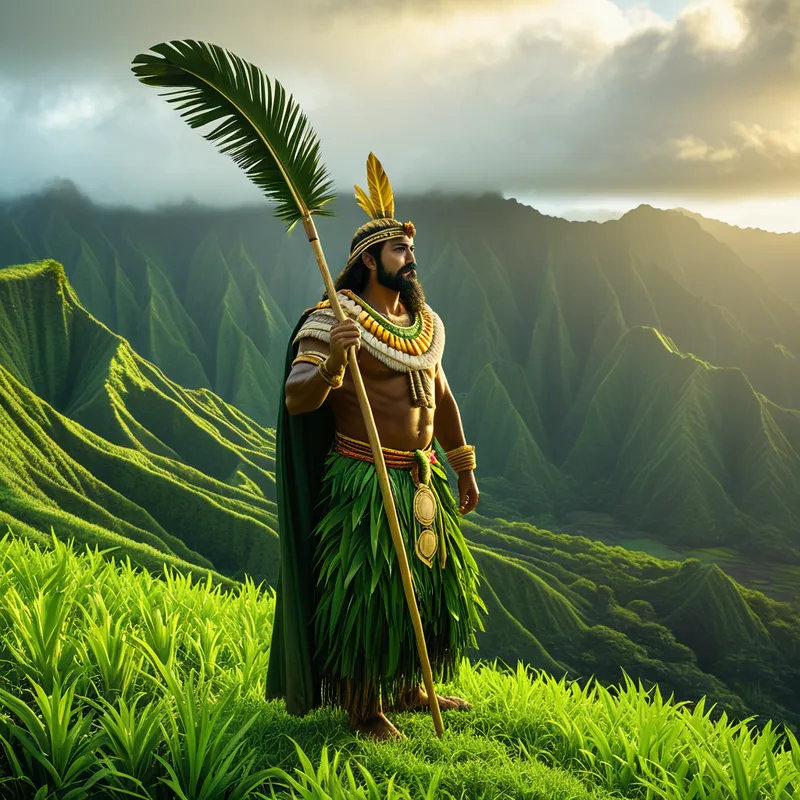
Listen. The wind that carries the scent of rain over the parched red earth has a name. The cloud that breaks over the Kona slopes, promising life, has a form. He is Lono-i-ka-makahiki, Lono of the Makahiki season. He is the great provider, the one who walks the land not with the tread of a conqueror, but with the patient step of a husbandman.
In the time when the sun hung low and weary, and the `uala vines grew thin in the fields, the people would lift their eyes to the brooding sky. They knew the signs. The wild, rolling surf of the western shores signaled his approach from the mystical lands of Kahiki. He came not on a wave of war, but on a cloudbank of abundance. His form was vast, yet gentle; he was the storm that cleanses and the shower that nourishes.
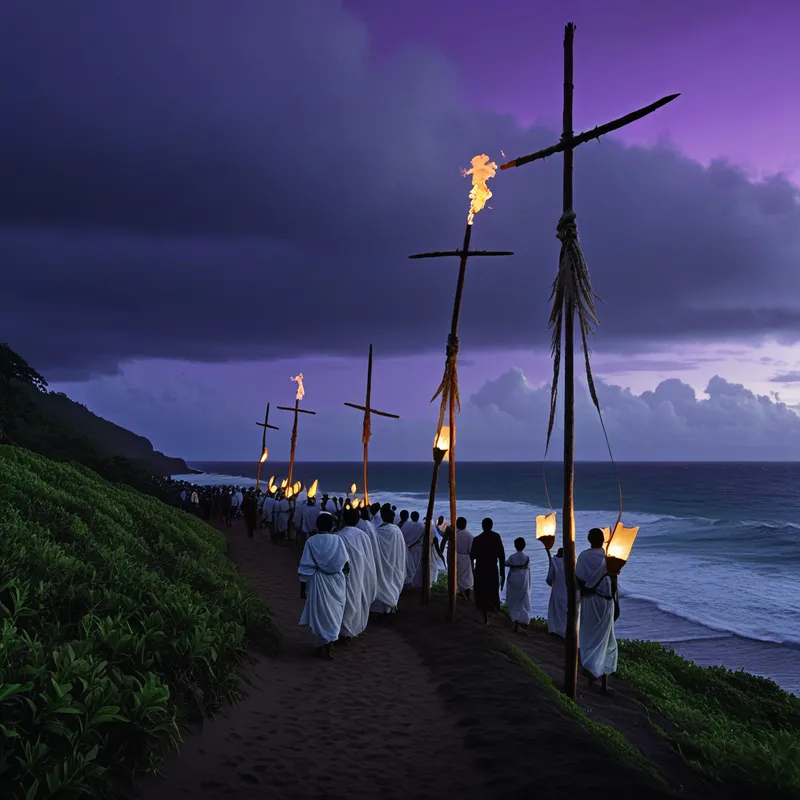
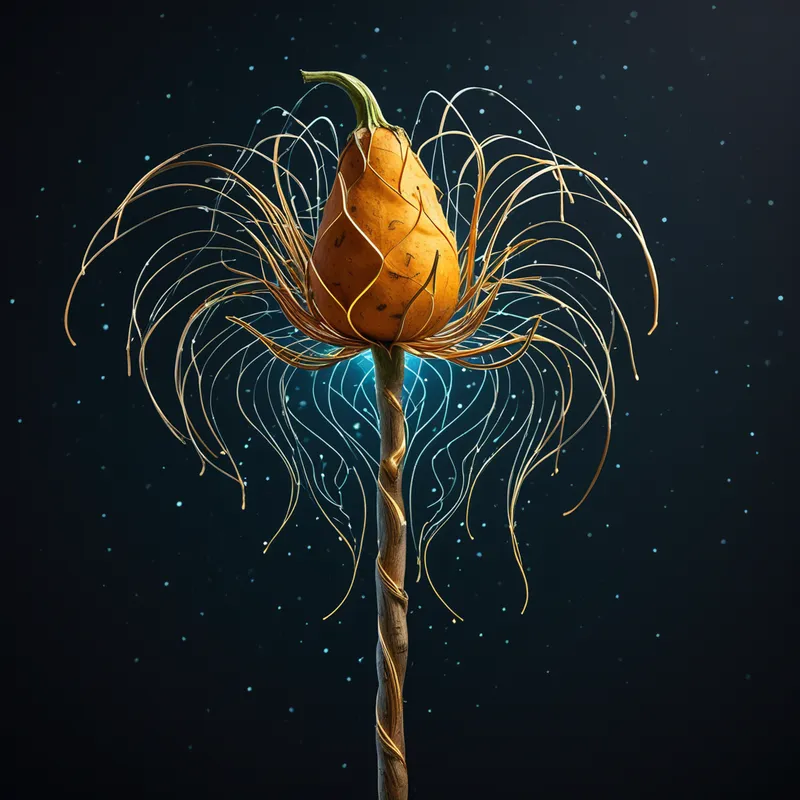
His descent was a marriage. He, the sky, sought his bride, the earth, Papa. Where his rains fell, the hard soil softened. The dormant kalo shoots in the loi stirred, pushing forth new, heart-shaped leaves. The <abbr title="Sweet potato">uala beds swelled with hidden treasure. The ulu</abbr> trees dropped their heavy fruit with soft thuds. For four sacred months, the law of Lono reigned. The sounds of industry and war fell silent. The <abbr title="War god">ku</abbr> images were covered. Only the sounds of games, of celebration, of chants for fertility filled the air. Lono’s symbol, the <abbr title="A long staff with a crosspiece and white kapa banners, representing Lono">Lonomakua</abbr>, was carried in procession around each island, a circuit of blessing that touched every ahupuaa, every valley.
But a marriage between sky and earth is a cycle, not an eternity. As the sun strengthened, the time of his presence waned. The culmination was the Makahiki. The people gathered their finest offerings—the first fruits, the fattened pigs, the finest kapa cloth—and laid them at the feet of his symbol. There was feasting, but beneath it ran a current of poignant farewell. The final ceremony was a ritual of departure. The symbol of Lono was carefully dismantled, or set adrift on a canoe toward the western horizon, back to Kahiki.
He departed, as he always must. The land, now pregnant with his gift, was left to bring forth its yield. The people watched the empty sea, their stores full, their hearts holding the memory of the gentle god. They knew the silence after his leaving was not abandonment, but the necessary space for growth. The rains would lessen, the sun would bake the soil, and they would work the bounty he had bestowed. They waited, faithful, for the winds to shift again, for the first distant cloud on the horizon to take the shape of the returning god.
Cultural Origins & Context
This was not merely a story told for entertainment; it was the cosmological engine of pre-contact Hawaiian society. The myth of Lono was lived annually through the Makahiki festival, a four-month period from approximately October to February. During this time, the normal kapu (sacred prohibitions) of the war god Kū were suspended, and the peaceful, fertile kapu of Lono governed.
The myth was passed down through oli (chants) and hula, performed by trained kahuna (priests) and kumu hula (hula masters). Its primary societal function was threefold: it regulated the agricultural calendar, it facilitated the collection of taxes (hookupu) for the alii (chiefs) in a sacred context, and it provided a necessary period of peace and games that renewed social bonds. The circuit of the Lonomakua around the island was a physical mapping of the god’s blessing and the chief’s sovereignty over the land. The myth thus wove together ecology, politics, and spirituality into a single, seamless tapestry of life.
Symbolic Architecture
At its core, the myth of Lono is a profound allegory of the necessary rhythm between presence and absence, investment and harvest, the sacred and the profane.
The god must depart for the seed to become a harvest. The beloved must be released for love to mature into legacy.
Lono represents the fertilizing principle—not just physically, but psychically. He is the inspired idea, the wave of creative energy, the period of nourishing rain on the parched soil of the soul. His arrival is always conditional and temporal. He is not the ruler who stays to govern the day-to-day, but the benefactor who provides the raw potential for growth. His opposite, Kū, is the principle of hard work, structure, and defense—the labor required to build the taro patch and protect it. The Hawaiian year required both.
The ritual departure is the most psychologically potent element. It symbolizes the necessity of internalizing the divine gift. The external god, the obvious source of blessing, must be “set adrift” so that his power can be integrated and made manifest through human effort. The bounty is not truly ours until we are left alone to tend it.
The Dreamer's Resonance
When this myth stirs in the modern dreamer, it often manifests as dreams of a benevolent, departing figure, or of a season of abundant growth coming to a natural, melancholic end. One might dream of a nurturing teacher leaving, a lush garden that one must now tend alone, or a powerful creative project whose initial inspiring “spark” has faded.
Somatically, this can feel like a gentle deceleration after a period of energetic expansion—a slight hollowing, a quiet ache of farewell paired with a deep, cellular fullness. Psychologically, the dreamer is navigating the transition from receiving to stewarding, from being filled to being responsible. There is a grieving of the direct connection to the source, which is a necessary step toward genuine maturity and ownership of one’s creative and emotional yields.
Alchemical Translation
The individuation process modeled here is the alchemy of internalizing the numinosum—the sacred, awe-inspiring influence. We all experience periods where inspiration, love, or insight descends upon us like Lono’s rain. It feels divine, external, gifted.
The work of the soul is not to cling to the cloud, but to learn to irrigate with the water it left behind.
The “Makahiki” of the psyche is the conscious, ritualized act of gratitude and release. We honor the inspiration, the relationship, the grace—and then we consciously let its symbolic form depart. We cover the “war god” of our ego-driven striving and allow a season of peace to process the gift. The psychic transmutation occurs in the silence that follows. The departed god becomes an inner compost, enriching the soil of the unconscious. What grows from that soil—the actual art, the deepened character, the lived wisdom—is our unique harvest. It is no longer just Lono’s bounty; it is the fruit of our own cultivated land, born from the sacred marriage between the transcendent gift and our human toil.
We become, in a sense, the island that knows how to wait in fertile patience, trusting the cycle, knowing that the nourishing rains will return only after we have fully worked with what was last given.
Associated Symbols
Explore related symbols from the CaleaDream lexicon:
- Rain — The primary manifestation of Lono's blessing, representing fertilizing inspiration, emotional nourishment, and the cleansing arrival of a new cycle.
- Earth — The bride of Lono, symbolizing the receptive self, the body, and the material world that must be made fertile to receive and manifest spiritual gifts.
- Seed — The latent potential deposited by Lono's visit, representing ideas, relationships, and creative projects that require a period of hidden growth after the initial inspiration.
- Journey — The cyclical path of Lono from Kahiki and back, modeling the necessary rhythm in life between engagement and withdrawal, inspiration and integration.
- Sacrifice — The offerings made to Lono during Makahiki, representing the gratitude and release required to complete a cycle and ensure its future return.
- Order — The sacred peace and structure of the Makahiki season, representing a necessary container of ritual and rest for creative energy to take root.
- Goddess — Reflected in Papa, the earth mother, as the essential, receptive counterpart to the sky father's fertilizing power, symbolizing the feminine principle of embodiment.
- Circle — The circuit of the Lonomakua around the island, representing the completion of a cycle of blessing, wholeness, and the integration of the sacred with the entire domain of life.
- Harvest — The tangible yield that appears after Lono's departure, symbolizing the mature fruits of psychological and creative work that only appear after the inspiring force has been internalized.
- Ocean — The vast realm from which Lono arrives and to which he returns, representing the unconscious, the source of numinous inspiration, and the medium of cyclical renewal.