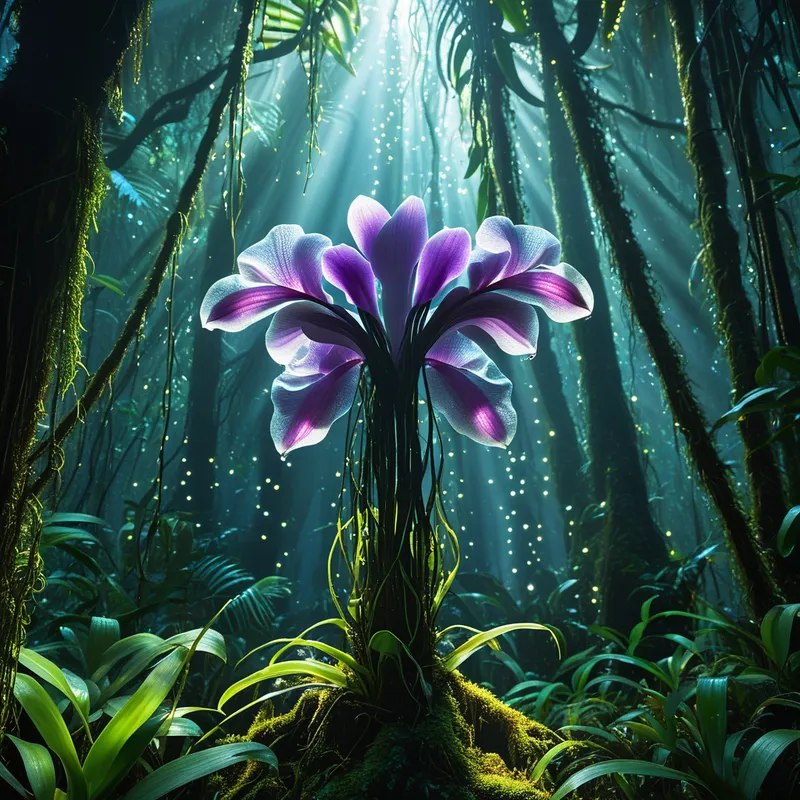
Local Flower Spirits/Deities Myth Meaning & Symbolism
A myth of spirits dwelling within blossoms, teaching that beauty is a covenant, life is a fleeting gift, and the sacred dwells in the smallest, most local place.
The Tale of Local Flower Spirits/Deities
Listen. Before the world was hard with roads and loud with machines, the land breathed a softer song. In that time, the boundary between what you see and what you feel was thin as a petal. In every valley, on every hillside, in the damp hollows where the sun dappled the earth, the local spirits made their home. They were not grand gods of thunder or ocean, but the genius loci of the blossom.
They were the whisper in the honeysuckle that made its scent so intoxicating at twilight. They were the patience in the cactus flower, waiting a full year for a single night of luminous bloom under the desert moon. They were the fierce joy in the alpine flower clinging to a crack in the mountain stone, painting the grey rock with a stroke of impossible purple.
One such story is told by the fire, of a time when the people forgot. They walked heavily upon the earth, taking the bright blooms for granted, weaving them into crowns that were cast aside when wilted, never a word of thanks whispered to the green stem. The local flower spirits, slighted and saddened, began to withdraw. The colors of the world grew muted. The scents faded. The fruits that followed the flowers grew sparse and bitter. A greyness, not of winter but of spirit, settled over the land.
The people felt a hunger no meal could satisfy, a thirst no water could quench. It was the children who noticed first—the silence where the bee’s hum should be, the dull green where a flash of red once lived. A young girl, whose heart had not yet learned to be separate from the world, went out alone. She did not go to hunt or to gather, but to sit. She sat by a patch of earth where only a single, stubborn daisy remained.
For three days and three nights, she sat. She offered her breath to the cool morning air. She shed tears onto the dry soil. On the third night, as the first star pierced the twilight, she began to sing. It was not a song of words, but a song of feeling—a melody of apology, of longing, of love for the sheer fact of the daisy’s existence.
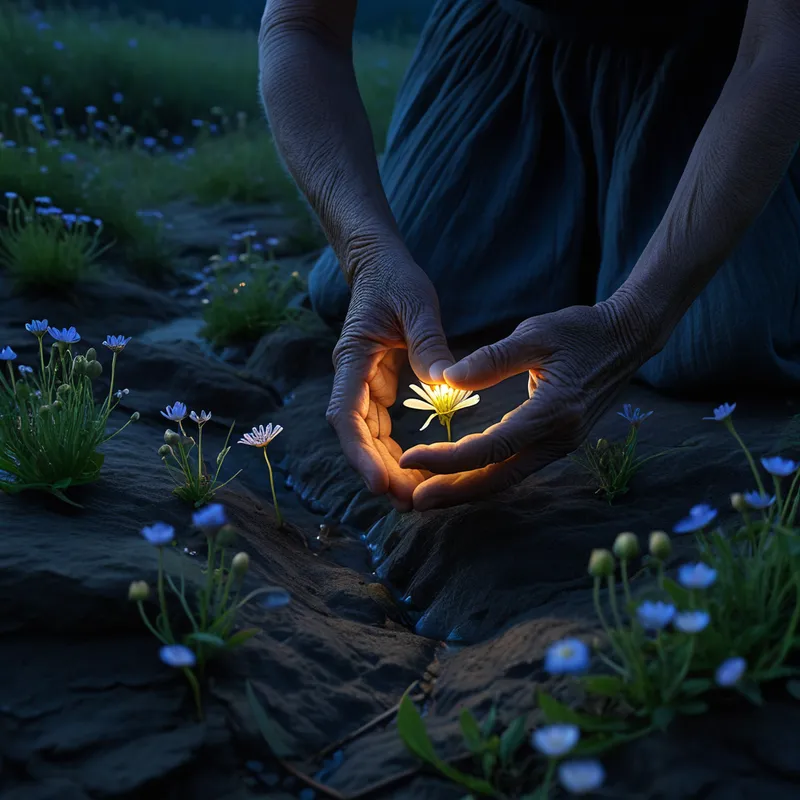
As she sang, a soft light kindled within the flower’s white petals. It grew, and from its center stepped a being no taller than her thumb, shimmering like captured moonlight on dew. It was the local spirit of that very patch, that very daisy. It spoke not with a voice, but directly into her heart. "You have remembered the covenant," it said. "Beauty is not a possession. It is a conversation. We give color and scent and fruit. You give attention and gratitude and care. This is the exchange that makes the world whole."
The girl returned to her people, the tiny spirit-light dancing in her palm. Where it shone, color rushed back into the world like a tide. Flowers burst from the earth in profusion, more vibrant than before. And the people remembered. They learned the names of the local spirits—not to command them, but to greet them as neighbors. They left offerings of song and water. They took only what they needed, and always with thanks. The land and its people were once again in conversation, and the world was woven back into beauty.
Cultural Origins & Context
This pattern of myth is not a single story, but a living thread woven through countless indigenous traditions across the globe. From the Rusalki and Polevik of Eastern Europe to the myriad plant-kami of Shinto, from the flower maidens of various Native American tales to the complex botanical deities of Mesoamerican cultures, the concept is universal. These narratives were not formal scriptures but oral teachings, passed down by elders, herbalists, and storytellers—often the same person.
Their societal function was profoundly practical and psychological. They encoded ecological knowledge, dictating sustainable harvesting practices and the medicinal uses of plants through the language of relationship with a spirit. More deeply, they served as a constant, daily reminder of an animistic worldview: the cosmos is alive, conscious, and communicative. The myth enforced an ethics of reciprocity, teaching that human survival and flourishing are contingent upon respectful participation in a network of sentient relationships, beginning with the most local and immediate.
Symbolic Architecture
At its core, the myth of the local flower spirit is a masterclass in the symbolism of the Anima and the principle of relatedness. The flower spirit is the soul of a place made visible, the psychological truth that our environment is not a dead backdrop but a resonant field that responds to the quality of our attention.
The flower is the world's answer to its own longing for form; the spirit is the consciousness within that form, the witness to its own beauty.
The "forgetting" of the people symbolizes the modern psyche's descent into literalism and alienation—the state where nature becomes "resource" and the soul feels orphaned in a mechanical universe. The withdrawal of the spirits represents the phenomenological truth that when we cease to relate to the world as sacred, it ceases to appear sacred to us; its vitality and meaning recede. The child, often the protagonist, represents the undeveloped, feeling function of the psyche that remains connected to the unconscious and the natural world. Her act of sitting, weeping, and singing is not an action, but a reception—a ritual of opening that re-establishes the connective tissue between the human and the more-than-human.

The Dreamer's Resonance
When this mythic pattern stirs in the modern dreamer, it often manifests as dreams of encountering a specific, breathtakingly beautiful flower in an unexpected place—growing through concrete, blooming in a room, or held in the hand of a dream figure. Alternatively, one may dream of a neglected garden suddenly bursting into impossible bloom, or of tiny, luminous beings tending to plants.
Somatically, this dream points to a process of re-sensitization. The psyche is attempting to reawaken a numbed capacity for wonder, beauty, and intimate connection. It signals a deep, often painful, longing for the "local"—not just a physical place, but a localized state of soul, a feeling of being at home in one's own senses and in one's immediate environment. Psychologically, the dreamer is likely going through a phase where the analytical, achieving ego has led to a feeling of barrenness or existential thirst. The dream is the unconscious offering the antidote: the instruction to stop, to attend, and to engage in the simple, profound exchange of gratitude.

Alchemical Translation
The individuation process modeled here is one of grounding spirit in the specific, and finding the infinite in the infinitesimal. It is the alchemy of negredo—the grey, wilted period of alienation—transmuted into the albedo of clarified relationship.
The modern seeker, lost in abstraction and globalized noise, is called to become the child in the myth. The "work" is not a heroic quest outward, but a deliberate, humble turning inward and downward—to the "local flower" of one's own life. This could be the daily ritual of making tea, the care of a single houseplant, the mindful walking of a familiar neighborhood path. The act of "singing to the daisy" is the practice of devoted, grateful attention to this one thing.
Individuation is not about becoming universally grand, but about becoming profoundly specific. The soul blooms where it is planted, not where it is projected.
Through this practice, the psychic split between self and world begins to heal. The spirit that emerges is the realization of one's own daimon—not as a separate entity, but as the conscious, participating node in a living network. The covenant remembered is the foundational truth of existence: life is a reciprocal gift. In tending to the local spirit—the soul of our immediate reality—we are, in the same gesture, tending to the deepest, most flowering core of our own being. The beauty that returns is the color and fragrance of a life lived in authentic conversation with the world.
Associated Symbols
Explore related symbols from the CaleaDream lexicon: