Élivágar Myth Meaning & Symbolism
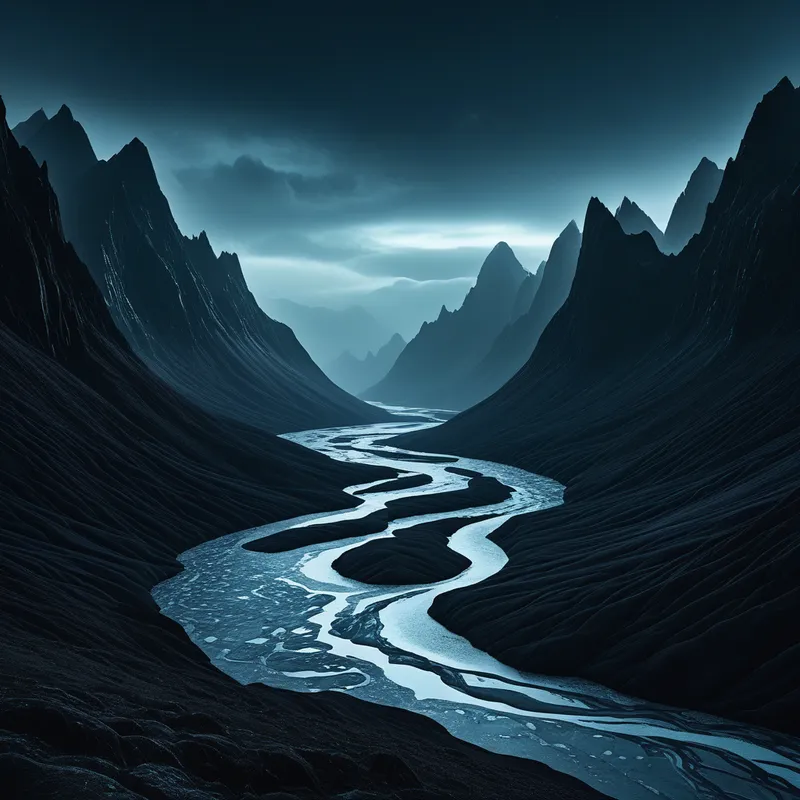
The eleven poisonous rivers of ice that flowed from Niflheim, whose meeting with fire birthed the first being and the raw material of the world.
The Tale of Élivágar
Before the worlds, there was the Yawning Void. Ginnungagap. It was not a place, but an absence so profound it was a presence—a hungering maw between two utter extremes.
To the north, from the wellspring Niflheim, a terrible cold seeped forth. It was a cold that was not merely the absence of heat, but an active, venomous force. From eleven great fountains, this cold took shape. It became rivers. They were not rivers of water, but of congealed frost, of rime so ancient it had become a flowing poison. This was Élivágar. They crept, they oozed, they crawled with a grinding, crystalline slowness into the great void, their surfaces black as obsidian, glinting with a sickly, inner frost-light. Their very essence was stagnation, a deadly inertia that promised only an eternal, unmoving sleep.
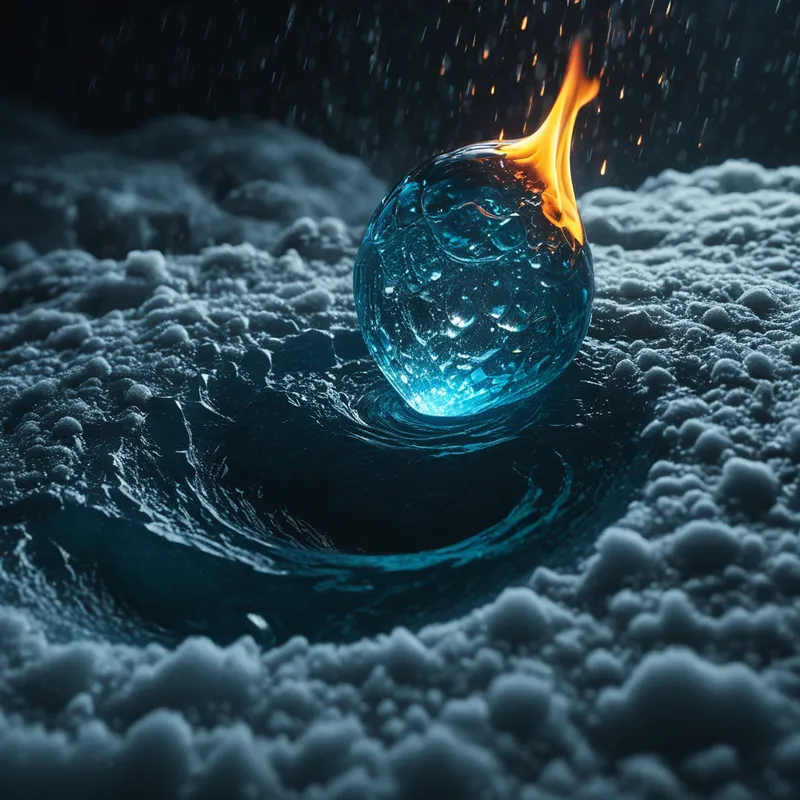
To the south, from the realm of Muspelheim, came the answering extreme. Not warmth, but a furious, creative conflagration. Sparks and embers, each a nascent sun, flew into the gap. Where the ice-rivers met this fiery breath, a miracle of violence occurred.
The air in the void began to sweat. It was a sweat born of agony—the agony of fire licking ice, of poison meeting purity. The venom of Élivágar melted, but it did not become harmless water. It became a living rheum, a seething, steaming slush. And in that slush, in that chaotic, fertile agony where the two primordial powers cancelled and yet amplified each other, life stirred.
It was not a god, not yet. It was a proto-being, a giant of potential named Ymir. He formed from that venomous melt, a sleeping, sweating colossus. And as he slept, more life sprang from him—from the sweat of his armpit, a male and female giant; from his legs, a son. The slush of Élivágar continued to drip, and from those dripping rime-drops, another form emerged: Audhumla. She licked the salty ice-blocks, and with each lick, over three days, she freed a being of a different order: Buri, radiant and whole.
Thus, from the poisonous, flowing inertia of Élivágar, when met by its absolute opposite, came the raw, messy, and monstrous substance of all that is. The gods themselves would later slay Ymir and fashion the earth from his flesh, the seas from his blood, the sky from his skull. But the foundation of it all, the very clay of creation, was the melted, venomous ice of the eleven rivers. The first thing to exist was not light, nor love, nor order. It was a toxic, frozen flow, waiting for the spark that would force it into becoming.
Cultural Origins & Context
This myth of cosmic origins is preserved primarily in the Prose Edda, written by Snorri Sturluson in the 13th century, drawing from older poetic sources like the Völuspá. It is crucial to remember that Snorri was a Christian scholar writing down a fading pagan tradition; his account is systematized, yet it channels profound archaic themes.
The myth of Élivágar was not a children's story. It was a foundational cosmology, recited by skalds and perhaps embedded in ritual, explaining the nature of a world perceived as fundamentally harsh, dynamic, and born from conflict. For the Norse, existence was not a gentle emergence from nothingness, but a violent, alchemical reaction between opposing, active principles. The myth served to root human experience in this primal drama. It explained why the world is both beautiful and treacherous, fertile and deadly—because its very substance is the transmuted venom of Élivágar. It placed the listener at the end of a long chain of causality that began with poisonous ice, fostering a worldview that respected raw, untamed potential and the creative power of necessary conflict.
Symbolic Architecture
Élivágar represents the primordial, undifferentiated state of the unconscious before it is engaged by consciousness. It is not evil, but it is potentially destructive in its pure, unmoved state. It is the frozen potential within us, the unlived life, the trauma, the innate complexes, and the sheer weight of psychic inertia that flows from the cold, impersonal depths of the psyche (Niflheim).
The first state of the soul is not peace, but a frozen river. Wholeness is not its origin, but its hard-won destination.
The eleven rivers suggest a multiplicity—a fragmented, chaotic origin. The "poison" or "venom" (eitr) is a key symbol. It is the intoxicating, paralyzing quality of pure potential when it remains unconscious. It is the bitterness of unexpressed grief, the toxicity of repressed anger, the chill of isolation. Yet, this same eitr is the fundamental substance of creation. The myth insists that our most challenging, "poisonous" material is the very stuff from which our world—our personality, our creativity—must be built.
The meeting with the fires of Muspelheim is the arrival of the differentiating principle: attention, will, the spark of consciousness (or in a broader sense, the encounter with the "Other"). This meeting causes a "melting"—a dissolution of rigid, frozen patterns. The resulting state, the slush that forms Ymir, is the prima materia of the alchemists and the psyche: the chaotic, messy, but now activated raw material of the self.
The Dreamer's Resonance
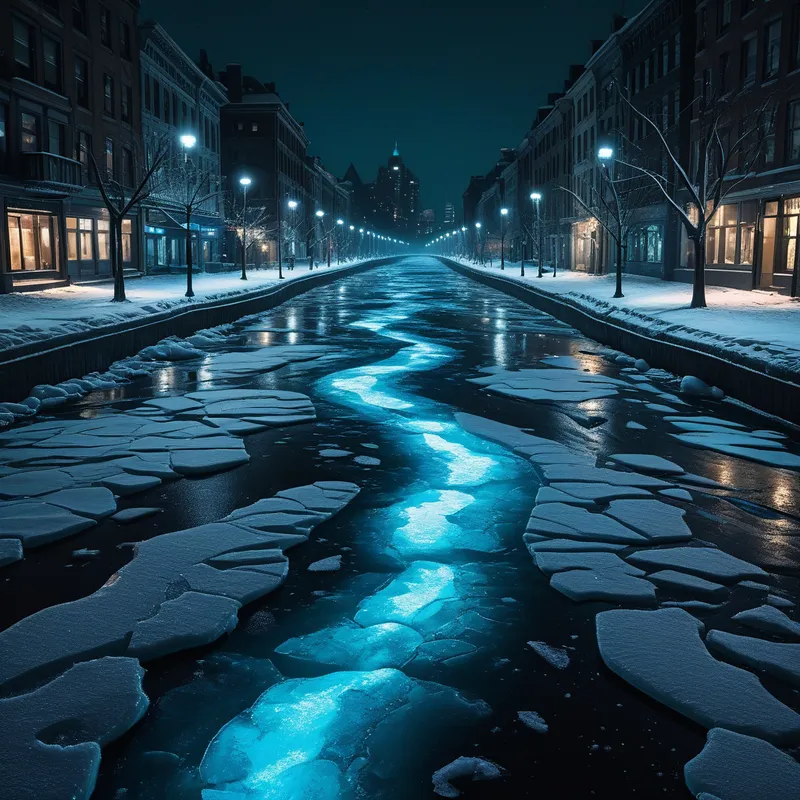
When the pattern of Élivágar manifests in modern dreams, it often appears as dreams of frozen landscapes, of being trapped in ice, or of encountering black, sluggish, or polluted water. One might dream of a house with pipes bursting with frozen black liquid, or of walking alongside a river that is perfectly still and cold to the touch, inducing a deep sense of dread and stagnation.
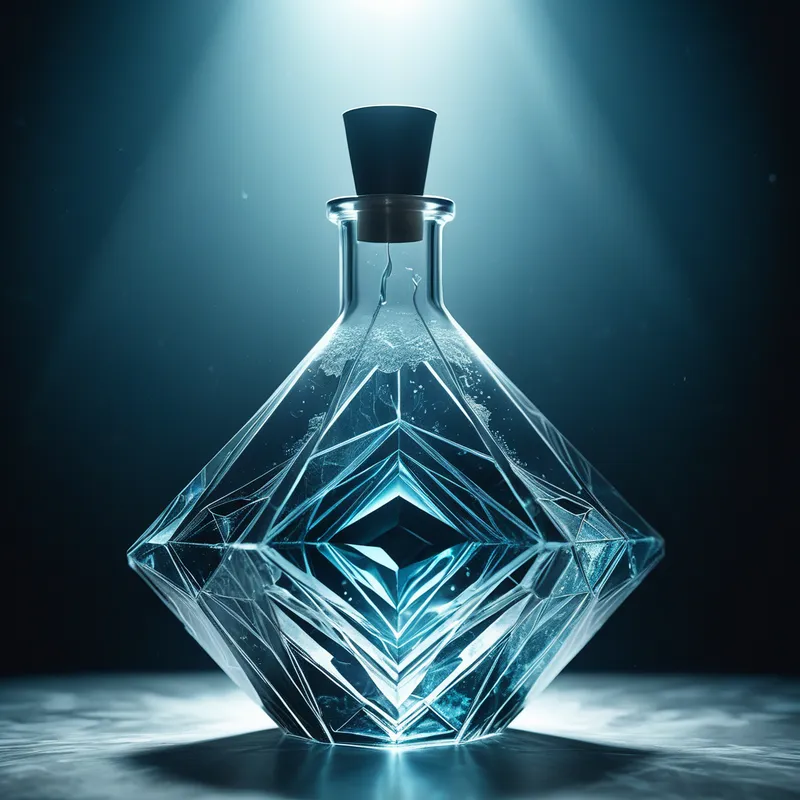
Somatically, this correlates with a psychological process of confronting the "cold" within—the places where our emotional life has gone numb, where we feel stuck in repetitive, frozen patterns of behavior or thought. The poison (eitr) in the dream is the felt-sense of something toxic that we have been carrying, perhaps a resentment that has chilled into cynicism, or a creative impulse that has frozen solid from lack of expression. The dream is presenting the unconscious in its Élivágar state: as a flowing, active inertia that is slowly shaping our reality from the shadows. The dream is the psyche's first act of "dripping" this material into the gap of awareness, beginning the painful, necessary thaw.
Alchemical Translation
The myth of Élivágar provides a stark blueprint for the process of individuation—the psychic transmutation of the base self into a more whole, conscious being. It tells us that the journey does not begin with light, but by acknowledging and engaging our inner "poisonous ice."
The first step is Nigredo, the blackening. This is the recognition of the Élivágar within—the cold, toxic, frozen flows of our shadow. We must allow these rivers to flow into our awareness (the Ginnungagap), without immediately trying to fix or warm them. This stage feels like depression, confusion, or a dissolution of old certainties.
The second is Coniunctio Oppositorum, the union of opposites. This is the meeting of the ice (the unconscious, cold, feminine/Niflheim principle) with the fire (consciousness, passion, masculine/Muspelheim principle). In therapy or self-work, this is the moment when a deep, frozen memory is finally touched by the heat of conscious feeling, or when a rigid complex is confronted by a new perspective. It is a violent, chaotic, and creative process—it "steams."
The self is born in the steam where poison meets flame.
From this chaotic melt comes the Prima Materia—the activated, messy substance of Ymir. This is the raw material of transformation: our activated complexes, our heated emotions, our newly fluid traumas. The work of individuation is then to do as the gods did: to dismember this chaotic, giant-sized totality of raw psychic material. We must sort it, shape it, and rebuild it into a habitable inner world—the flesh of our new earth, the blood of our emotional life, the dome of our understanding. The poison is not eliminated; it is alchemically transmuted into the very structure of our being. We do not transcend our Élivágar; we build our world from its thawed and redeemed flow.
Associated Symbols
Explore related symbols from the CaleaDream lexicon: