
Leprechaun Myth Meaning & Symbolism
A solitary fairy cobbler, guardian of a hidden hoard, whose capture demands a cunning bargain with the ever-shifting, trickster nature of the psyche.
The Tale of the Leprechaun
Listen now, and quiet your breath. Forget the green of cheap dye and the jig of a fool. We go into the Sídhe-touched places, where the light falls slant and the shadows hold their breath. Here, in the deep hollows under the hawthorn, or by a stream that sings with a voice not its own, you might hear it. Tap-tap-tap. A sound like a tiny, persistent heartbeat from the earth itself.
He is Lobaircin, the little stooping one. You will not find him seeking company. His world is solitude, his craft his kingdom. See him there, on a toadstool stool, his back bent not with age alone, but with the weight of eternal focus. His fingers, gnarled as old roots, work the finest leather, stitching a shoe so small and perfect it could only fit the foot of a fairy lord or a wren-king. The air smells of damp moss, tanned hide, and the cold, metallic scent of the deep earth. He is the cobbler to the unseen world, and his payment is not in thanks, but in gold—ancient, cold coin he gathers coin by coin, hoarding it in a single pot he must hide from the greed of men and the envy of his own kind.
This is the moment the tale turns. A mortal, driven by a hunger that drowns out the stream's song and the bird's warning, has spied him. The human lunges, not with violence, but with a desperate, clumsy grab. The leprechaun is caught! His eyes, like chips of polished bog-oak, flash not with fear, but with a deep, weary cunning. The mortal demands the treasure. The air grows thick, charged with the magic of a bargain being born.
The leprechaun sighs, a sound like wind through dry reeds. "Very well," he says, his voice a dry rustle. "I am in your power. My pot of gold lies buried at the foot of yonder tree." He points a bony finger across the field to where a lone blackthorn</abbr stands, a lacework of white blossoms against the grey sky. "Under the very roots."
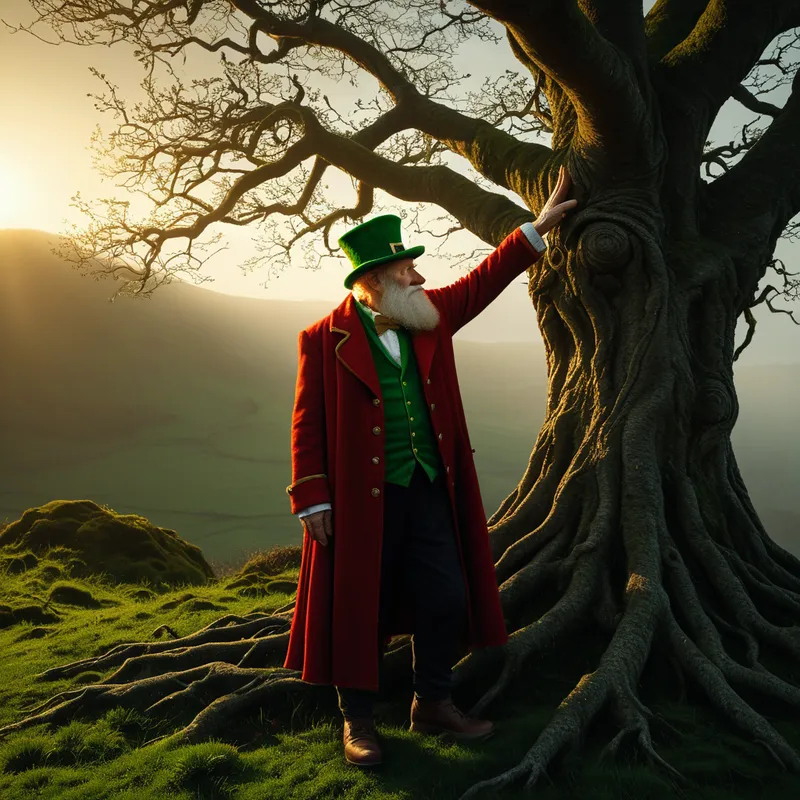
Triumph floods the mortal. But the leprechaun is not done. "To mark the spot," he says, pulling a scrap of vibrant red cloth from his sleeve, "I shall tie my garter to the lowest branch." And so he does. The mortal, fearing trickery, insists the leprechaun stay. "Keep your eye upon me," the little man says, a faint smile playing on his lips. "Do not look away for even an instant."
The mortal agrees, his gaze locked on the wizened face. He blinks. Just once. And in that fleeting darkness, between one heartbeat and the next, the leprechaun is gone. Vanished. The field is empty but for the wind. The mortal stumbles to the blackthorn, heart pounding. There, tied to the branch, is the red garter. But the ground beneath is untouched. And then he sees it—a second blackthorn, identical, fifty paces away, with an identical red scrap fluttering from its branch. Then a third. And a fourth. The entire field is suddenly a forest of blackthorns, each bearing the maddening, perfect marker. The treasure is forever present, forever just out of reach, guarded not by force, but by the most potent magic of all: the illusion of choice, the maze of the distracted mind. The gold was never the prize. The true test was the gaze.
Cultural Origins & Context
The leprechaun is a creature of the later Irish folk tradition, a specific denizen of the vast and varied population of the Aos Sí. Unlike the noble Tuatha Dé Danann of the mythological cycle, the leprechaun is a figure of the hearth and the field, passed down not by bards in chieftains' halls, but by seanchaí (storytellers) by the fireside. These tales were social tools, told to children and adults alike. They served as cautionary fables about greed, the perils of dealing with the Otherworld, and the virtue of craft and self-sufficiency.
His identity as a cobbler is key. In a rural society where good footwear meant survival, the shoemaker held a peculiar, almost magical status. The leprechaun’s solitary, obsessive dedication to his craft mirrors the idealized, self-contained artisan. His gold, often said to be a crock left at the end of the rainbow—a place one can never actually arrive at—symbolizes a fortune that is inherently unattainable through direct pursuit. The myth was a folk-psychological commentary on the madness of materialism and the respect owed to the dedicated, unseen work that holds the world together, stitch by tiny stitch.
Symbolic Architecture
Psychologically, the leprechaun is a potent archetype of the Trickster, but one specialized in the guardianship of hidden value. He is not the shadow of evil, but the shadow of the self-contained psyche. His gold is not mere wealth, but the hoarded potential of the unlived life, the unused talent, the repressed creative spark—the personal treasure buried by habit, fear, or societal expectation.
The treasure is always buried at a specific spot, yet to find it, one must hold a gaze that transcends the specific.
The leprechaun himself represents the autonomous, crafty, and utterly amoral function of the unconscious that guards this treasure. He is not good or evil; he is a force of nature, bound by his own laws of bargain and illusion. The red garter or coat he wears is a flash of vibrant, arresting color—a symbol of the captivating, distracting complexes that pull our attention away from the deep, patient work of excavation. His escape via the distracted gaze is the core truth: the unconscious cannot be captured by the conscious mind's crude, grasping intent. It can only be approached through indirect means—through symbol, dream, and a willingness to be tricked out of one's literal-mindedness.
The Dreamer's Resonance
When the leprechaun pattern emerges in modern dreams, it signals a confrontation with the "hoarded self." You may dream of finding a tiny, exquisitely made object; of being led on a frantic, futile chase; or of bargaining with a small, wizened figure who seems both ancient and childlike. Somatically, this can feel like a buzzing anxiety, a restless energy focused on a goal that perpetually recedes.
Psychologically, this is the process of the ego encountering the guardian of a complex—often a complex around talent, creativity, or self-worth ("the gold"). The leprechaun's tricks—the multiplying trees, the vanishing act—mirror the mind's own defenses: rationalization, procrastination, and the production of endless alternatives to avoid the vulnerable, specific work of unearthing the real treasure. The dream is a snapshot of the psyche's economy, where the ego's greedy demand for instant fulfillment is met with the unconscious's cunning protection of its slow, organic processes.

Alchemical Translation
The leprechaun myth models the alchemical stage of Nigredo, where the seeker must face the folly of their own literal-minded pursuit. The individuation journey here is not one of heroic conquest, but of humiliating, necessary failure. The mortal's grasping capture is the ego's inflation, believing it can seize the treasure of the Self by force of will.
The transmutation begins not in claiming the gold, but in losing the leprechaun.
The true "alchemical translation" is in the moment of blinked-eyed disillusionment. The dissolution of the ego's plan (the failed capture) is the prerequisite for a new kind of seeing. One must learn to bargain not for the treasure's location, but for an understanding of the rules of the game. The leprechaun’s craft—the meticulous making of shoes—is the clue. Individuation demands we become, in part, the leprechaun: attending to the small, precise, often solitary craft of soul-making (the shoes), rather than obsessing over the spectacular prize (the gold). The treasure becomes a byproduct of dedicated craft, not its object. To integrate the leprechaun is to develop a tricksterish relationship with one's own rigidities, to use cunning and indirect attention to outwit the defenses that keep one's potential buried, and to finally understand that the gaze which holds the world steady is the very gaze that makes the treasure disappear.
Associated Symbols
Explore related symbols from the CaleaDream lexicon: