Lenten Purple Myth Meaning & Symbolism
A sacred season of forty days where the soul descends into shadow, cloaked in royal sorrow, to be stripped and reborn in the light of dawn.
The Tale of Lenten Purple
Listen. There is a season that is not a season, a time outside of time, born in the long shadow of a winter sun. It begins in dust. Not the fertile dust of the field, but the ash of endings—of palms burned, of hopes once waved high now ground to powder. A mark is made upon the brow: a smudged cross, a seal of mortality. Remember you are dust.
And with that memory, the world is draped.
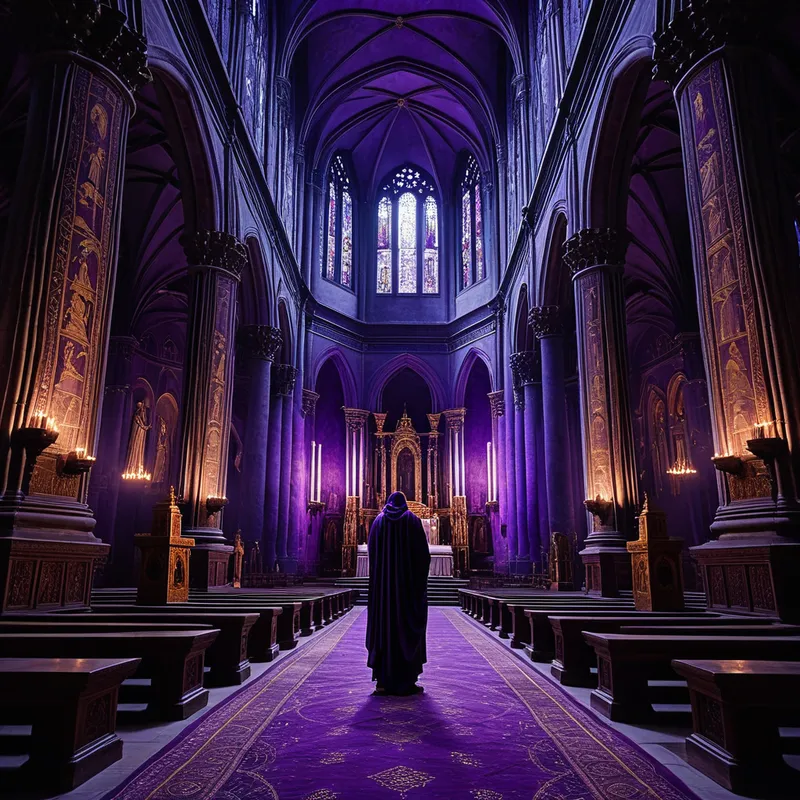
It is not a sudden darkness, but a deepening. The exuberant golds and celebratory whites are gently, reverently covered. In their place, a profound and royal hue descends upon the sacred spaces—the Lenten Purple. It cloaks the statues, the crosses, the very altars where light once danced. It is the color of a twilight sky just before the last light fails, of a bruise healing, of a king’s robe laid aside in grief. The music falls silent, the alleluias are buried. A great hush descends, a collective inward turning.
For forty days and forty nights, the people walk this shrouded path. They become pilgrims in their own lives. The table is stripped bare of fatness; feasts are forsaken. It is a journey into a desert of the spirit, following the footsteps of a prophet who faced wild beasts and whispering temptations on barren stones. The purple is their companion, a constant, somber reminder. It speaks of a throne, yes, but a throne awaiting its king. It speaks of sovereignty, but a sovereignty purchased through humility.
The conflict is not with dragons or giants, but with the whispering chaos within. It is the struggle of hunger against purpose, of noise against silence, of the self against the Self. The rising action is the slow, grinding work of subtraction—of letting go, of being unmade. The purple witnesses it all, absorbing the sighs, the failures, the small, stubborn acts of fidelity.
Then, a shift. As the journey nears its end, the purple deepens. On a day of profound silence, it is torn away. The altars are laid bare, stripped to the stone. The vestments are removed. The purple, having done its work of veiling, now reveals the naked truth beneath: a barren stage, an empty tomb. It is the ultimate desolation.
But in the deepest night of that silence, a spark is struck. The long vigil begins. And then—a cry in the darkness. A flame, new and fragile, is kindled from flint. And as the ancient song of triumph rises, the purple is gone. Not discarded, but transmuted. In a flash of glory, it is replaced by blinding white and gold. The dawn has broken. The king, not of sorrow but of life, has taken his throne. The fast is broken with a feast. The alleluia, buried, has burst from the ground. The purple was not the end, but the womb. The season of ash gives birth to the season of fire.
Cultural Origins & Context
The rhythm of Lent and its symbolic color find their roots in the early catechumenate of the 3rd and 4th centuries. This was the final, intense period of preparation for adults seeking baptism at the Easter Vigil. For them, these forty days were a literal stripping away of their old pagan life, a time of exorcisms, scrutinies, and instruction. The purple—or more accurately, violaceus, a dye derived from the rare murex shellfish—was the color of imperial authority and profound cost. To drape the catechumens (and later, the whole community) in this metaphor was powerful: they were preparing to enter the kingdom of God, a process requiring the solemn dignity of repentance.
The societal function was one of communal re-alignment. In an agricultural world, late winter and early spring were lean times; the Lenten fast mirrored the natural scarcity. But more deeply, it synchronized the entire community’s psychic and spiritual rhythm. Through liturgy, hymnody, and visual change (the veiling of images), the story was not just told but lived. The purple served as a constant, non-verbal teacher, pulling the collective gaze away from distraction and toward the interior journey of preparation. It was a shared somatic experience—a visual fasting that supported the physical and spiritual one.
Symbolic Architecture
The myth of Lenten Purple is an archetypal map of individuation through descent and return. Its symbols are not mere decorations but the very architecture of transformation.
Purple is the threshold color, the hue of the liminal space where one thing dies so another can be born. It holds the tension of opposites: royalty and penitence, wealth and poverty, dawn and twilight.
First, it symbolizes Sovereignty in Exile. The purple robe is the mark of the king, but here the king is in the desert, fasting. It represents the ego’s necessary humbling before the greater authority of the Self. The individual must confront the illusion of their own petty kingship to discover their true, divine regality.
Second, it embodies the Alchemy of Sorrow. This is not despair, but compunctio—the “piercing” of the heart that leads to tender reflection. The purple absorbs light, turning it inward. Psychologically, this is the process of shadow-work: willingly entering the darkened interior to acknowledge and integrate what has been ignored or denied. The fast, the silence, the somber color—all are containers for this difficult, essential work.
Finally, it is the Veil of the Mystery. Purple cloaks the sacred images. This act signifies that the familiar, consoling representations of the divine are being withdrawn, forcing the seeker to encounter the mysterium tremendum et fascinans—the terrifying and fascinating mystery—directly, in the desert of faith. The ultimate revelation comes not through the veil, but after its removal.

The Dreamer's Resonance
When the pattern of Lenten Purple appears in modern dreams, it rarely manifests as a literal church scene. Instead, it surfaces as a somatic and atmospheric quality. The dreamer may find themselves in a library where all the books are bound in deep violet leather, but the text inside is fading. They may wander through an office building where all the windows are tinted a twilight purple, muting the outside world. They may be given a simple, heavy garment of this color and feel compelled to put it on, experiencing both a sense of dignity and a profound weight.
These dreams signal a psyche initiating a necessary period of contraction. The ego is being called to a psychic fast. The process underway is one of sublimation and introversion. Libidinal energy is being withdrawn from external pursuits, relationships, or ambitions and redirected inward for assimilation. The “purple” mood in the dream is the psychic container for this operation—it is the feeling-tone of intentional withdrawal, of respectful mourning for an outgoing attitude that must be released. It is the soul’s way of draping its own altars, creating a sacred space for inner work that feels solemn, necessary, and strangely royal.

Alchemical Translation
The alchemical Magnum Opus finds a precise parallel in the Lenten journey, with Purple as the color of the crucial nigredo phase. This is not the black of annihilation, but the rich, dark violet of dissolution.
The fast is the solve: the breaking down of the complex, inflated personality (the prima materia) into its base components—hunger, vulnerability, truth. The purple silence is the vessel where this dissolution occurs.
The individual begins with the “ash” of their own acknowledged limitations (“Remember you are dust”). They willingly enter the “purple” stage—the nigredo—by engaging in conscious sacrifice (giving up a habit, undertaking therapy, entering a period of solitude). This is the putrefaction, where old identities and dependencies are allowed to decompose in the dark. The suffering of this stage is not pointless; it is the ferment that releases the spirit trapped within the matter of a maladapted life.
The stripping of the altars on Good Friday represents the ultimate confrontation with the caput mortuum, the dead head or worthless residue left after the nigredo. One faces the bare, stark truth of the psyche without its usual adornments and comforts.
Then, in the vigil light struck in darkness, the albedo begins. The purple has done its work. The integrated insights, the humility earned in the desert, now begin to shine with a new, pure light. The Easter dawn is the rubedo—the embodiment of the transformed Self, where the sovereignty hinted at by the purple is fully realized, not as egoic power, but as authentic, resurrected life. The modern seeker’s journey from a felt sense of fragmentation (ash) through a disciplined, somber introspection (purple) to a renewed sense of wholeness and vitality (golden dawn) is the living myth, the alchemical translation of Lenten Purple enacted in the soul.
Associated Symbols
Explore related symbols from the CaleaDream lexicon: