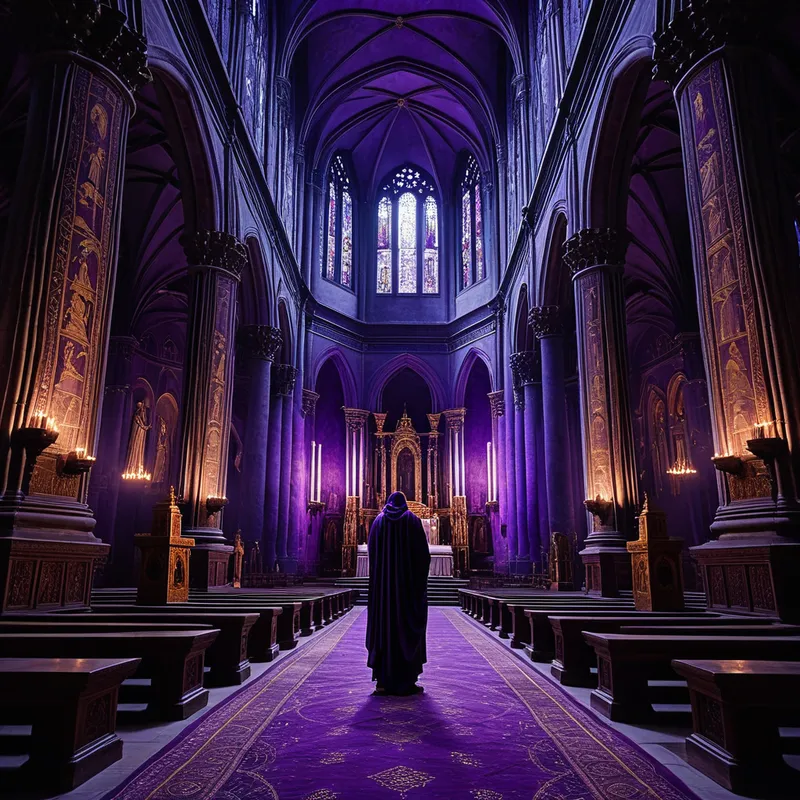
The Dream of Penitence: The Soul’s Silent Ledger
The Somatic Echo
It begins not as a thought, but as a weight. A density in the chest, a slow, cold mercury pooling behind the sternum. The shoulders carry an invisible yoke, a phantom architecture of stone and lead. The breath becomes shallow, a careful negotiation with a space that feels too small, as if the very air in the room is owed a debt. This is the somatic echo of penitence—a deep, pre-verbal knowing that something within the system is out of balance. It is not the sharp sting of shame, but the deep, resonant ache of a structural misalignment. The body becomes the first confessional, holding the tremor of an account unsettled, a contract with the self that has been silently breached.
The Dreamer’s Log
In the dream, I am in a vast, silent library that is also a mausoleum. My task is not to read, but to return. On the shelves are countless glass vials, each glowing with a soft, trapped light. I know, with a certainty that chills my blood, that each light is a truth I spoke but did not mean, or a feeling I felt but did not honor. I hold one. It is warm. I am supposed to place it back, but my hand trembles, and it slips. The vial shatters on the stone floor, and the light—my light—spills out, seeping away into the dark, cold rock, lost forever. The silence that follows is absolute, and it judges me.
This is the alchemy of the unlived moment: the psyche demands an audit, not of sins, but of surrendered authenticities, where the shattered vessel releases its captive energy back to the primordial ground of being.

The False Lead
Penitence is not guilt. Guilt is a surface emotion, a flare of conscience about a specific action. Penitence is the tectonic plate beneath it. It is not about regretting a mistake made last week; it is about sensing the foundational cost of a pattern lived for decades. It is not the cry of “I did a bad thing,” but the hollow echo of “I have been untrue to a core part of my own architecture.” To mistake this profound, structural call for mere self-flagellation over daily missteps is to confuse the ocean’s depth for the ripple on its surface. This dream theme is not about punishment; it is about a profound, non-negotiable rebalancing.
Psychological Architecture
Here, Shadow work is not a battle but a reconciliation of accounts. The psyche operates as an internal family system, where exiled parts—the vulnerable child, the fierce protector, the silenced artist—have been running up a debt in your name. They have acted out, withdrawn, or sabotaged, all in a currency of attention and integration you have failed to pay. Penitence is the moment the central Self, the inner sovereign, receives the statement. The weight you feel is the sum total of energy spent maintaining the exile, the interest compounding on ignored intuitions, stifled tears, and unvoiced truths.
The individuation process here is one of assuming responsibility not for being “bad,” but for being asleep to certain contracts of your own soul. It is the arduous, graceful work of going inward not to blame, but to balance the ledger. You sit with each exiled part, not as a judge, but as a debtor finally ready to pay—with presence, with acknowledgment, with the courageous space to let it be what it is. The foundation of the personality must be re-poured to include these neglected aspects, transforming the internal economy from one of lack and debt to one of wholeness and circulation.
Mythic Resonance
We see this in the story of the Fisher King, guardian of the Grail, who lies wounded and impotent, his kingdom reduced to a barren wasteland. His wound is a perpetual, aching penitence for a transgression he barely understands—a failure of passion, a moment of spiritual slumber. The land withers in sympathy. The healing does not come from a magic potion, but from the Grail Knight, Perceval, asking the essential, compassionate question: “What ails you?” The question itself is the key, representing the conscious attention required to begin the reconciliation. The myth tells us that the ruler’s personal, silent penitence becomes the world’s condition; its resolution requires an act of witnessed, compassionate inquiry.
Symbolic Nodes
- Empty Rooms, Vast Halls, Barren Landscapes: The internal territory laid waste by neglect.
- Heavy Objects (Stones, Spheres, Chains): The tangible weight of the unlived life.
- Shattering Glass or Ceramics: The breaking of fragile containers that held captive energy or false personas.
- Unpayable Debts or Impossible Tasks: The soul’s perception of its accumulated deficit.
- Kneeling, Bowing, or Prostration: The somatic posture of the ego yielding to a deeper, structural truth.
- Silent Judges or Absent Audiences: The internalized court of the superego, or the feeling of being accountable to an invisible, essential law.
Archetypal Resonance
The Ruler Archetype is the core energy in the theme of penitence, specifically in its shadow aspect of failing its own sovereignty. The Ruler’s purpose is to create order, ensure prosperity, and take responsibility for its domain—the inner kingdom of the psyche. The somatic echo of penitence is the Ruler feeling the kingdom in disarray, the subjects (instincts, emotions, talents) in rebellion or exile, and the resources (vitality, joy, purpose) depleted. The ache is the weight of the crown that has been worn lightly, the throne left unattended. The alchemical potential lies in the Ruler’s return to its true duty: not through tyranny or control, but through assuming deep, compassionate responsibility for the entire inner realm, listening to its reports, and integrating its exiled citizens to restore true, authentic order from within.
The Alchemical Process
The transmutation of penitence is the Opus Contra Naturam—the work against the ingrained nature of avoidance. The base material is the leaden weight of ignored debt. The heat is applied through the unbearable, patient act of staying with the feeling. You do not rationalize it, you do not fix it, you do not confess it to another to be absolved. You let the cold mercury of it pool in your awareness. You feel its density, its pull, its specific gravity within your emotional body.
This is the nigredo, the blackening, where the ego’s pretenses of innocence dissolve. The pressure is the conscious, daily choice to turn toward the exiled parts your psyche has deemed “unworthy” or “too much.” As you hold this tension—the weight of the debt versus the courage to face it—a slow separation occurs. The pure substance of your authentic responsibility is distilled from the toxic slag of guilt and self-pity. The silver emerges: the clear, reflective understanding that penitence was never about paying for a crime, but about reclaiming a lost authority. The sovereign returns to the throne, not to rule with an iron fist, but to govern with a listening heart, transforming the barren wasteland into a fertile, integrated inner state.

The Integration Protocol
Question 1: If the weight in my chest had a voice, not to accuse me, but to simply state its account, what one sentence would it speak?
Question 2: What exiled part of myself have I been making pay for its own existence, and what is the first installment of ‘attention’ I can offer to settle that debt?
Question 3: Where in my current life is there a ‘barren landscape’—a relationship, a project, my own vitality—that mirrors an internal territory I have neglected to govern with integrity?
Action 1 (The Silent Ledger): For one week, carry a small, smooth stone in your pocket. Each time you feel the somatic echo of that inner weight, move the stone to your other pocket. Do not analyze, just transfer it. This is a somatic ritual of acknowledging the debt’s presence and your conscious choice to hold it differently.
Action 2 (Unstructured Amnesty): Set a timer for 15 minutes. With a pen and paper, begin writing a letter from your inner sovereign to one exiled part of you. Do not write about it; write to it. Offer no apologies, but simply state: “I see you. You are hereby recalled to the court. Your testimony is needed.” Let the writing be messy, illogical, emotional.
Action 3 (Libation Ritual): Find a quiet outdoor space. Hold a cup of water. Speak aloud one small, true thing you have been avoiding feeling or acknowledging—a resentment, a fear, a hidden desire. Pour the water onto the earth, saying, “I return this truth to the ground of my being, no longer captive.” The act is one of releasing the energy from the fragile vial of secrecy back to the whole.
Final Validation
The path of penitence is arduous because it is the most honest one. It asks you to lay down the armor of your own perceived innocence and feel the true contours of your responsibility—not for everything, but for your own wholeness. This weight you carry is not a curse, but a compass. It is the profound intelligence of your soul, refusing to let you build your life on a foundation of forgotten promises to yourself. To feel it is not a failure, but the first, crucial act of sovereignty. The integration of this theme does not make you lighter in a trivial sense; it makes you denser, more real, more grounded in the authentic authority that comes from having balanced your soul’s deepest, most silent ledger. The kingdom awaits its true ruler.