Lectus Myth Meaning & Symbolism
The myth of Lectus, a liminal deity of thresholds, explores the sacred moment of choice and the weight of crossing from one state of being to another.
The Tale of Lectus
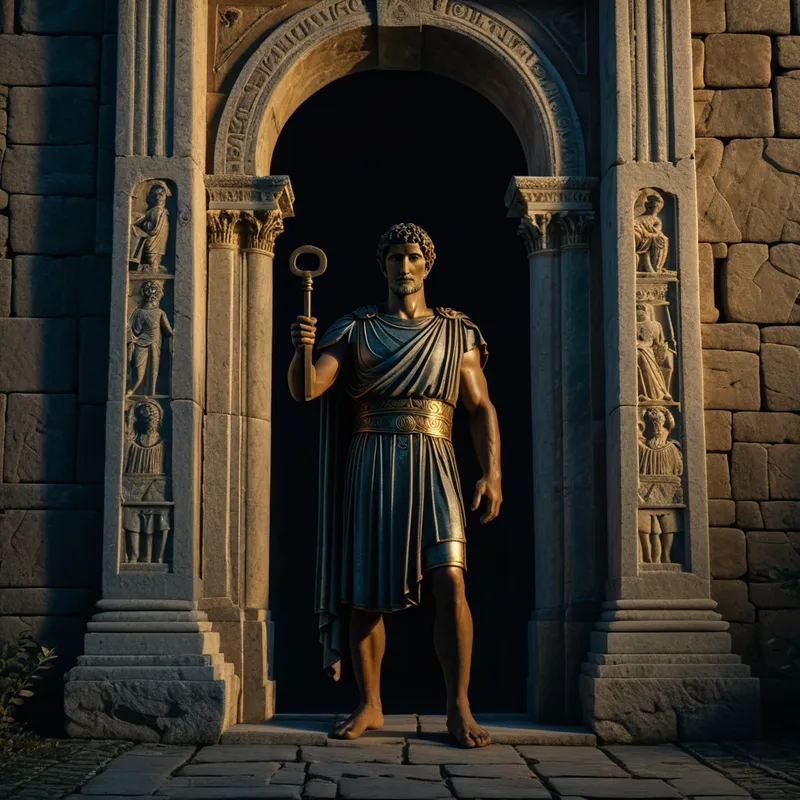
Hear now of the space between breaths, the moment between heartbeats. In the golden age of the Imperium, when gods walked in the whispers of the cypress trees and in the echo of sandals on flagstones, there was a deity seldom invoked but always present. His name was Lectus, and he was the spirit of the threshold.
He did not dwell in grand temples upon the Capitoline, nor did he command legions or the harvest. His domain was the humble limen, the worn stone step, the wooden beam over a doorway, the arch of a city gate. He was the silent witness to every crossing.
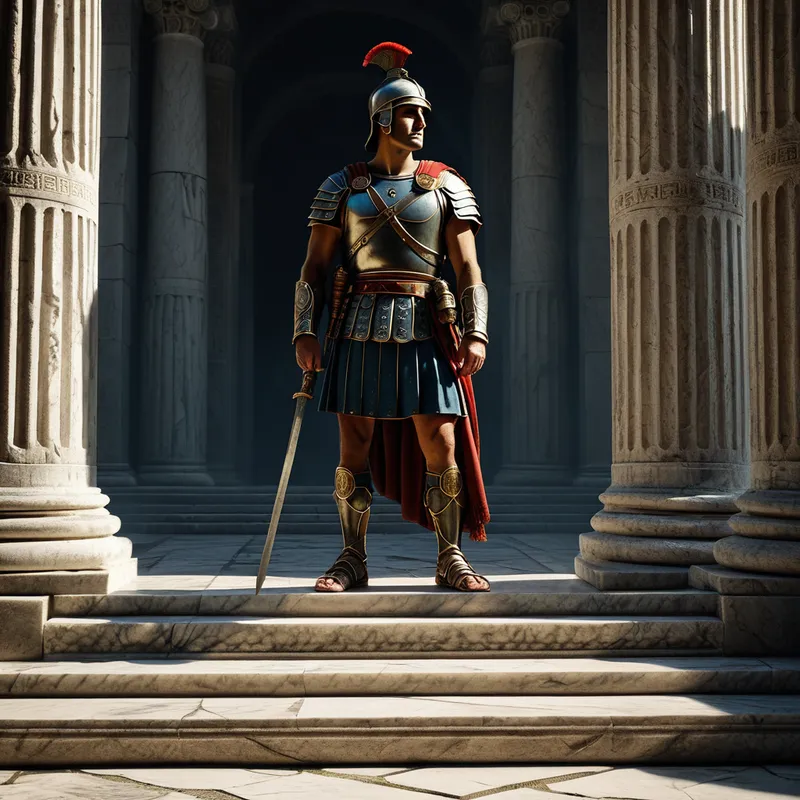
The story is told of a young soldier, Marcus, on the eve of his first battle. The night was thick with the scent of damp earth and cold metal. Before him stood the great leather-and-wood door of the commander’s tent, a barrier between the anxious chatter of the camp and the solemn orders of war. As Marcus reached for the flap, the air grew still. The sounds of the camp faded into a distant murmur. There, leaning against the tent post as if he had always been there, was a man of indeterminate age. He wore a simple grey tunic, and in his hand, he idly turned a simple bronze key.
“You hesitate, son of Rome,” said the man, his voice like the sound of a door closing softly in a distant room. “Your foot is raised. To place it inside is to accept the mantle of the legionary, to take the sacramentum upon your soul. To lower it is to turn back to the life of the colonist, the farmer, the son. Both paths are valid. Both are true. But here, now, you are neither. You are in my domain.”
Marcus felt the weight of the moment press upon him, not as fear, but as a profound clarity. He saw not two futures, but the shimmering, fragile now from which they both sprang. He felt the grain of the earth beneath his sandal, the cool night air on his knuckles. The deity, Lectus, merely watched, his eyes holding the patience of stone.
“The threshold is not a barrier,” Lectus whispered. “It is an altar. Your choice is the offering.” With a slow breath, Marcus let his foot fall forward. The sounds of the camp rushed back—the clank of armor, a low laugh. The space where the god had stood was empty, save for the impression of peace left in the air. Marcus entered, his destiny sealed not by force, but by a conscious step from one state of being into another.
Cultural Origins & Context
The figure of Lectus emerges from the deeply ingrained Roman preoccupation with boundaries, order, and ritual correctness. While not a major figure in the state religion, his presence was foundational in domestic and civic cult. He was a numen, a spiritual force inherent in a specific place or action—in this case, the act of crossing.
His worship was intimate. Small shrines, often just a niche with a carved stone or a bit of oil, were placed at the entryways of homes. Before a bride was carried over the threshold of her new husband’s house, a small offering—a coin, a bit of grain—might be made to Lectus to ensure her transition from virgin to matron was blessed. Merchants honored him at the doorways of their shops, and generals, albeit quietly, at the gates of marching camps. The myth was not recited in epic poetry but passed down in family lore and the quiet instructions of priests of the Pontifices. Its function was societal and psychological: to sacralize moments of change, to instill a mindful pause before action, and to acknowledge that destiny is shaped not by grand fate alone, but by a million conscious crossings.
Symbolic Architecture
Lectus is the archetypal embodiment of the liminal space. He is not the journey, nor the destination. He is the doorway itself. Psychologically, he represents the ego’s necessary confrontation with the threshold of the unconscious. Before integration can occur, one must stand in the uncomfortable, fertile space between the known self and the unknown shadow.
The threshold is the sacred ground where the self of yesterday meets the possibility of tomorrow. To honor it is to make choice conscious.
The bronze key he holds is not for locking or unlocking in a literal sense. It symbolizes the mechanism of decision, the unique “shape” of a choice that fits the “lock” of a particular life circumstance, opening one potential reality while closing others. The soldier Marcus’s hesitation is not cowardice; it is the essential human experience of existential freedom, the terrifying and glorious weight of authorship over one’s own life. Lectus does not advise or command. His presence sanctifies the pause, transforming anxiety into ritual, and impulse into conscious intent.
The Dreamer's Resonance
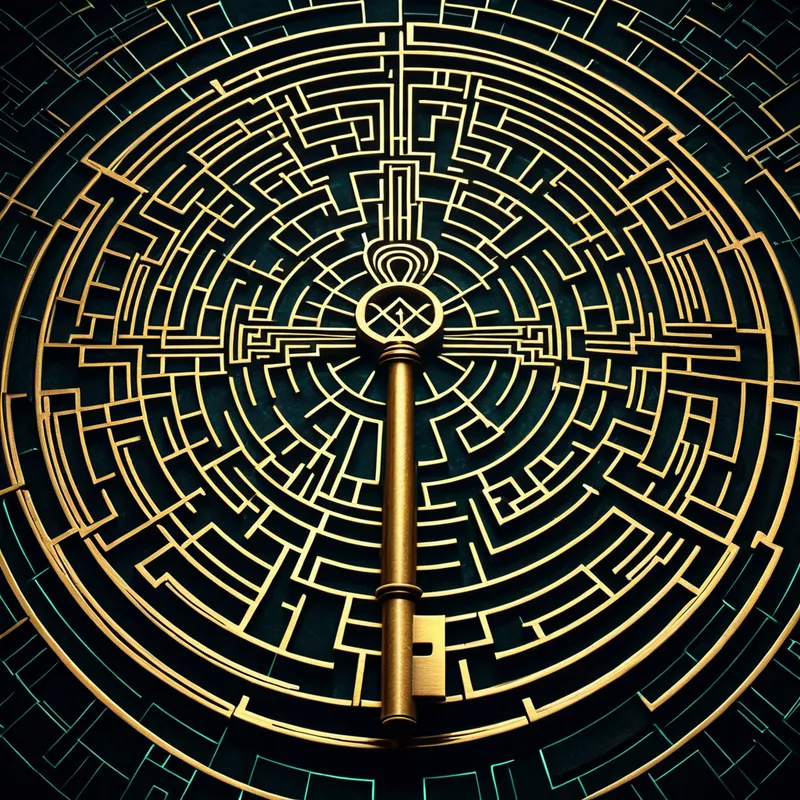
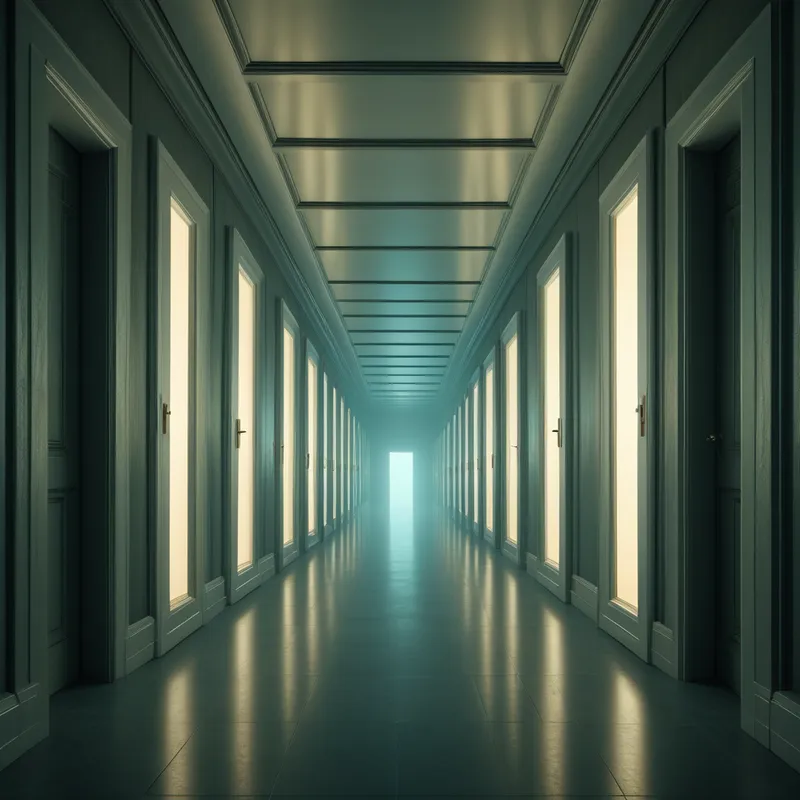
When the pattern of Lectus appears in modern dreams, it signals a profound somatic and psychological process of transition. The dreamer may find themselves stuck in a doorway, unable to move forward or back. They may be presented with a series of identical doors, or a key that does not fit. The architecture of the dream feels charged, silent, and waiting.
This is the psyche’s theater for processing life thresholds: career changes, the end of a relationship, a move, a commitment, or an internal shift in identity. The somatic feeling is often one of suspension—a tightness in the chest, a lightness in the head, the sensation of being on the precipice. The dream is not about solving the choice, but about dwelling in the liminality. It asks the dreamer to feel the full weight of the “in-between,” to acknowledge the death of the old state before the birth of the new can be fully embraced. The anxiety of the dream is the friction of transformation itself.
Alchemical Translation
The alchemical process mirrored in the myth of Lectus is the nigredo—not as decay, but as the necessary dissolution of form to make way for new creation. In the journey of individuation, we must repeatedly encounter our personal thresholds. The conscious ego, comfortable in its known world, must approach the doorway to the wider Self.
The alchemical key is forged in the fire of conscious hesitation. By pausing at the limen, we transmute blind fate into chosen destiny.
The myth models this transmutation perfectly. First, Recognition: Marcus sees Lectus. The ego becomes aware of the threshold as a sacred, autonomous complex. Second, Containment: The pause. The energy of impulse is held in the vessel of awareness, preventing a reactive, unconscious step. Third, Sacrifice: The offering of the old identity (the carefree youth) on the altar of the moment. Finally, Integration: The step is taken, but now imbued with consciousness. The choice is no longer something that happens to the individual, but an act of the individual. Each such conscious crossing adds a piece to the philosopher’s stone of the integrated Self, building a personality that moves through life’s many gates not as a victim of circumstance, but as a mindful co-creator of its passage. Lectus reminds us that the power lies not in what lies beyond the door, but in the sacred act of stepping through it.
Associated Symbols
Explore related symbols from the CaleaDream lexicon: