Lascaux Bison Myth Meaning & Symbolism
A primordial tale of a wounded bison, a fallen hunter, and the sacred exchange of life that sustains the world.
The Tale of Lascaux Bison
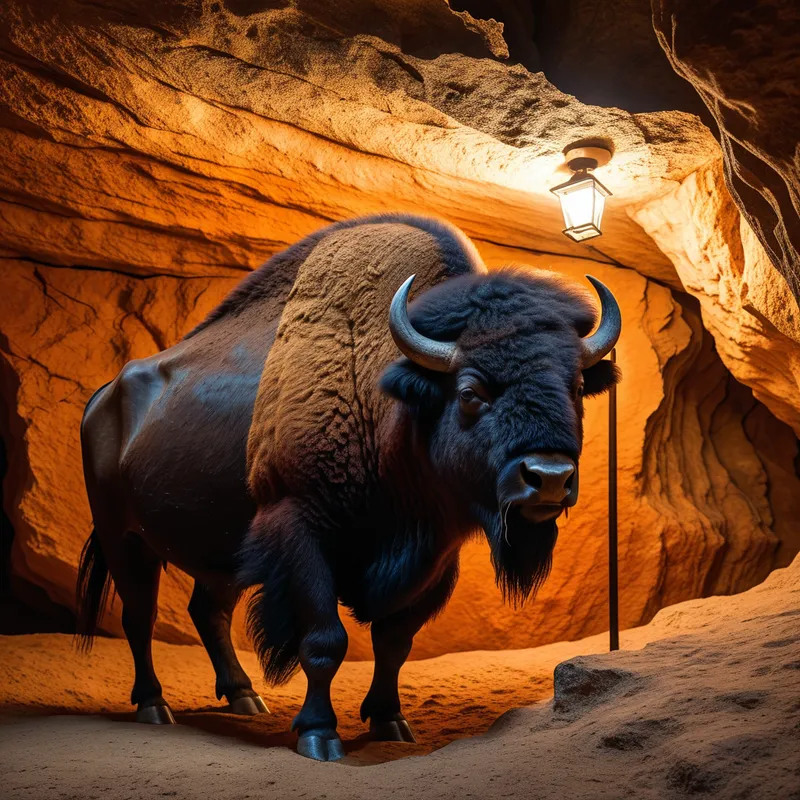
Listen. The story is not in the words, but in the breath of the stone, in the memory of the flame that once danced before it. It begins in the deep belly of the world, in a chamber where the earth dreams. The air is cold, thick with the smell of damp clay and burnt fat. The only light is a trembling heart of fire, held in a stone lamp, and it throws great, leaping shadows that are older than memory.
Here, in this sacred dark, the People did not paint a hunt. They witnessed a happening.
From the wall of living rock, he emerges—the Bison. His form is a mountain of muscle and storm-cloud hide, painted not with a brush but with a hand, with blown pigment, with a soul’s urgency. He is in motion, yet eternally still. His head is lowered, not in grazing, but in a profound and terrible charge. From his flank, a story is told in a single line: his entrails spill forth in a great, looping cascade of life. He is dying. A mortal wound has been given.
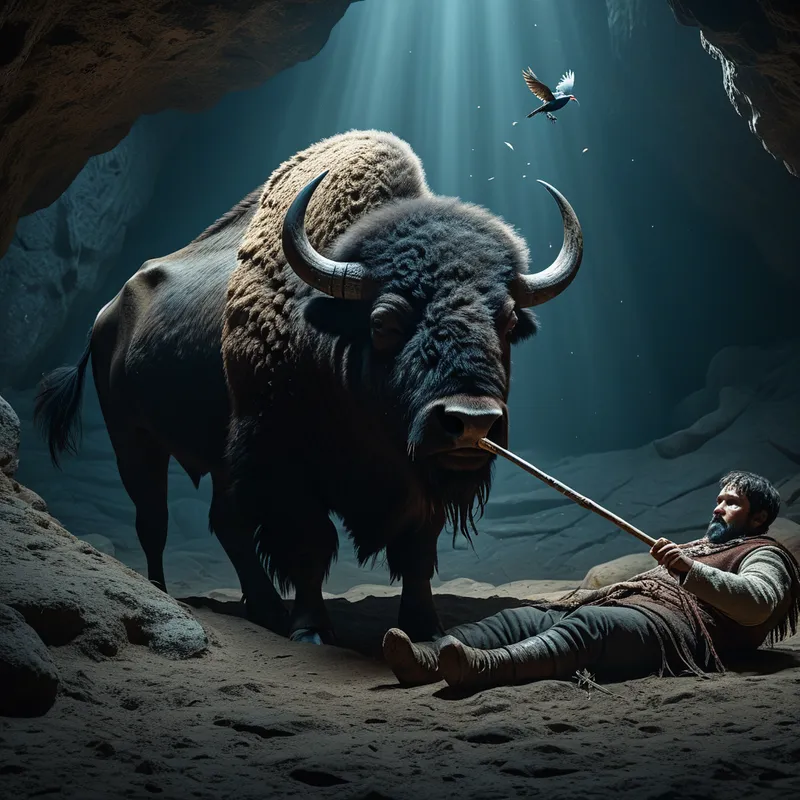
But look. Before his mighty, doomed charge lies a figure. A man. Or the spirit of a man. He is prone, fallen, his body limp upon the ground. His form is simple, a story in a silhouette. And his face… his face is not a face. It is the head of a bird. He holds a staff, topped with the likeness of a bird, a staff that has fallen from his grasp. He, too, is dead or dying.
Between them hangs a silence louder than any thunder. There is no victory here. No triumphant hunter. No conquered beast. There is only the moment. The Bison, in his final, earth-shaking fury, giving his life. The Bird-Man, in his ritual posture, receiving his death. It is a perfect, awful balance. A spear has flown, yes, but it has flown both ways. The hunter is hunted by the consequence of his act. The giver of death is joined in the same fate.
And above this sacred duel, on a separate plane, walks a rhinoceros. It turns away, indifferent, walking into the eternal dark of the cave, as if carrying the witness of this event into the depths of time itself. The story does not end. It echoes. The Bison gives his body so the People may live. The Man gives his spirit so the Bison’s soul may return. It is the first covenant, written in blood and ochre on the parchment of the world’s bone.
Cultural Origins & Context
This narrative, frozen in the Lascaux cave’s Shaft Scene, is not a literal record. For the Paleolithic peoples of the Magdalenian culture, the cave was not a canvas but a cervix—a passage between worlds. The act of painting deep within these perilous, lightless labyrinths was itself a high-stakes ritual, likely conducted by shamans or spiritual specialists.
The myth encoded here functioned as a core psychic and social technology. In a world where survival was utterly interdependent with the migratory herds, the act of killing was fraught with spiritual danger. How does one justify taking such magnificent, powerful life? The myth provides the answer: it is not a taking, but a participated exchange. The hunter must also be willing to be hunted by the spiritual consequence of his act. The bird-headed figure signifies a trance state, a shamanic journey where the human consciousness (symbolized by the bird, a creature of air and spirit) leaves the body to negotiate with the spirit of the prey. The story was likely re-enacted through ritual, dance, and trance, ensuring the cosmic balance remained intact and the herds would return.
Symbolic Architecture
At its heart, the Lascaux scene dismantles the simplistic duality of victor and victim. It presents a unified field of sacrifice and regeneration.
The wound is not an end, but a mouth; it speaks the covenant between the eater and the eaten.
The Bison represents the incarnate world—fecund, powerful, and endlessly generous in its sacrifice. Its spilled entrails are not merely gore; they are the unraveling of its physical substance into the sustenance of the community, the literal guts of life given over. The Bird-Man represents the human spirit that must undergo a symbolic death—a death of ego, of separateness—to ethically partake in this bounty. The bird is the soul liberated, traveling to the spirit realm to explain, to apologize, to ensure the cycle continues.
Together, they form a complete circuit: matter (Bison) and spirit (Bird-Man) engaged in a fatal, fertile dance. The rhinoceros is the timeless witness, the indifferent backdrop of nature’s law against which this delicate ritual of reciprocity is performed.
The Dreamer's Resonance
When this myth stirs in the modern unconscious, it rarely appears as a cave painting. It surfaces in dreams of profound, mutual confrontation. One might dream of a powerful, wounded animal (a bull, a bear, a mythical beast) standing over them, or of being the one who has inflicted a wound that somehow also cripples the self. The somatic feeling is often one of awe, terror, and a strange, peaceful acceptance all at once.
Psychologically, this dream pattern signals a critical encounter with the Shadow, not as an enemy to be slain, but as a powerful, instinctual force (the Bison) with which one is inextricably linked. The “wound” is the necessary cost of engaging with this deep, raw life energy. To access its vitality—its creativity, its passion, its sheer animal will—one’s conscious, performing self (the ego, the “hunter”) must fall. It must experience a ritual death, a humility, symbolized by the prone Bird-Man. The dreamer is processing the truth that any real gain, any true feeding of the soul, requires a reciprocal sacrifice of a former attitude or identity.
Alchemical Translation
The alchemical process mirrored here is the nigredo, the blackening, the descent into the cave of the unconscious to face the primal, wounded matter of the psyche. The modern individual’s “individuation” often begins with such a confrontation: a depression, a crisis, a rupture that feels like a mortal wound to one’s sense of self (the fallen hunter).
The triumph is not in avoiding the fall, but in recognizing that the fall is the other half of the charge.
The Bison is the instinctual, embodied Self in its raw, untamed form. To integrate it, one must first “wound” it—that is, bring conscious attention to it, which initially feels like a violent intrusion. But in doing so, one’s conscious identity is inevitably overthrown (the Bird-Man’s death). The alchemical gold, the treasure hard to attain, is the realization of profound interconnection. It is the understanding that the psyche is not a kingdom to be ruled by the ego, but an ecosystem of reciprocal sacrifice. The energy that feeds your ambition (the hunter) must be reconciled with the deep, instinctual being that is the source of that energy (the Bison). The transmutation is from a psychology of conquest to a psychology of covenant. One learns to hold the spear and receive the charge as parts of a single, sacred motion—the eternal, necessary exchange that turns death into life, and isolation into wholeness.
Associated Symbols
Explore related symbols from the CaleaDream lexicon: