Lares Myth Meaning & Symbolism
The Lares were protective spirits of the Roman household, embodying the sacred bond between ancestors, place, and the living family.
The Tale of Lares
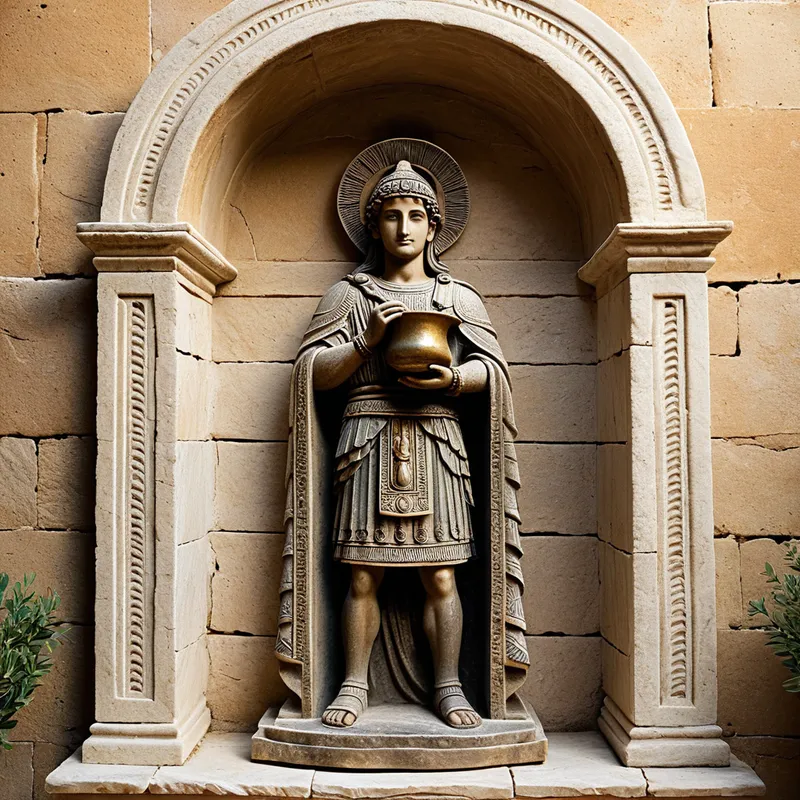
Listen, and feel the air grow still. It is not the stillness of emptiness, but of a presence so deep it becomes the very fabric of the walls. In the heart of the Roman home, in the atrium, where the hearth-fire whispers and the smoke curls toward the open sky, there is a sacred corner. A small niche, a lararium, carved into the wall or standing as a miniature temple of wood and plaster.
Here, they dwell. Not as towering Olympians demanding grand sacrifice, but as quiet watchers. They are the Lares. Sometimes one, often two, depicted as youthful figures caught in a dance, a rhyton raised in one hand, a patera in the other. They are frozen in a moment of perpetual offering, of eternal vigilance.
Their story is not one of epic voyages or monstrous battles. It is the story of the threshold. It begins each morning, as the first light touches the compluvium. The paterfamilias approaches. His steps are deliberate. In his hands, simple gifts: a pinch of salt, a few grains of wheat, a drop of wine from the family’s meal the night before. He places them in the small dish before the figures. The air smells of incense—frankincense, myrrh—and the faint, sweet scent of yesterday’s garlands.
He speaks no grand prayers to the heavens. His voice is low, for these listeners are intimate. He gives thanks for the safety of the night. He commends the family to their care for the day. He whispers the names of the dead—the father’s father, the mother’s mother—for in the mist of memory, the Lares and the Di Parentes are kin. They are the genius of the place, born from the very land the house sits upon, and the genius of the lineage, the accumulated soul of the bloodline.
At every meal, a morsel is cast into the hearth-fire for them. At every birth, marriage, and departure, they are the first witnesses. They see the toddler’s first steps in the atrium. They hear the whispered secrets of siblings. They hold the joy of homecomings and the silent grief of loss. They are the unseen participants in every mundane and monumental moment. Their conflict is the threat of neglect, of forgetfulness. Their triumph is the continuity of the flame, the unbroken chain of daily reverence that weaves a net of protection so fine it is felt not as a barrier, but as a belonging. When a family moves, they are carefully transported, for to leave them behind is to leave the soul of the home itself. They are the story that the walls would tell, if stones could speak.
Cultural Origins & Context
The Lares were not gods of the state, but of the soil and the stock. Their origins are shrouded in the pre-Roman past of Etruscan and Latin peasant life, rooted in animistic beliefs that saw spirit in crossroads, fields, and the boundary-stone of a farm. They were the Lares Compitales of the crossroads, the Lares Praestites who guarded the city, and most intimately, the Lares Familiares of the household.
Their societal function was foundational. Roman identity was not merely individual; it was familial, anchored in the domus (the household). The Lares cult, overseen by the paterfamilias, was the ritual engine of this identity. It taught piety (pietas), the sacred duty to family, ancestors, and gods. It was a democratized sacredness; even the enslaved members of the household participated, for they too belonged to the domus. The myth was passed down not in epic poems, but in daily practice—a father showing his son how to make the offering, a mother reminding a daughter to honor them. It was a living tradition, a psychological and social anchor that transformed a physical dwelling into a numinous, protected space.
Symbolic Architecture
Psychologically, the Lares represent the genius loci—the spirit of a place—internalized. They symbolize the psychic process of ensoulment, of investing a space, a relationship, or an aspect of the self with sacred meaning and protective attention.
The Lares are not guardians against what is outside, but the sacred affirmation of what is within. They mark the boundary where the world ends and the soul's domain begins.
They embody the confluence of memory (the ancestors) and presence (the living family). They are the archetypal representation of the "container," the safe and bounded psychic space necessary for healthy development. The small, regular offerings symbolize the energy—the libido or psychological attention—required to maintain any sacred inner space: a commitment, a creative project, a core value, or one's sense of self. Neglect of the Lares symbolizes psychic fragmentation, a loss of inner cohesion and belonging. Their constant presence speaks to the need for an internalized, benevolent witness to our lives.
The Dreamer's Resonance
When this mythic pattern stirs in the modern unconscious, it often manifests in dreams of houses. Not of palaces, but of the first home—a childhood house, a grandparent's apartment, a familiar room. The dreamer may discover a forgotten room, warm and safe, often containing old photographs or familiar, comforting objects. Conversely, they may dream of a house that is empty, cold, or whose doors won't lock, signifying a rupture in this inner sanctuary.
Somatically, this process can feel like a deep yearning for grounding, a literal seeking of one's corner. It may arise during life transitions—a move, a loss, the birth of a child, a feeling of existential homelessness. The psyche is asking: Where is my altar? What do I honor daily? What unseen presences uphold my sense of belonging? The dream is an invitation to identify and tend to the "household gods" of one's own psyche—the core values, memories, and relationships that provide an internal home.

Alchemical Translation
The alchemical work modeled by the Lares myth is that of coagulatio—the making solid, the creation of a sacred vessel. In the journey of individuation, we must move from the prima materia of diffuse experience and ancestral inheritance into a coherent, self-contained individual. This is not an act of isolation, but of sacred integration.
The ritual before the Lararium is the psyche's daily practice of self-creation. We take the scattered fragments of our day, our history, and our lineage, and through the act of mindful attention, we offer them back to the center, forging our identity anew.
The modern individual must become their own paterfamilias, consciously building their inner lararium. This involves identifying what is truly sacred in one's inner "household": which memories to honor, which values to "feed" with attention and action, which internalized voices of the "ancestors" (parents, teachers, culture) are benevolent and which must be respectfully laid to rest. The triumph is not in becoming impervious, but in becoming a well-bounded, ensouled space—a domus where the self can dwell in safety, where the past is integrated, and from which one can engage the world with a sense of rooted belonging. The Lares teach that wholeness is found not in wandering, but in consecrating the ground beneath your own feet.
Associated Symbols
Explore related symbols from the CaleaDream lexicon: