Lararium Myth Meaning & Symbolism
A myth of the household's living soul, where the spirits of place and lineage guard the threshold between the mundane and the sacred.
The Tale of Lararium
Listen, and let the smoke of memory carry you. Not to the roar of the Forum, nor the clash of the legion’s shield-wall, but to a quieter sound—the soft closing of an oak door, the hiss of olive oil on the hearth-fire, the whisper of a name spoken only within walls.
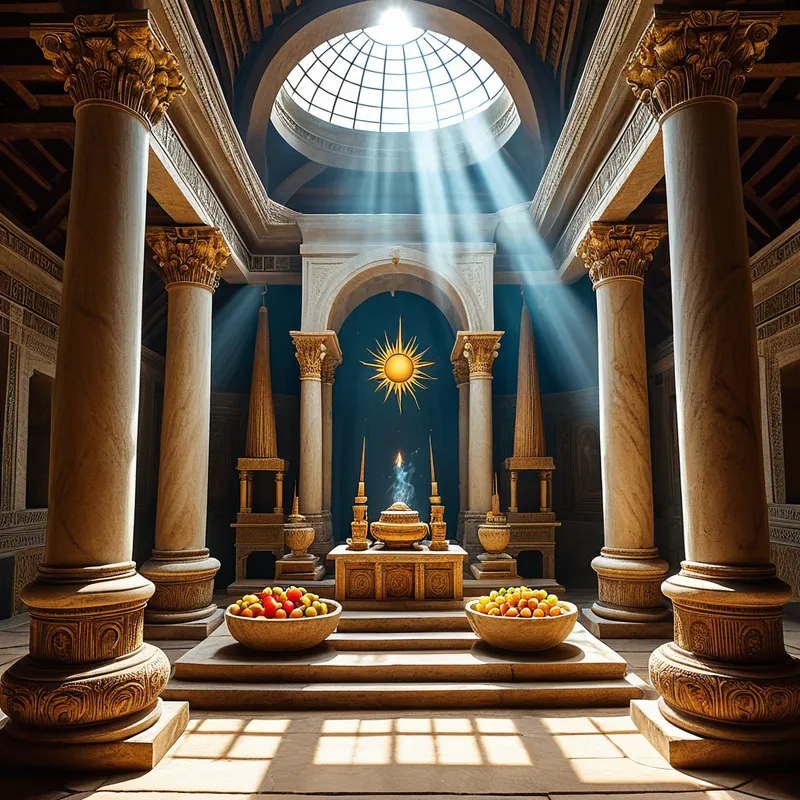
Here, in the heart of the domus, the world finds its axis. The air is thick with the scent of baking bread and dried herbs, a tangible warmth that settles on the skin like a second tunic. Against a wall, often where the morning light first spills, stands a small shrine. It is not grand like the temples of the Capitoline, but its presence is immense. A niche, perhaps, or a wooden cabinet, sometimes a simple shelf. Upon it rests a world in miniature: two small figures, carved from wood or molded from clay. These are the Lares, their faces serene, their postures watchful. Beside them, perhaps, a tiny clay jar—the spirit of the pantry, the Penates. Before them, a lamp’s flame dances, a living star captured in earthenware.
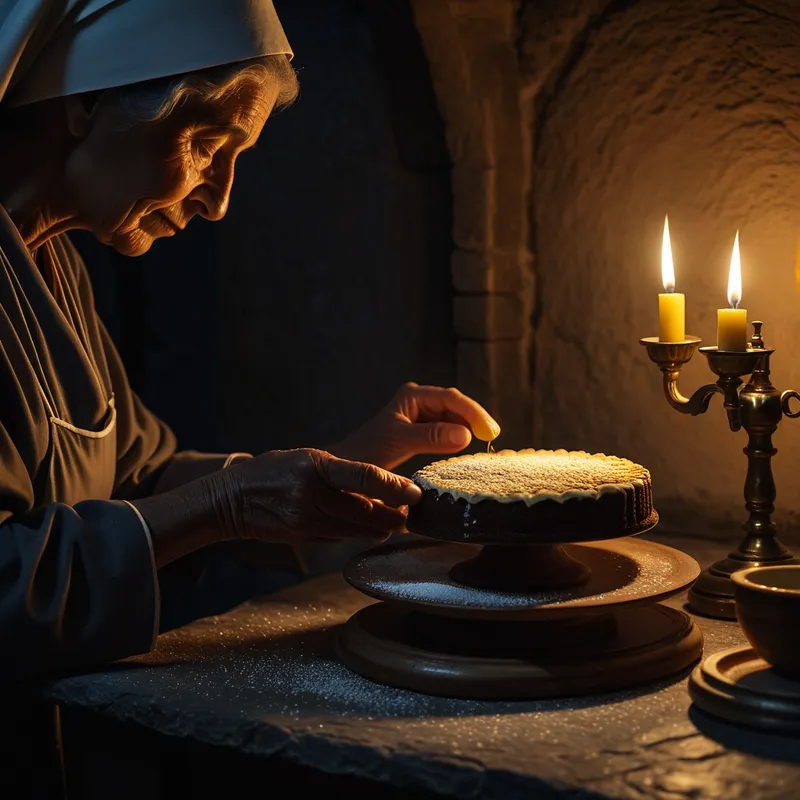
Each dawn, the paterfamilias or the materfamilias approaches. Their footsteps are deliberate, a ritual in themselves. They do not come with grand pleas for victory or wealth, but with the humble currency of continuity: a pinch of salt, the first fruits of the meal, a few drops of wine. The offering is placed with a touch that is both casual and profoundly sacred. The flame is tended. For a moment, there is only silence, a communion deeper than words.
This is the pact. The family moves through its day—the squabbles of children, the mending of clothes, the planning of tomorrow. And the Lares watch. They are in the solidity of the threshold stone that keeps out the chaos of the street. They are in the certainty of the roof-beams that hold back the sky. They are the unseen hand that guides a lost object back to its place, the sudden feeling of warmth on a cold evening that is more than just the fire. They are memory made manifest, the spirit of every ancestor who ever tended this same flame, their presence layered into the very plaster of the walls.
When a child is born, they are presented here, introduced to the guardians of their lineage. When a son comes of age, he dons the toga virilis before this shrine, stepping into manhood under their gaze. When a daughter marries, she takes a flame from this hearth to light her new one, a thread of spirit connecting two homes. And when the final breath leaves a body within these walls, the Lares witness the soul’s departure, becoming themselves a repository for that love, adding another layer to the home’s silent song.
The myth of the Lararium is not one of epic voyage or monstrous battle. Its conflict is the relentless tide of time and forgetting. Its rising action is the daily choice to remember. Its resolution is the enduring sanctuary, the circle of light that holds against the outer dark, maintained not by a hero’s sword, but by a household’s consistent, loving attention.
Cultural Origins & Context
The Lararium was not merely furniture; it was the legal and spiritual core of the Roman domus. Its practice stemmed from the ancient Roman concept of numen, the animating spirit present in all things. Every crossroads, spring, and boundary had its numen. The household was the primary universe for most Romans, and thus its numen required cultivation.
This was a profoundly local and personal religion. There was no centralized dogma from the state priesthoods regarding how to honor the Lares. The rituals were passed down mos maiorum, "the way of the ancestors," from parent to child through daily practice. It was the woman of the house, the materfamilias, who was often its primary custodian, linking the cult directly to the rhythms of domestic life—cooking, cleaning, and nurturing.
Societally, the Lararium functioned as the engine of Roman identity. Before one was a citizen of Rome, one was a member of a familia under the protection of its Lares. It taught pietas—not piety in a modern sense, but the sacred duty to what sustains you: family, home, and ancestors. It grounded abstract civic virtues in the tangible reality of the hearth. Even slaves participated; they had their own festival, the Compitalia, where the Lares of the crossroads were honored, acknowledging their place, however humble, within the larger web of spiritual and social belonging.
Symbolic Architecture
Psychologically, the Lararium represents the sanctuary of the psyche—the internal space where we honor what truly sustains us. The Lares symbolize the autonomous, guiding spirits of a life. They are not the ego, but the deeper, often silent patterns of instinct, heritage, and belonging that form the foundation of identity.
The Lares are the psychological equivalent of the immune system; they are the autonomous, background processes that maintain the integrity of the self, fighting off the chaos of meaninglessness and alienation.
The physical house translates to the self. The threshold is the boundary of the ego, the Limen. The hearth-fire is the warmth of conscious attention and libido (life-energy). The daily offerings are the small, consistent acts of self-care, reflection, and gratitude that "feed" our inner stability. The Penates represent our inner resources—our talents, memories, and nourishment—which must be recognized and conserved.
To neglect this inner shrine is to risk a profound disorientation. One may own a house, but without a Lararium, it is not a home. One may have a personality (ego), but without connection to these inner Lares, there is no grounded self.
The Dreamer's Resonance
When the imagery of the Lararium arises in modern dreams, it signals a process of psychic home-building or a crisis of inner belonging. The dreamer may be navigating a major life transition—a move, a new relationship, the birth of a child, or the loss of a family member. The psyche is working to establish a new "center" or repair a neglected one.
One might dream of:
- Discovering a hidden shrine in a modern apartment, suggesting the awakening of a need for ritual, grounding, or connection to personal history.
- A Lararium that is dusty, broken, or ignored, reflecting a feeling of being spiritually or emotionally "unhoused," disconnected from one's roots or inner values.
- Struggling to light the lamp on the shrine, indicating a depletion of vital energy or difficulty focusing conscious attention on what matters.
- The Lares figures being active, moving, or communicating, which can be a powerful encounter with autonomous complexes or guiding archetypes that are seeking recognition.
Somatically, this dream process can feel like a deep yearning for anchor, a craving for order and ritual, or anxiety about thresholds and safety. It is the psyche’s architecture asserting itself, demanding that we tend to the foundation before adding more rooms to our external lives.
Alchemical Translation
The alchemical process mirrored in the Lararium myth is coagulatio—the making solid, the creation of the sacred vessel. In individuation, it is the stage where diffuse experiences and insights must be given a stable, inner form. The hero’s journey here is not outward conquest, but inward cultivation.
The ultimate alchemy is not turning lead to gold, but turning a house into a temenos, and a life into a ritual worthy of its own unseen guardians.
First, one must identify the inner temenos—the sacred precinct within. This is the act of setting a psychological boundary, declaring what is "me" and what is "not-me," what nourishes and what depletes. This is the building of the shrine’s wall.
Second, one invokes the Lares. This is deep introspection to name the silent forces that have always guided you: a love of nature inherited from a grandparent, a stubborn resilience, a creative impulse that feels like a separate voice. These are given recognition—"named" as the figures on the shelf.
Third, and most critical, is the daily offering. This is the opus, the work. It is the commitment to small, daily practices that honor this inner sanctum: five minutes of silence with morning coffee, journaling, walking the same path, cooking a meal with care. These are the pinches of salt and grains. They are not grandiose, but their consistency is what transforms the space from a concept into a living, protective reality.
The triumph is not a dragon slain, but a flame that never goes out. It is the achievement of an inner home that can withstand the outer storms, a self that is not just constructed, but consecrated by one’s own attentive, loving presence. The Lares, once honored, become active partners in the psyche, not as controlling gods, but as the embodied spirit of a life that is truly, deeply, one’s own.
Associated Symbols
Explore related symbols from the CaleaDream lexicon: