Lanka Myth Meaning & Symbolism
The story of the demon-king Ravana's island fortress, a citadel of power and desire, and the epic quest required to reclaim what was lost.
The Tale of Lanka
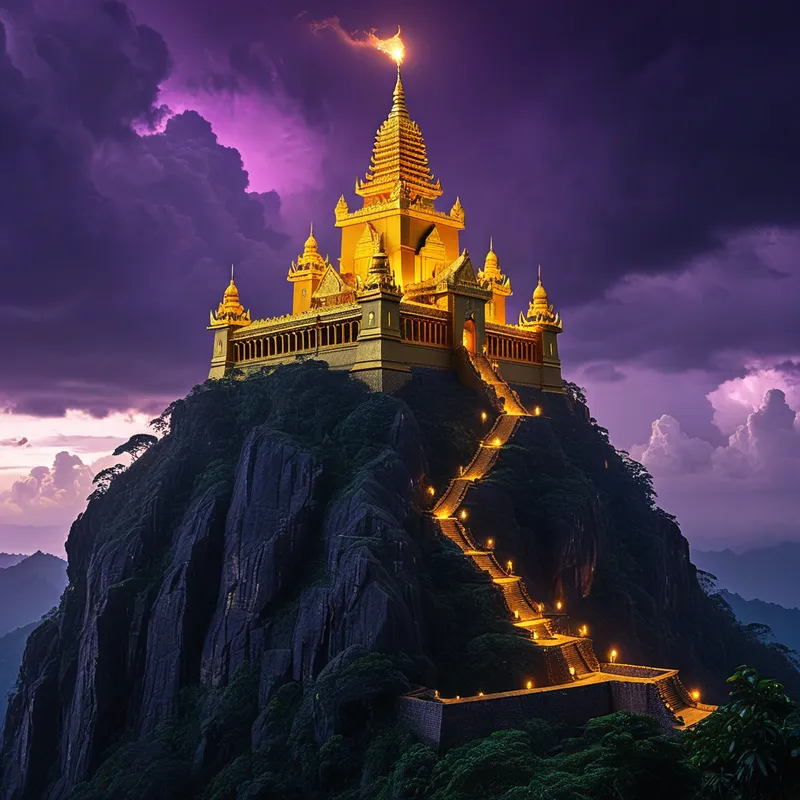
Listen, and hear of a city that was not built for men. It was a fortress of the mind, a citadel of will, raised from the churning depths of the ocean by the divine architect, Vishwakarma, for the god of wealth himself. It was a place of impossible geometry, its walls fused of gold and crystal, its spires piercing the clouds that gathered around the peak of the Trikuta mountain. This was Lanka, a jewel set in the sapphire of the sea, a kingdom of absolute sovereignty.
And into this jewel came a king who was a storm of contradictions. Ravana, with his ten heads that held the wisdom of the Vedas and the fury of a thousand suns, with his twenty arms that could hold up the world or tear it asunder. Through terrible penance, he had wrested boons from the gods, making his body invincible to all but the weakest of creatures. Lanka became the throne of his ambition, a beacon of power that cast a long, dark shadow across the three worlds. His will was law, and his desire was a fire that consumed all boundaries.
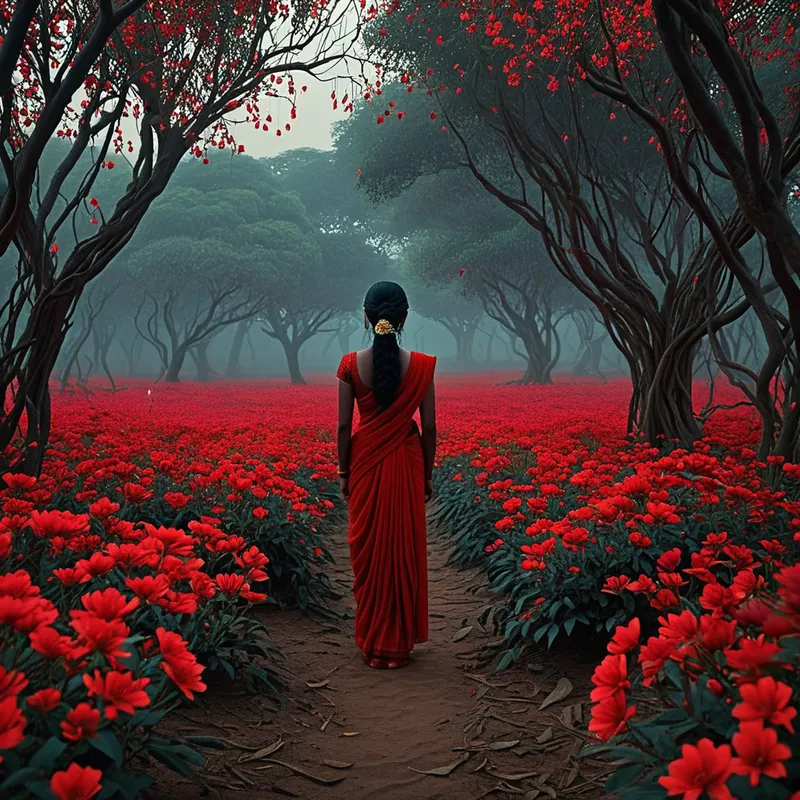
The fire found new fuel in a vision of perfect beauty: Sita, the wife of Rama. In a moment of vulnerability, when Rama was lured from her side, Ravana descended. He came not as an army, but as a mendicant, a trick of form. When denied, his illusion fell away, and he seized her, carrying her across the sky in his chariot, a dark comet streaking towards his island fortress. In Lanka, he placed her not in a dungeon, but in the Ashoka Vatika, a garden of sorrowful beauty, hoping time and splendor would bend her will.
But Sita’s will was of a different substance. She turned her back on the golden towers, her gaze fixed only on the earth from which she was born and the horizon where her love resided. Her steadfastness became a silent, potent curse upon the gilded city.
Far away, a prince’s heart turned to stone, then to purpose. Rama, with his brother Lakshmana, began a quest that would become the axis of the world. They forged an alliance with the exiled monkey-king, Sugriva, and his greatest warrior, Hanuman. It was Hanuman who made the impossible leap across the ocean, who found Sita in her garden-prison, and who, in a moment of glorious fury, set the golden towers of Lanka aflame with his burning tail—a first, prophetic scorching of the demon-king’s pride.
Then came the bridge of stones, named for Rama himself—Rama Setu—a testament to devotion and collective will, laid upon the sea by an army of monkeys and bears. The siege of Lanka was a cataclysm of clashing destinies. The air grew thick with the cries of celestial weapons and falling warriors. Ravana’s son, the noble Indrajit, wielded deadly magic. The giant Kumbhakarna awoke from his eternal sleep to bring ruin. Yet, one by one, the pillars of Ravana’s power fell.
The final confrontation was a symphony of destruction. Rama, standing in his chariot, and Ravana, in his own, became the focal points of the universe. Arrows fell like rain, blotting out the sun. Finally, upon the counsel of the dying Vibhishana, Rama loosed the Brahmastra, the ultimate weapon. It found its mark, piercing the demon-king’s heart—the one place his boon did not protect, the seat of his mortal attachment and arrogance. Ravana fell, and his fall shook the very foundations of his golden city. The shadow lifted. The fire of desire was extinguished. And from the silent Ashoka grove, Sita emerged, her ordeal ended, the rightful order of the world restored through an epic trial of love, duty, and devastating war.
Cultural Origins & Context
The myth of Lanka is the narrative heart of the Ramayana, attributed to the sage Valmiki. For millennia, it has not merely been a story but a living cultural technology, transmitted through oral recitation, dramatic performance (like the Ram Lila), scripture, and now visual media. Its societal function is multifaceted: it is a foundational treatise on dharma, a template for ideal kingship, familial loyalty, and conjugal fidelity. The conquest of Lanka serves as the ultimate parable of the victory of divine order (rita) over chaotic, egoistic power (adharma). It was told to delineate the boundaries of acceptable power and the catastrophic personal and social consequences of transgressing them, especially through the violation of another’s sovereignty (Sita) and the usurpation of another’s rightful place (Rama’s exile, Sugriva’s kingdom).
Symbolic Architecture
Lanka is far more than a physical location; it is a profound psychic symbol. It represents the fortified, glittering citadel of the inflated ego, constructed from the hard-won gold of one’s talents, knowledge, and power (Ravana’s boons and scholarship). It is a kingdom of the shadow, where all that is rejected by the conscious self—unbridled desire, arrogance, boundless ambition—reigns supreme.
The golden city is the ultimate prison, built not to keep others out, but to seal the self within its own brilliant, sterile perfection.
Ravana embodies the tragic potential of the unintegrated psyche: a being of immense capability whose gifts become curses because they serve a consciousness centered on possession and self-aggrandizement. His ten heads symbolize not wisdom, but the fractured, obsessive intellect that argues endlessly for its own justification. Sita in the Ashoka grove is the soul (atman) held captive by this complex, surrounded by the demonic projections (the rakshasis) of one’s own corrupted thoughts and temptations. Her unwavering focus on Rama is the psyche’s innate orientation toward its own transcendent, unifying principle (Brahman, the Self).
The burning of Lanka by Hanuman is the first, necessary incursion of disruptive spirit (Hanuman as son of Vayu, the breath of life) into the stagnant, ordered tyranny of the ego. The final battle is the inevitable, total war between the conscious personality identified with its divine purpose (Rama) and the entrenched, autonomous complex (Ravana) that has seized control of the inner world.

The Dreamer's Resonance
When this myth stirs in the modern dreamer, it often manifests as a sense of being trapped in a place of great personal achievement that feels hollow or oppressive. One may dream of a magnificent, isolating house or a high-tech fortress from which they cannot leave. There is a somatic feeling of weight—the gold of Lanka is heavy. The captive figure (Sita) represents a vital but neglected aspect of the dreamer’s own life: their creativity, their vulnerability, their authentic connection to others or to nature, held hostage by a dominant, "demonic" drive for success, control, or intellectual mastery (Ravana).
The appearance of a heroic figure (Rama) or a helpful, energetic animal/messenger (Hanuman) signals the mobilization of the ego’s strength and the support of the unconscious (the monkey army) to stage a rescue mission. This is the psyche initiating a reclamation project. The process is one of acknowledging that one’s greatest strengths have built one’s greatest prison, and that liberation requires a humbling, bridge-building (Rama Setu) collaboration with instinctual, "less civilized" parts of the self to cross the emotional ocean of resistance.
Alchemical Translation
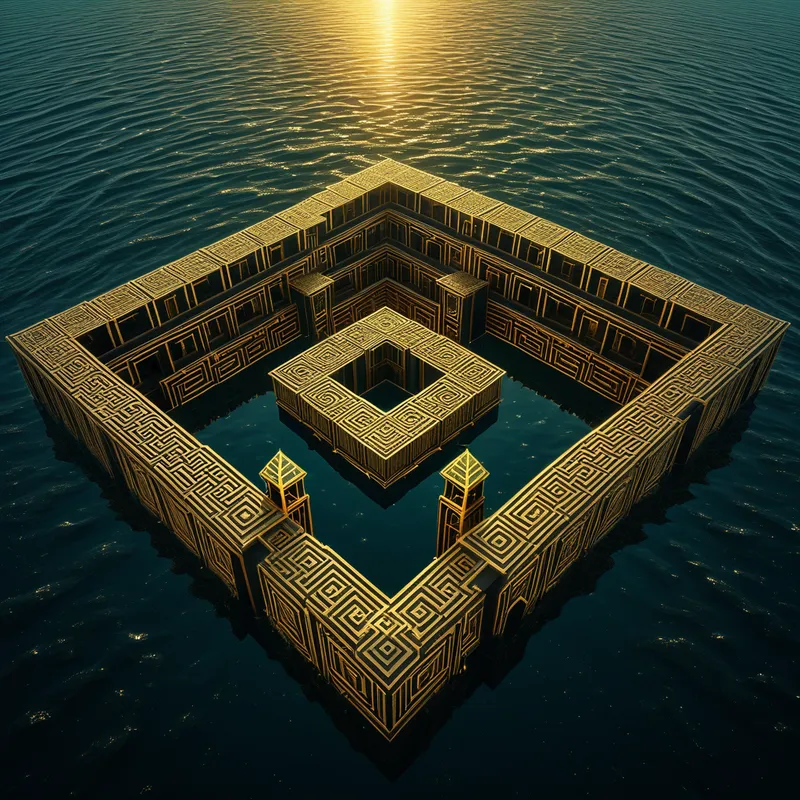
The alchemy of the Lanka myth is the transmutation of the personal fortress into an integrated kingdom. It models the Jungian process of individuation, where the goal is not to destroy the shadow (Ravana) utterly, but to defeat its tyrannical rule and integrate its potent energy. Ravana’s knowledge and power are not evil in themselves; they become destructive when serving an insatiable, separate self.
The conquest of Lanka is not a demolition, but a change of regime. The gold remains, but its use is transformed from hoarding to circulation.
For the modern individual, this translates to a profound inner campaign. First, one must recognize the "Sita" that has been abducted—what true value have you sacrificed for the sake of your fortress-ego? Then, one must accept the necessary exile (Rama’s forest journey) from the comfort of that ego’s dominion. The building of the bridge signifies the patient, often tedious work of connecting conscious intention with the raw, instinctual forces of the unconscious (the Vanaras). The final battle is the courageous confrontation with the core complex, aiming not for annihilation but for a precise strike at its vulnerable center—its identification with its own story of separateness and entitlement.
The triumph is the return of the soul (Sita) to its rightful place at the center of a conscious life, and the establishment of a wise, self-aware governance (Vibhishana as the new ruler of Lanka) over one’s inner kingdom. The golden city is not razed; it is redeemed, its splendor now in service to a wholeness greater than itself.
Associated Symbols
Explore related symbols from the CaleaDream lexicon: