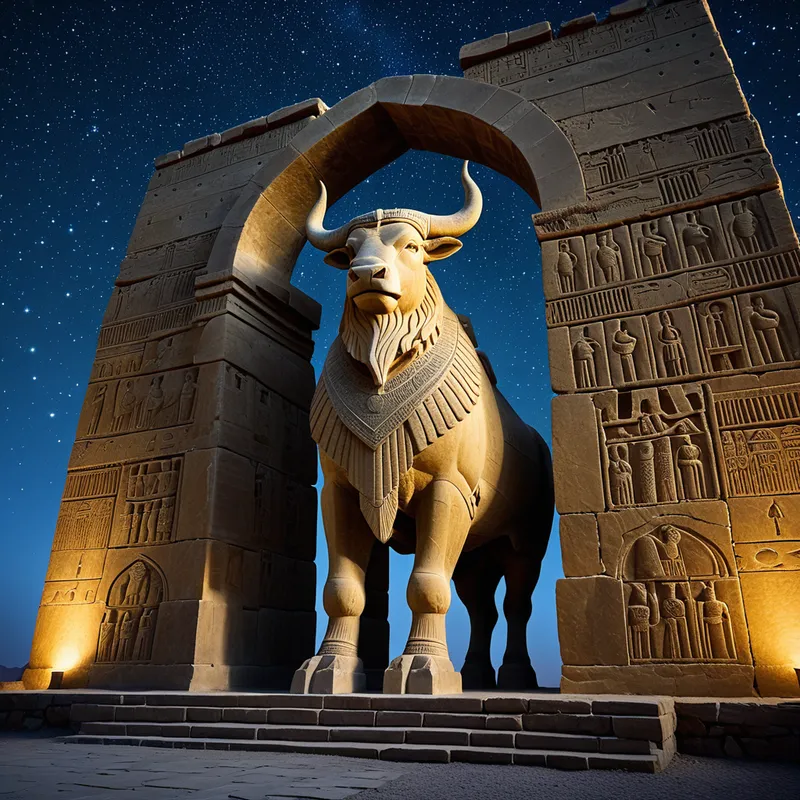
Lamasu Myth Meaning & Symbolism
A celestial being of stone and spirit, the Lamasu stands at the threshold, its hybrid form a bulwark against chaos and a mirror to the integrated soul.
The Tale of Lamasu
Hear now the tale that is whispered by the desert wind and etched in stone older than kingdoms. In the time when the gods walked the earth in the shadow of the ziggurat, the world was a place of raw and terrifying power. Demons of the howling waste, the Udug and the Lilu, slithered on the edges of perception, hungering for the ordered light of the city, for the beating heart of the temple.
And so, the great gods—Anu in the high heavens, Ea in the deep abyss—conferred. The boundary was too thin. The sacred needed a sentinel that was neither fully of this world nor fully of the other. From the clay of the Apsu and the breath of the Imhullu storm, they fashioned a being of impossible synthesis.
It was given the body of a mighty bull, its muscles coiled like river currents, its hooves capable of shaking the foundations of mountains—the very emblem of earthly, untamed strength. Upon this formidable frame, they set the broad, feathered wings of a great eagle, each pinion capable of catching the high, clean winds that touch the face of the sun, granting it the domain of the sky and divine perspective. And crowning this hybrid form, they placed the serene, bearded head of a human king, eyes of polished obsidian seeing with the wisdom of Adapa, crowned with the horned tiara of divinity.
This was the Lamasu. Not a tale of a quest, but a story of becoming a place. Its myth is its station. With a sound like grinding continents, it settled at the threshold—the city gate, the temple door, the palace entrance. It did not move. It became the boundary. Its five legs (so the clever sculptors showed) were both at rest and in eternal stride, forever caught between advancing and standing firm. By its mere presence, the chaotic whispers of the outer dark fell silent. The Shedu might patrol, but the Lamasu was the law of the threshold. It did not fight; it presided. Its story is the eternal moment of facing the chaos, integrating its power, and declaring: This far, and no further. Here, there is order. Here, there is sanctuary.
Cultural Origins & Context
The Lamasu was not merely art; it was a functional, theological technology of the Fertile Crescent. From the Assyrian halls of Kalhu to the Babylonian Processional Way, these colossal figures were the ultimate expression of royal and divine authority. They were apotropaic—designed to avert evil. Their placement was a deliberate act of psychic and spiritual defense, mapping a sacred cosmology onto urban geography.
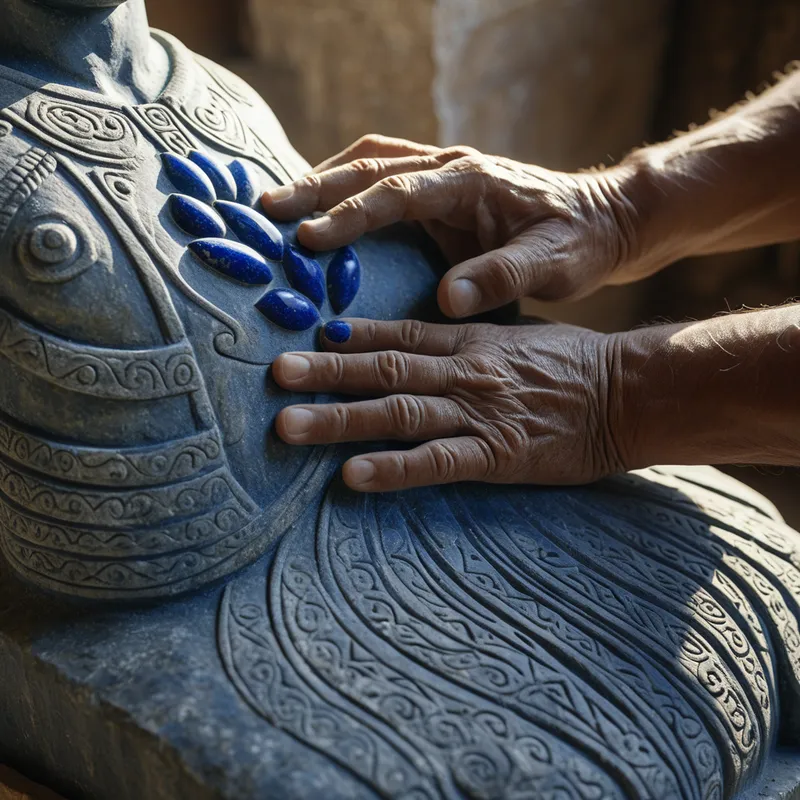
The myth was passed down not in a single epic poem, but in the very act of their creation. The ritual of carving—from the quarrying of alabaster or gypsum blocks to the final inscription of the king's protective formulae—was the telling of the myth. The artisans were priests of form, and the Lamasu's hybrid nature was a direct reflection of the Mesopotamian worldview: a universe composed of interconnected, often conflicting, domains (earth, sky, underworld, civilization) that required constant mediation. They served as permanent, public reminders that the king, as the gods' regent, held the chaotic forces of nature and enemy nations at bay, protecting the delicate me of civilization.
Symbolic Architecture
Psychologically, the Lamasu is a master symbol of the integrated Self, a living mandala guarding the threshold of consciousness.
The guardian at the gate is not there to keep you out, but to ensure you enter whole.
Its bull-body represents the immense, instinctual, and somatic power of the unconscious—the raw libido and foundational life force. The eagle's wings symbolize the spirit, intellect, and capacity for transcendent vision, the ability to see patterns from a higher, broader perspective. The human head signifies conscious awareness, rationality, and the ordering principle of the individual ego and cultural wisdom. The Lamasu is the successful fusion of these three realms: the earthly (body/instinct), the celestial (spirit/mind), and the human (consciousness/culture). It is the antithesis of fragmentation.
Its liminal position is its core meaning. It does not reside safely within the city (conscious identity) nor is it lost in the outer wilderness (the undifferentiated unconscious). It occupies the critical, dynamic border—the ego-Self axis. It represents the psychic function that can hold the tension between inner chaos and outer order, between unknown impulses and conscious life, and transform that tension into protective, defining structure.

The Dreamer's Resonance
When a Lamasu appears in the modern dreamscape, it seldom arrives as a literal stone statue. It manifests as the experience of the threshold. One may dream of a door in their home that was never there before, feeling simultaneously compelled and forbidden to open it. Or of a strange, hybrid animal—perhaps a dog with the eyes of an owl—standing calmly but immovably at the foot of their bed. The somatic sensation is often one of awe mixed with deep grounding; a palpable, heavy stillness.
This dream motif signals a critical phase of psychic reorganization. The dreamer is likely facing an internal or external "chaos"—a disruptive life transition, a surge of repressed emotion, or a challenge to their core identity. The Lamasu-dream is the psyche's announcement that a new, more complex structure of the Self is being assembled to meet this chaos. It is the emergence of an inner guardian, an autonomous complex capable of holding the line while integration occurs. The dream is less about passing the guardian and more about recognizing its necessary, formidable presence within oneself.
Alchemical Translation
The alchemical process mirrored in the Lamasu myth is not the heroic solve (dissolution) but the crucial, often overlooked coagula (coagulation). It is the stage where the disparate elements, having been broken down in the nigredo, are recombined into a new, more resilient substance.
Individuation is not the dissolution of boundaries, but the conscious construction of a sacred, living perimeter.
For the modern individual, the "Lamasu work" involves the conscious building of inner thresholds. This is the practice of discernment—learning to say "no" not from fear, but from a sense of integrated self-preservation. It is the act of taking one's raw, bull-like passions and instincts, lifting them with the wings of reflection and meaning (the eagle), and directing them with the wise, human head of conscious choice. The triumph is not in slaying the dragon of chaos, but in developing the psychic stature that causes chaos to respect your borders.
We build our own Lamasu when we establish rituals that separate work from rest, when we create internal containers to hold powerful emotions before acting on them, or when we define values that non-negotiably guide our decisions. We become, in our own sphere, the hybrid guardian—firmly planted in reality, connected to our depths, oriented by spirit, and governed by conscious wisdom. We cease being victims of every passing wind from the inner or outer wastes, and become the sovereign, silent, and immovable presence that defines what is sacred within our own being.
Associated Symbols
Explore related symbols from the CaleaDream lexicon: